
How You Can Bake Angel Food Cake Without a Regular Pan
You don’t need a traditional tube pan to bake angel food cake—you can use loaf, bundt, or glass pans instead. These alternatives work well if you don’t have a regular pan on hand.
Just grease or lightly line your pan, fill it no more than two-thirds full, and bake at a slightly adjusted temperature and time to prevent overbrowning or undercooking.
Cool the cake upside down to keep it airy, then carefully loosen edges before removing. Keep these tips in mind, and you’ll enjoy a light, fluffy cake every time.
There’s more to discover about each step and pan choice.
Why You Can Skip the Traditional Angel Food Cake Pan
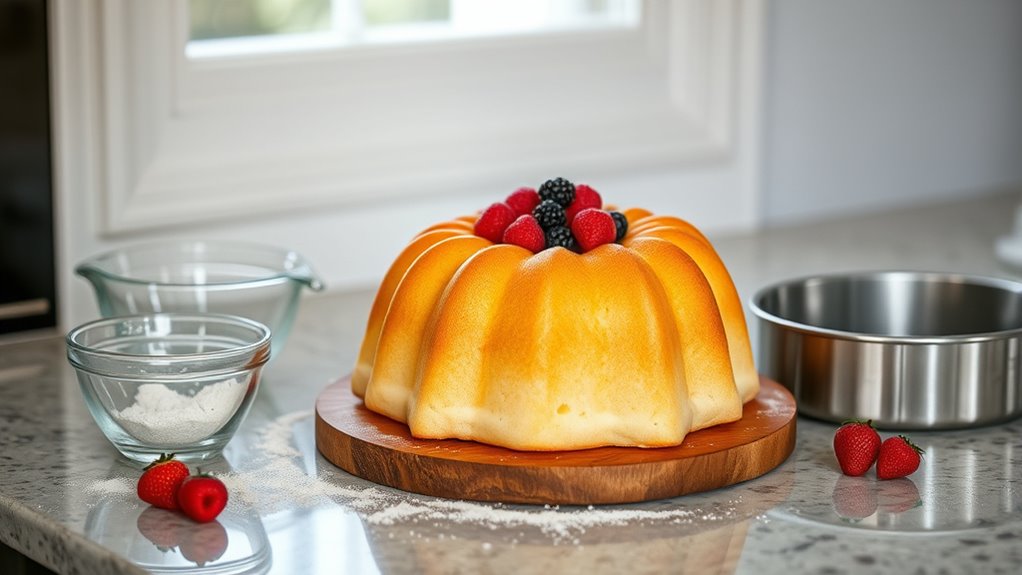
Although traditional tube pans are designed for angel food cake, you don’t need one to bake a light, airy cake. The key to success lies in the batter’s whipped egg whites and careful folding, not the Angel Food Cake pan itself. You can use a standard loaf pan or other unconventional pans, like glass dishes, to achieve the same fluffy texture.
Just remember not to grease the pan, so the batter clings and rises properly. When using a loaf pan, you might need to adjust baking times since the batter spreads differently than in a tube pan. Proper cooling—such as inverting the pan—is essential no matter the pan you choose.
This way, your recipe remains versatile and just as delicious without the traditional equipment.
Best Alternative Pans for Angel Food Cake
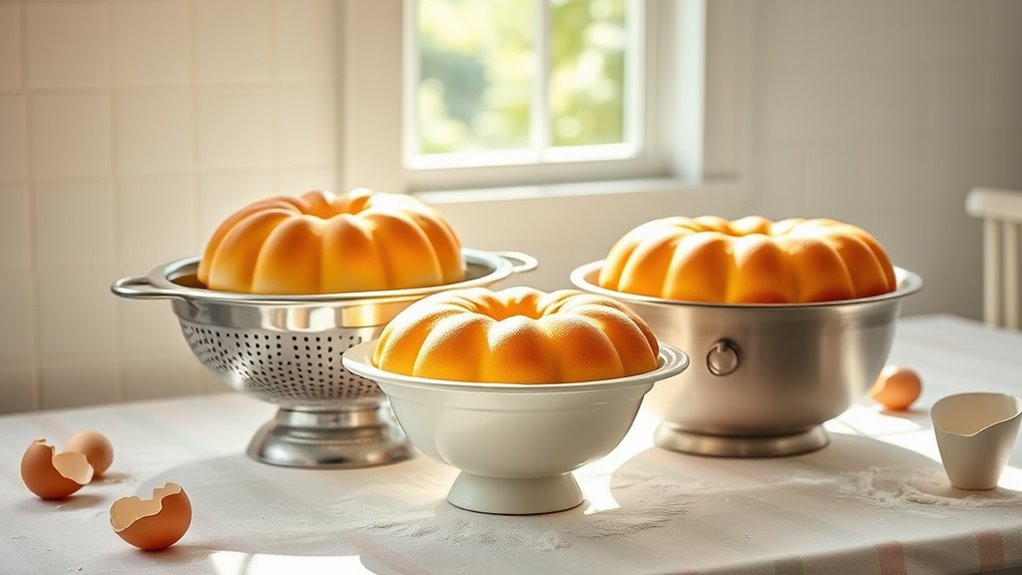
If you don’t have a traditional tube pan, you can use loaf pans or Pyrex dishes to bake your angel food cake. Ramekins work well too, especially for smaller portions.
Just remember to fill your pans no more than two-thirds full and adjust the baking time slightly for even results.
Baking In Loaf Pans
When you don’t have a traditional angel food cake pan, you can still bake a light, airy cake using a greased loaf pan with the right preparation. Make sure to grease the pan well and fill it only two-thirds full to allow your angel food cake to rise properly.
Bake at 350°F for 35-45 minutes, checking for a golden crust and dry cracks. Once out of the oven, cool the cake upside down on bottles or cans to keep its height.
| Step | Tip |
|---|---|
| Grease | Use butter or oil thoroughly |
| Filling | Only fill 2/3 to room temp batter |
| Baking | 350°F for 35-45 mins |
| Cooling | Invert on bottles or cans |
Using Ramekins Or Pyrex
Since ramekins and small Pyrex dishes offer great heat distribution, you can use them as excellent alternatives for baking individual angel food cakes. Make sure your ramekins or Pyrex are ungreased to help the batter rise properly.
Before pouring in the batter, lightly spray the pans with non-stick spray or line them with parchment paper to prevent sticking. Baking time will be shorter—around 20 to 25 minutes—so keep an eye out for a golden crust and a dry crack on top.
After baking, cool your cakes upside down by placing the ramekins on a rack or inverted cups to maintain volume and avoid collapse. Using these ungreased ramekins or Pyrex dishes makes baking angel food cake simple and effective without a regular pan.
How to Prepare Loaf, Bundt, and Glass Pans
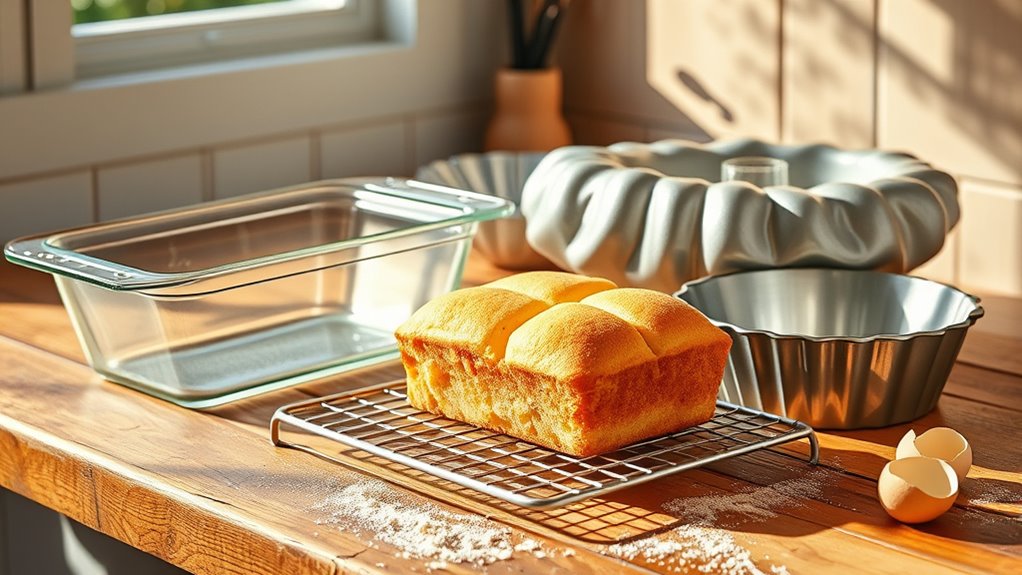
Although angel food cake traditionally bakes in ungreased pans, you’ll need to grease loaf, bundt, or glass pans thoroughly to prevent sticking. Use plenty of butter or oil to create a well-greased pan, especially if you’re using a loaf pan or bundt pan. Fill the pan no more than two-thirds full to give the cake room to rise.
Once baked, cool the cake upside down by placing the pan on inverted cans or bottles—this helps maintain the cake’s structure and prevents collapsing. After it cools completely, carefully loosen the edges with a serrated knife or spatula, then gently remove the cake.
Proper preparation and cooling ensure your angel food cake bakes evenly and retains its light, airy texture, even without the traditional tube pan.
How to Adjust Baking Time and Temperature for Different Pans
When you switch pans, adjusting both baking time and temperature is key to getting your angel food cake just right. Glass or dark pans usually need a 25°F temperature drop, while smaller pans call for shorter baking times. Keep a close eye on doneness by testing the center early to avoid overbaking or undercooking.
Temperature Adjustments For Pans
If you switch to a smaller or denser pan, you’ll want to lower your oven temperature by 25°F to avoid over-browning. Glass pans also need a 25°F reduction since they conduct heat better than metal. Adjust baking time based on pan size, but always check doneness with a golden crust and a clean toothpick.
Monitor your cake closely, especially with unconventional pans, to ensure even baking.
| Pan Type | Oven Temperature Adjustment | Notes on Baking Time |
|---|---|---|
| Small/Dense | -25°F | 5-10 mins less |
| Glass | -25°F | Follow visual cues |
| Large | No change | 5-10 mins more |
This helps you keep perfect doneness without overcooking or burning your angel food cake.
Baking Time Variations
Adjusting oven temperature is just one part of baking angel food cake in non-traditional pans—you’ll also need to modify baking times to match the pan’s size and material. Smaller or shallower pans, like loaf pans or ramekins, usually require reducing baking time by 10-15 minutes compared to a standard tube pan.
On the other hand, thicker or denser pan materials such as glass or ceramic slow heat transfer, so you’ll want to increase baking duration by 5-10 minutes. If you’re baking at higher altitudes, consider raising the oven temperature by 5-10°F and slightly extending the baking time to ensure proper rise.
Always adjust baking time carefully based on your pan material and size, and use an oven thermometer to maintain accurate oven temperature for best results.
Monitoring Doneness Closely
Since different pans conduct heat uniquely, you’ll need to monitor your angel food cake closely rather than relying solely on the timer. Use an oven thermometer to confirm your oven’s temperature matches the setting. Adjust baking time depending on pan size and material, checking doneness by observing a golden crust and using a center tester like a toothpick.
For denser pans, reduce baking time by 10-15 minutes and test earlier. Use this quick guide:
| Pan Type | Baking Time Adjustment | Doneness Check | Surface Appearance | Center Tester Result |
|---|---|---|---|---|
| Tube pan | Standard time | At timer end | Golden, firm | Clean or moist crumbs |
| Loaf pan | -10 to -15 minutes | Start checking early | Deep golden | Clean or moist crumbs |
| Glass pan | Slightly less time | Monitor closely | Golden, firm | Clean or moist crumbs |
| Metal pan | Standard or slightly less | Monitor closely | Golden, firm | Clean or moist crumbs |
| Ceramic pan | Slightly more time | Test after standard time | Golden, firm | Clean or moist crumbs |
Step-by-Step Guide to Baking Angel Food Cake in a Loaf Pan
Though angel food cake traditionally bakes in a tube pan, you can successfully use an ungreased 9×5-inch loaf pan as long as it’s spotless and free of grease. Start by carefully folding whipped egg whites into your dry ingredients, preserving their airiness to keep the cake light.
Pour the batter gently into the prepared loaf pan. Bake at 350°F for 35-40 minutes until the cake turns golden and a toothpick inserted comes out clean. Once done, invert the loaf pan immediately onto a bottle or cooling rack to cool upside down for at least an hour—this prevents collapse.
Finally, loosen the edges with a knife and slide the angel food cake out gently before slicing and serving. This method guarantees successful baking without a regular pan.
How to Bake Angel Food Cake in Mini Bundt Pans and Ramekins
When baking angel food cake in mini Bundt pans or ramekins, you’ll want to grease the pans lightly or choose non-stick versions to prevent sticking. Fill each pan no more than two-thirds full to allow the batter to rise without overflowing. Adjust your baking time to about 20–25 minutes, watching for a golden crust and a dry crack on the surface as signs of doneness.
Using mini Bundt pans or ramekins gives you individual-sized cakes, perfect for portion control or gifts. Keep an eye on the baking process since these smaller pans cook faster than regular ones. Proper greasing and careful filling ensure your angel food cake bakes evenly and releases easily from the pans after baking.
Cooling and Removing Angel Food Cake From Alternative Pans
If you want your angel food cake to hold its delicate structure, you’ll need to cool it upside down by resting the pan on inverted jars or cans. This prevents the cake from collapsing as it cools.
When using alternative pans like loaf or glass dishes, let the cake cool completely before you try to remove it. To loosen the cake, gently run a thin serrated knife or spatula around the edges.
For pans with removable bottoms, slide an offset knife carefully to loosen the cake, making removal easier. Avoid greasing the pan, as the ungreased surface helps the cake cling during baking and release smoothly after cooling.
Taking these steps ensures your angel food cake comes out clean and maintains its airy texture.
How to Keep Your Angel Food Cake Light and Fluffy Without a Tube Pan
Because angel food cake relies on trapped air for its light texture, you’ll want to use an ungreased loaf or glass baking dish that lets the batter cling and rise properly without collapsing. Skipping the Tube Pan means you must whip egg whites to soft peaks, then gently fold in dry ingredients to keep your Angel Food Cake light and fluffy.
Bake at 350°F for 35-45 minutes, adjusting time based on your pan’s size and material. Once baked, invert the pan onto jars or cans during cooling to prevent the cake from collapsing. Avoid greasing the pan altogether; this helps maintain the cake’s airy structure.
Serving Ideas for Angel Food Cake From Alternative Pans
Although you might not have a traditional tube pan, you can still create stunning presentations with angel food cake baked in loaf or glass pans. Angel food cake from alternative pans can be sliced horizontally and filled with whipped cream and fresh fruit, turning it into a beautiful layered dessert.
Using a rectangular or glass pan lets you cut sheet-style angel food cake into individual servings or stack layers for elegant layered desserts. Just remember to cool the cake upside down to maintain its height and prevent collapsing.
These serving ideas offer versatility for parties and special occasions, making angel food cake from alternative pans just as delightful and visually appealing as those baked in regular pans.
Frequently Asked Questions
What to Do if You Don’t Have an Angel Food Cake Pan?
If you don’t have an angel food cake pan, use an ungreased loaf or 13×9-inch pan.
Bake carefully, then cool it upside down on cans to keep your cake fluffy and prevent it from collapsing.
What Can I Use if I Don’t Have a Cake Pan?
You can use a glass Pyrex dish or even mini Bundt pans instead of a cake pan. They’re different shapes but work well if ungreased, letting your angel food cake rise and stay fluffy.
Can You Bake a Cake on Top of a Stove?
Yes, you can bake a cake on your stove by using a heatproof dish placed over a pot of boiling water. Cover it tightly to trap steam, then cook until the cake is firm and fully set.
This method uses indirect heat, similar to a double boiler, which helps bake the cake evenly without burning. Make sure to monitor the water level in the pot and add more boiling water if needed during cooking.
Can I Use a Nonstick Pan for Angel Food Cake?
Yes, you can, but don’t rush. Lightly grease or flour your nonstick pan to avoid sticking without ruining fluffiness.
Watch the baking time closely—your cake’s rise depends on those subtle adjustments you make.
Conclusion
Baking angel food cake without a traditional pan might seem like sailing uncharted waters, but with the right tools and tweaks, you’ll navigate smoothly.
Whether you choose a loaf pan, bundt pan, or ramekins, your cake can still rise to the occasion—light, fluffy, and delicious.
So, don’t let the lack of a tube pan hold you back; plunge in, get creative, and enjoy a slice of sweet success from your very own kitchen adventure! Baking angel food cake without a regular pan is entirely possible when you adapt and use alternative bakeware effectively.