
How Many Eggs Make 1/2 Cup Egg White?
You’ll need about four large eggs to get 1/2 cup of egg whites since each white yields roughly two tablespoons.
How many eggs make 1/2 cup egg white depends on the size of the eggs. Egg size matters—smaller eggs require more, larger eggs less.
Measuring by volume or weight is more accurate than counting eggs alone.
Freshness also affects volume, with older eggs producing slightly more liquid.
If you want to guarantee precise measurements for your recipe or explore substitutions and measuring tips, there’s more useful info ahead.
How Many Large Eggs Make 1/2 Cup Egg Whites?
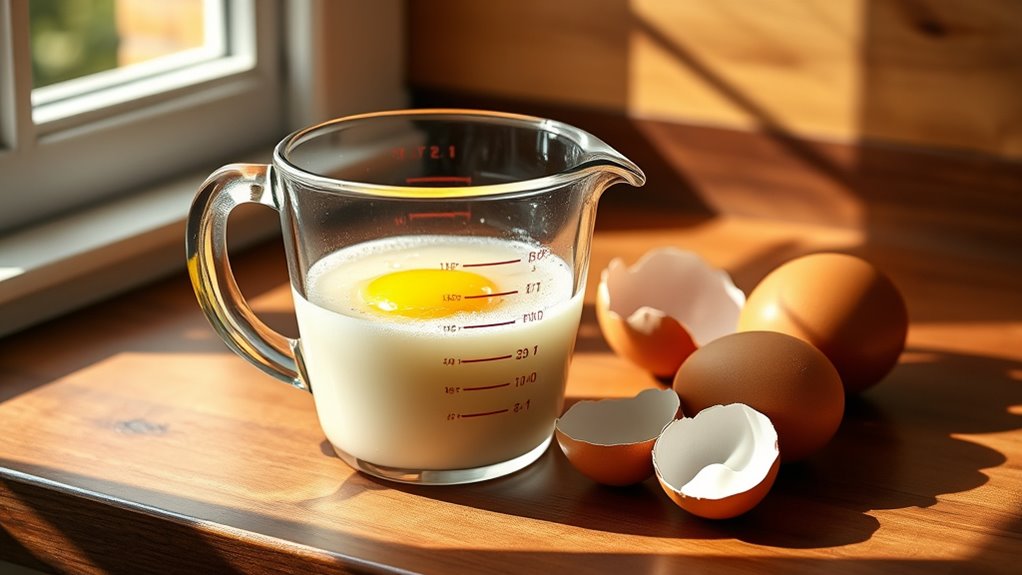
If you need 1/2 cup of egg whites, you’ll want to separate the whites from about four large eggs. Two large eggs typically yield 1/4 cup of liquid egg whites, so four eggs make roughly 1/2 cup. Each large egg white measures about 2 tablespoons, totaling 8 tablespoons—or 1/2 cup—with four eggs.
When a recipe calls for 1/2 cup egg whites, using large eggs is standard, but if you substitute another size, like a Jumbo Egg, you’ll need to adjust accordingly. Egg size conversion matters because different egg sizes affect volume; Jumbo Eggs have larger whites, so fewer might be required.
How Egg Size Affects the Number of Large Eggs Needed
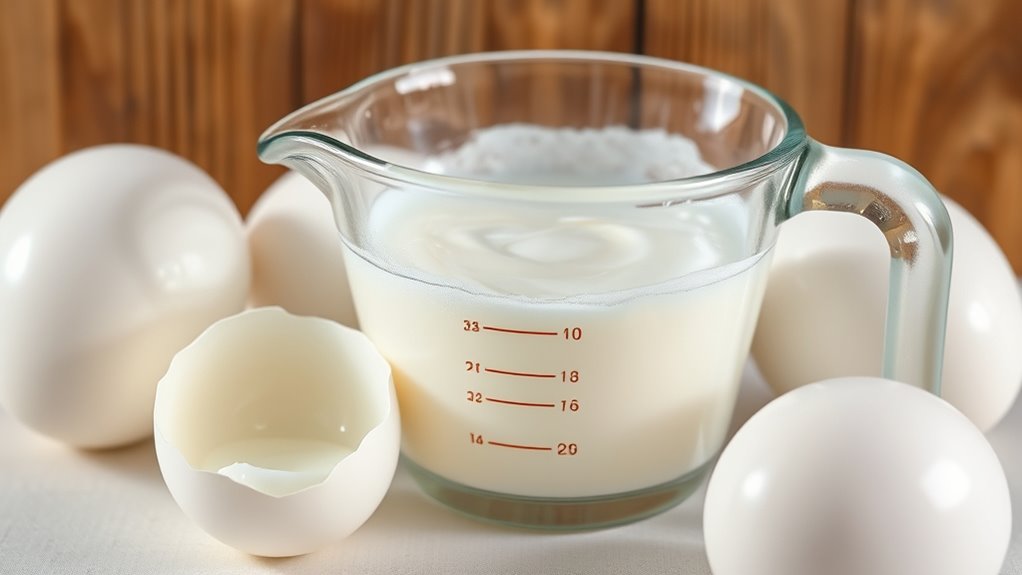
Because egg sizes vary, you’ll need to adjust the number of eggs you use to get exactly 1/2 cup of egg whites. The size of your eggs considerably impacts how many you need, especially when using large eggs as a baseline.
Egg size affects how many you need to measure 1/2 cup of egg whites accurately.
- Large eggs typically yield about 3 tablespoons of whites each.
- If your eggs are smaller, like medium or small, you’ll need more to reach 1/2 cup.
- Larger eggs, such as extra-large or jumbo, provide more whites, so fewer eggs are required.
- Fresh eggs tend to have firmer whites, but size remains the main factor for volume.
Measuring Egg Whites: Volume vs. Counting Eggs
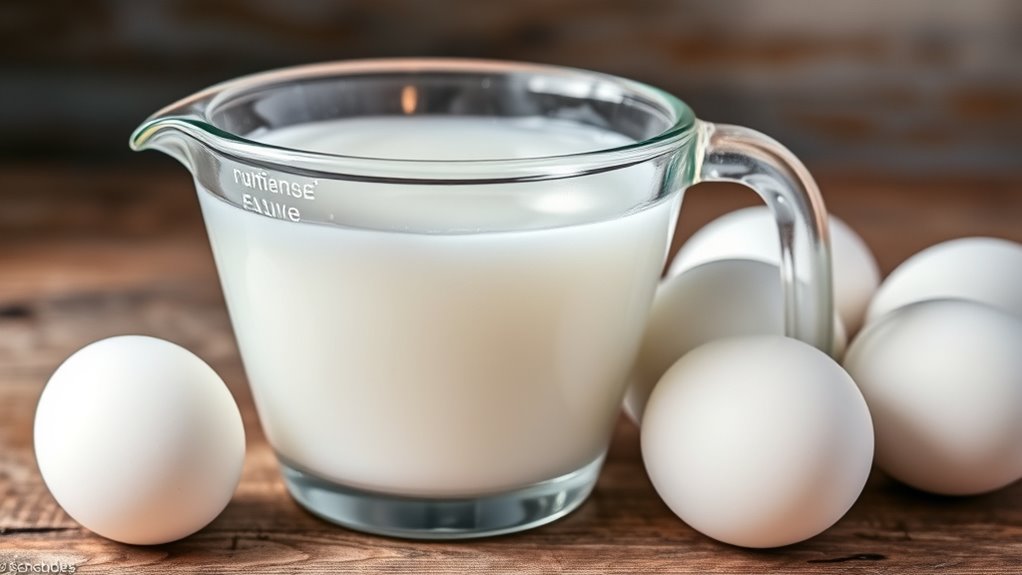
While counting eggs offers a quick estimate, measuring egg whites by volume or weight provides you the accuracy needed for consistent results, especially in baking where precision matters. Large egg whites typically yield about 3 tablespoons each, so relying solely on counting can cause slight variations.
Using a liquid measuring cup or a kitchen scale ensures you get exactly 1/2 cup.
Here’s a quick reference:
| Measurement Type | Equivalent |
|---|---|
| 1 large egg white | ~3 tablespoons (30 grams) |
| 2 large egg whites | ~6 tablespoons (60 grams) |
| 1/2 cup egg whites | ~8 tablespoons (120 grams) |
When to Use Liquid Egg Whites Instead of Fresh
When you need precise measurements and convenience, liquid egg whites offer a practical alternative to fresh ones. They come pre-measured, helping you avoid the guesswork with large eggs. Here’s when you should choose liquid egg whites:
- You require exact volume for recipes like meringues or soufflés.
- You want to reduce contamination risks since liquid egg whites are pasteurized.
- Fresh eggs aren’t available, and you need a quick, mess-free option.
- Consistency is key, as liquid egg whites provide reliable measurement regardless of egg size.
Using liquid egg whites saves time and ensures accuracy, especially when large eggs vary in size or when safety is a concern. They make cooking and baking simpler without compromising quality.
How Freshness Impacts Egg White Volume
You’ll notice that fresher eggs have thicker whites, which actually yield a bit less volume than older ones. As eggs age, their whites thin out and increase in volume, making it easier to measure out your needed amount.
Understanding this can help you adjust how many eggs you use, especially when exact measurements matter.
Freshness Effect On Volume
Because egg whites from fresher eggs are firmer, they measure slightly more volume than those from older eggs. When you use a fresh egg, you’ll notice the whites tend to hold together better, making your measurements more accurate.
Here’s how freshness affects egg white volume:
- Fresh egg whites are thicker and less watery, providing about 2-3 tablespoons per egg.
- As eggs age, the whites thin out and spread, reducing volume by 10-15%.
- Older egg whites may yield less than expected, impacting recipe results.
- Using fresh eggs ensures consistent volume, especially important in baking and cooking.
Egg Age And Consistency
Although fresher eggs have thicker, more viscous whites that may yield slightly less volume, you’ll find older eggs produce thinner whites that measure more easily and consistently.
As eggs age, their whites become clearer and more liquid, which increases the volume you get per egg. For example, a fresh egg’s white might measure about 2 tablespoons, while an older egg can yield 2.5 tablespoons or more.
This change in consistency means you might notice slight volume variations with fresh eggs, but older eggs give you a more predictable measurement. Despite these differences, you generally need about 2 to 3 eggs to make 1/2 cup of egg whites, regardless of the egg’s age.
Tips for Accurately Separating Egg Whites From Yolks
When separating egg whites from yolks, handle the eggs gently to prevent yolk breakage and contamination. You want clean, pure whites for your recipe, so follow these tips for accuracy:
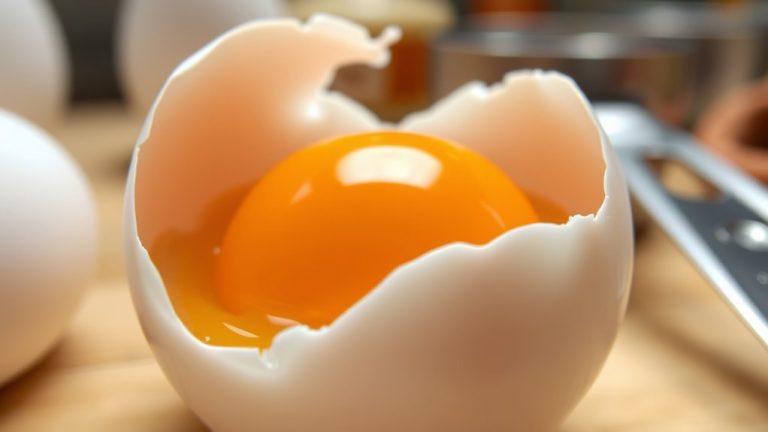
- Crack the egg gently and transfer the yolk back and forth between shell halves, letting the whites fall into a bowl.
- Use an egg separator tool if you’re new or want a cleaner process.
- Work with cold eggs—they separate more easily and reduce yolk breakage.
- Separate eggs one at a time over a bowl to avoid contaminating multiple whites if a yolk breaks.
Avoid cracked or dirty eggs, and always handle them with care to maintain the whites’ quality for your baking needs.
Why Accurate Egg White Measurement Matters in Baking
You know that even small changes in egg white amounts can alter the texture of your baked goods dramatically. Getting the measurement just right helps you achieve consistent results every time.
When you measure accurately, you guarantee your recipes turn out as intended, with the perfect rise and stability.
Texture Impact In Baking
Because egg whites play a key role in creating structure, measuring them precisely guarantees your baked goods achieve the perfect airy texture. When you get the quantity right, you help form the proper protein network needed for lightness and fluffiness. If you don’t, your meringues or soufflés might turn out dense or fail to rise.
Here’s why accurate egg white measurement matters in baking texture:
- Ensures stability and volume in delicate recipes like angel food cake.
- Prevents baked goods from becoming flat or heavy.
- Supports proper protein structure formation for fluffiness.
- Maintains the ideal consistency for items relying on air incorporation, such as macarons.
Measuring carefully guarantees your creations have that desirable, airy bite every time.
Consistency In Recipe Results
Although measuring egg whites might seem minor, getting the quantity exactly right guarantees your recipes turn out consistent every time. Precise measurement affects texture, rise, and stability in baked goods like meringues and soufflés. Slight variations can lead to over-dense or overly airy results, ruining your dish’s balance.
By using the correct amount, you ensure proper emulsification and foaming, making your culinary outcomes reliable batch after batch.
| Egg White Volume | Texture Outcome | Recipe Consistency |
|---|---|---|
| Too little | Dense, flat | Inconsistent rise |
| Accurate (1/2 cup) | Light, stable | Reliable repeatability |
| Too much | Overly airy, fragile | Unstable structure |
Stick to precise egg white measurements to perfect your baking every time.
Substituting Egg Whites for Whole Eggs
When substituting egg whites for whole eggs, you’ll need to account for the differences in moisture and binding, since egg whites lack the fat found in yolks. This means your recipe might need tweaks to maintain texture and flavor. Here’s how to make the switch effectively:
- Measure accurately: about 4 to 6 large egg whites yield 1/2 cup.
- Adjust fat: add a small amount of oil or butter to compensate for missing yolk fat.
- Modify moisture: consider adding a bit more liquid if the batter feels too dry.
- Expect texture changes: egg whites provide structure but less richness, so the final product may be lighter or less tender.
Converting Egg Whites From Other Bird Species
Understanding how to substitute egg whites from whole eggs sets a solid foundation, but you might also encounter recipes calling for egg whites from other bird species. Since a large chicken egg white is about 2 tablespoons, 4 whites equal ½ cup.
Duck egg whites are larger—3 to 4 tablespoons each—so you’ll need only 2 to 3 to reach ½ cup. Quail eggs have tiny whites, roughly 1 teaspoon each, meaning you’ll require 8 to 10 quail egg whites.
Bantam eggs fall in between, with about 1.5 tablespoons per white, so 3 to 4 work for ½ cup. To guarantee accuracy, always measure egg whites by volume or weight when substituting across species, adjusting the number accordingly for your recipe.
Tools and Techniques for Measuring Egg Whites Accurately
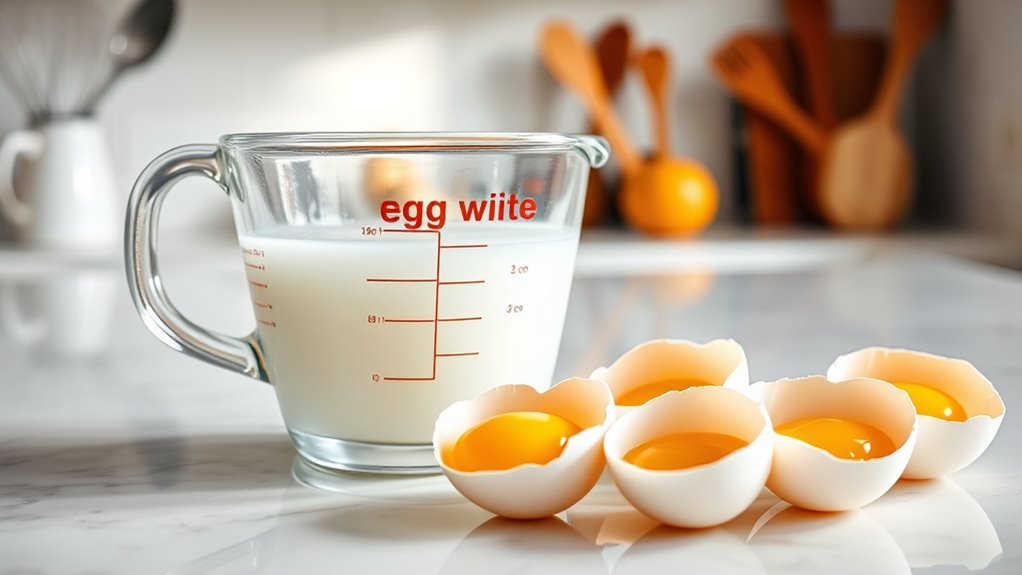
To measure egg whites accurately, you’ll want to use the right tools like a clear graduated liquid measuring cup or a kitchen scale. These tools help you achieve precise volume or weight, vital for consistent cooking and baking results. Here’s how to do it:
- Crack eggs into a separate bowl first to avoid yolk contamination.
- Use a clear liquid measuring cup to pour in the egg whites, checking the volume against the marked lines.
- For precision, weigh the egg whites on a kitchen scale—remember, one large egg white weighs about 33 grams.
- Combine whites from multiple eggs in the measuring cup or bowl until you reach 1/2 cup or 66 grams.
This approach guarantees you get exactly the amount you need every time.
Frequently Asked Questions
How Many Eggs Make 1/2 Cup of Egg Whites?
You’ll need about 2 large eggs to get 1/2 cup of egg whites.
If you want to be precise, use 3 eggs to guarantee you have a bit more than 1/2 cup for your recipe.
How Many Eggs Are in One Cup of Egg Whites?
You might be surprised, but it takes about 8 large eggs to make one cup of egg whites.
How Many Eggs Are in Half a Cup?
You’ll need about 3 to 4 large eggs to get half a cup of egg whites.
Since sizes vary, crack them into a measuring cup to make sure you hit the right amount every time.
How Many Eggs per Half Cup?
You know what they say, “Don’t put all your eggs in one basket.”
You’ll need about 3 large eggs to make half a cup of egg whites, ensuring you have enough for your recipe without guessing.
Conclusion
Picture cracking open fresh eggs, watching the clear whites gently fill your measuring cup until they reach that perfect ½ cup mark. Knowing that about 4 large egg whites get you there makes your baking smoother and more precise.
Whether you’re whisking up a fluffy meringue or a light omelet, this little measurement trick guarantees your recipes turn out just right, every time. Bringing your kitchen creations to life with confidence and ease is easier when you know how many eggs make ½ cup egg white.