
Choosing Between Kosher Salt vs Sea Salt
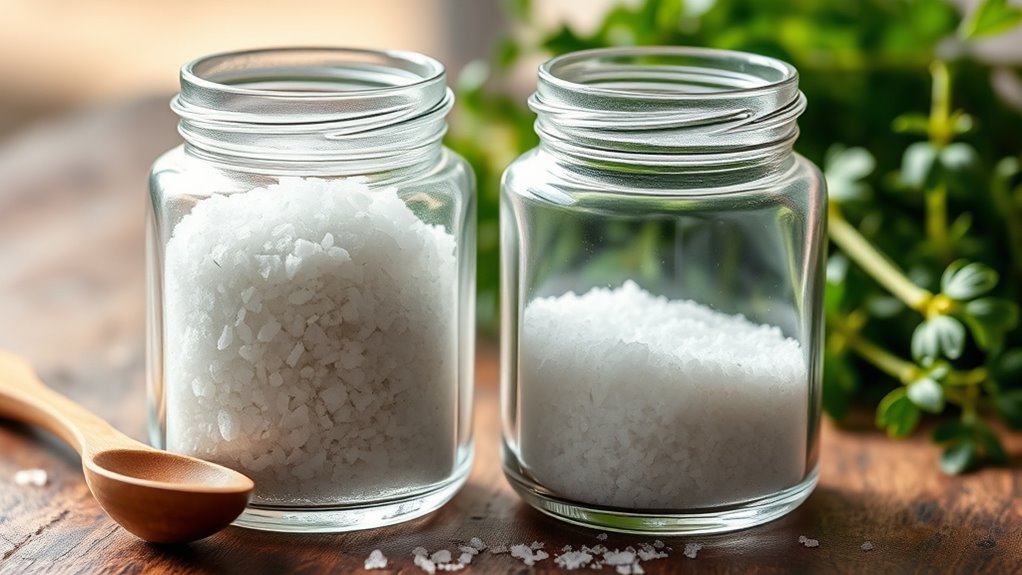
When choosing between kosher salt vs sea salt, consider your cooking needs and the flavor profile you want to achieve. Kosher salt has large, coarse crystals that provide precise control and a clean, pure salt flavor—perfect for seasoning during cooking.
Sea salt, on the other hand, offers trace minerals and varied crystal shapes that add complex flavor and texture. This makes sea salt ideal for finishing dishes where you want a burst of flavor and a crunchy texture.
Both kosher salt and sea salt are natural with no additives, but their different textures and mineral content affect taste and usage. Explore further to find out how to use each best.
Kosher Salt vs Sea Salt: Key Differences Explained
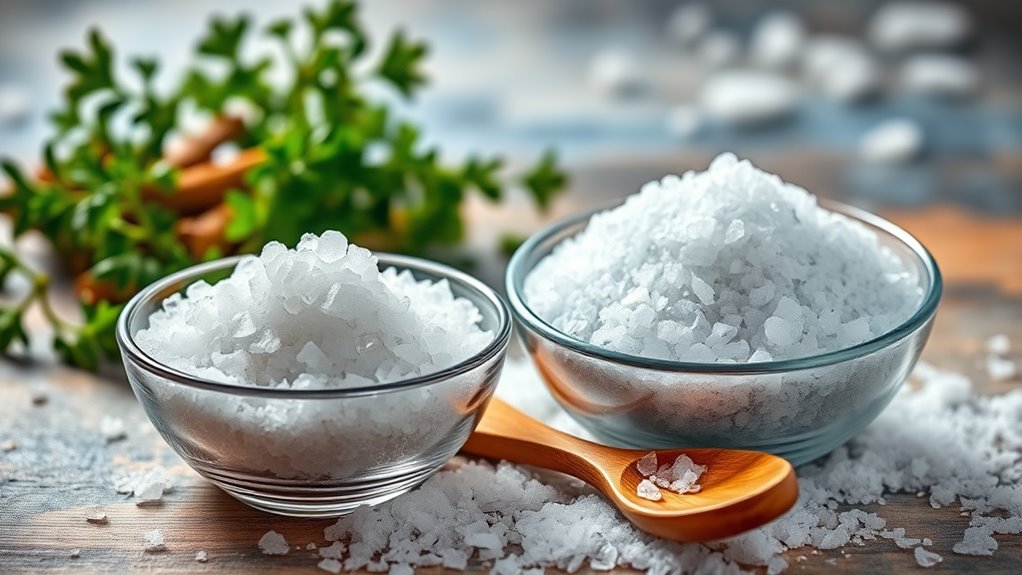
Although both kosher salt and sea salt add flavor to your dishes, they differ markedly in origin, texture, and use. Kosher salt is usually made from compressed rock salt, featuring large, uniform salt crystals that give it a coarse, pebble-like texture.
Kosher salt and sea salt both enhance flavor but differ in origin, texture, and culinary use.
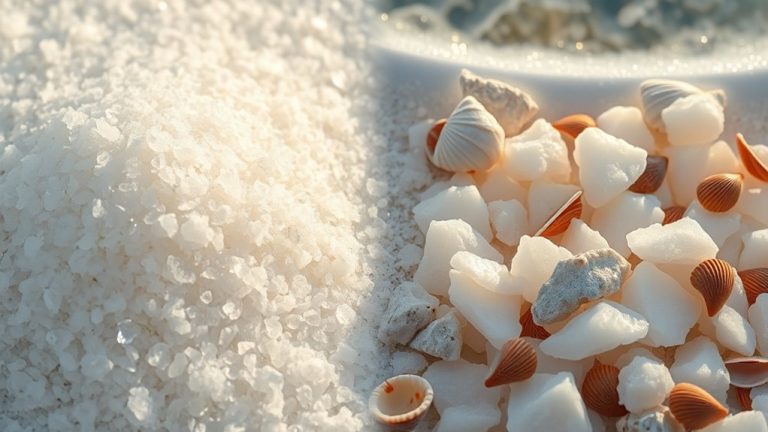
Sea salt, on the other hand, comes from naturally evaporated seawater, resulting in varied salt crystals that can be flaky, chunky, or pyramid-shaped.
You’ll find kosher salt harvested through industrial mining, while sea salt is gathered through a natural evaporation process.
Kosher salt tends to have no additives or minerals, whereas some sea salts retain trace minerals from their source.
These differences in salt crystals and production affect how you use each type, with kosher salt favored for cooking and sea salt commonly used as a finishing touch.
How Crystal Size and Shape Affect Cooking With Kosher and Sea Salt
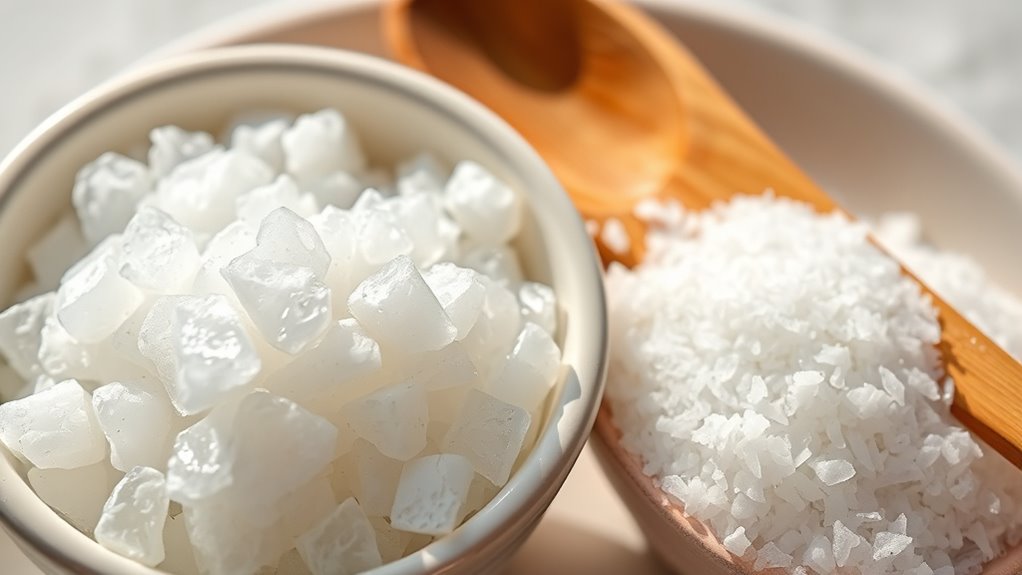
When you cook with kosher salt, its larger, coarse crystals let you season more evenly and with better control.
Sea salt’s various shapes—like flaky or pyramid crystals—change how quickly it dissolves and how it feels on your food.
Understanding these differences helps you adjust salt amounts and get the flavor just right.
Crystal Size Impact
Because crystal size and shape directly influence how salt dissolves and seasons your food, understanding these differences helps you choose the right salt for each cooking task.
Kosher salt features large, irregular crystals that dissolve slowly, giving you precise control over seasoning. Its coarse salt texture ensures an even distribution, making it ideal for seasoning meat or vegetables before cooking.
On the other hand, fine sea salt has much smaller crystals, similar to table salt, which dissolve quickly and can intensify flavor faster.
Coarse salt varieties of sea salt, with chunkier crystals, work well as finishing salts, adding both texture and a visual pop to dishes.
Knowing these crystal size differences lets you adjust quantities and timing for the best culinary results.
Shape and Texture Effects
Understanding the shape and texture of salt crystals helps you master how they interact with your food during cooking. Kosher salt’s large, cube-shaped crystals dissolve slowly, giving you a coarse texture that’s perfect for seasoning and curing. Their uniform crystal size and shape make it easy to pinch and control the amount you use.
Sea salt, on the other hand, varies widely—its crystals can be flaky, thin, chunky, or pyramid-shaped. This variety affects both how quickly the salt dissolves and the texture it adds to your dish.
Fine sea salt with smaller crystals dissolves rapidly, ideal for baking, while chunkier crystals provide a satisfying crunch and visual appeal when used as a finishing touch.
Choosing the right crystal shape and texture lets you tailor your seasoning precisely.
Why Chefs Prefer Kosher Salt for Seasoning
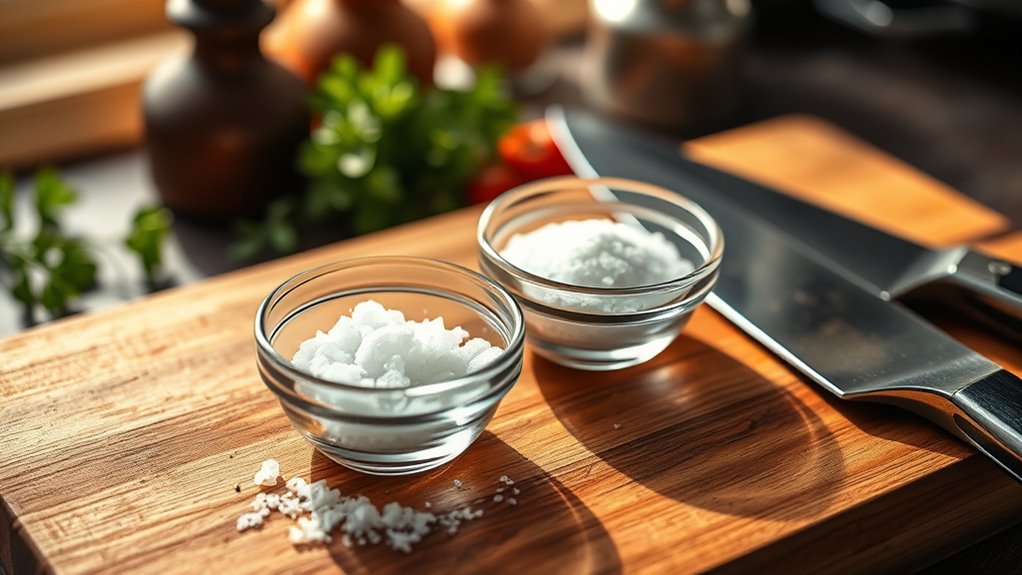
You’ll notice chefs reaching for kosher salt because its consistent crystal size lets them season dishes evenly every time. Its coarse texture makes it easy to pinch and sprinkle just the right amount without guessing.
This precise control helps you achieve perfect flavor balance in your cooking.
Crystal Size Consistency
When you season with kosher salt, its uniform crystal size gives you precise control over how much salt you add. This crystal size consistency means each grain is similar in shape and volume, making it easy to measure and sprinkle evenly.
The uniformity in kosher salt’s crystals guarantees your seasoning is consistent, avoiding the pitfalls of uneven salt distribution. Unlike sea salt, which can have varying crystal sizes, kosher salt dissolves quickly and spreads smoothly across your food.
This consistency in crystal size helps you achieve balanced flavors and reliable texture every time you cook. By choosing kosher salt, you reduce the risk of over-salting and get a more predictable seasoning experience, which is why chefs often rely on its uniformity in crystal size.
Precise Seasoning Control
The uniform crystal size of kosher salt doesn’t just guarantee even seasoning—it gives you precise control over how much salt you add. Thanks to its crystal structure, you can easily manage your salt levels without guesswork.
Here’s why kosher salt stands out for precise seasoning:
- Large, consistent crystals let you measure salinity accurately, making recipe adjustments straightforward.
- The coarse texture prevents clumping, so you get an even spread every time you season.
- Its sizeable grains let you pinch and sprinkle confidently, reducing the risk of over-salting.
With kosher salt, you’ll find seasoning becomes a more intuitive, controlled process, helping you perfect flavors with confidence every time you cook.
Easy Pinch And Sprinkle
Because kosher salt’s large, coarse crystals are easy to pinch and sprinkle, chefs prefer it for seasoning dishes by hand. When you use kosher salt, its uniform crystal size lets you control flavor precisely without over-salting.
Unlike sea salt, whose grain size can vary, kosher salt’s pebble-like grains prevent clumping and spread evenly, so you can quickly adjust seasoning as you cook.
You’ll find it effortless to pinch and sprinkle kosher salt exactly where needed, making it ideal for tasting and tweaking flavors on the fly.
While sea salt is great for finishing, kosher salt’s ease of handling gives you better control during cooking.
If you want consistent seasoning with minimal effort, kosher salt is your go-to choice for an easy pinch and sprinkle.
What Makes Sea Salt Ideal for Finishing Dishes
If you want to elevate your dishes with a final touch that delivers both flavor and texture, sea salt is an ideal choice. Its flaky crystals melt quickly, giving you an instant burst of flavor when finishing dishes. Plus, sea salt offers unique mineral notes that enhance complexity without overpowering your food.
Here’s why sea salt stands out for finishing dishes:
- Flaky crystals add a satisfying crunch and visual appeal, making your dishes look as good as they taste.
- The coarse texture provides a delicate saltiness that complements everything from salads to meats and desserts.
- Its natural, unprocessed form preserves minerals that enrich flavor, elevating your culinary presentation effortlessly.
Using sea salt lets you finish dishes with finesse and a gourmet touch every time.
Substituting Sea Salt for Kosher Salt: Tips for Perfect Flavor
When substituting sea salt for kosher salt, you’ll need to adjust quantities carefully since their crystal sizes and densities differ.
If you use flaky or coarse sea salt, you can substitute it directly but measure by volume cautiously because sea salt crystals may be larger and less dense.
Fine sea salt, however, often requires reducing the amount by about 25% to avoid over-salting due to its smaller crystals.
Always taste as you go since the variability in crystal size affects perceived saltiness.
For best results, pick a sea salt with a crystal size similar to your kosher salt and season gradually.
How Mineral Content Influences Taste and Nutrition in These Salts
Although both kosher salt and sea salt serve the same basic purpose in seasoning, their mineral content creates distinct differences in taste and nutritional value that you should consider.
Sea salt retains natural minerals like magnesium, calcium, and potassium, which influence its flavor profile and provide added health benefits. In contrast, kosher salt undergoes processing to remove most minerals, offering a cleaner, more neutral taste.
Sea salt contains natural minerals enhancing flavor and health benefits, while kosher salt is more refined and neutral in taste.
Here’s how mineral content affects these salts:
- Sea salt’s minerals give it a complex, sometimes briny flavor that varies by region.
- Kosher salt’s lack of minerals results in a pure sodium chloride taste.
- The minerals in sea salt can support electrolyte balance and overall mineral intake, boosting health benefits.
Understanding these differences helps you appreciate how mineral content shapes taste and nutrition.
Choosing Kosher or Sea Salt for Your Recipes
Since kosher salt and sea salt differ in texture and crystal size, you’ll need to adjust quantities carefully when swapping one for the other in recipes. Kosher salt’s large, consistent crystals make it easy to control seasoning, while sea salt varies from flaky to chunky, influencing how much you use.
When substituting, choose coarse sea salt and taste as you go to avoid over-seasoning.
| Salt Type | Crystal Size | Seasoning Tip |
|---|---|---|
| Kosher Salt | Large, uniform | Use as standard measurement |
| Sea Salt | Flaky to chunky | Start with less, adjust to taste |
| Fine Sea Salt | Small, dense | Use less volume than kosher salt |
Choose based on texture and flavor preference for best results.
Common Uses and Benefits of Kosher and Sea Salt
Understanding how kosher and sea salt function in your kitchen goes beyond just their texture and measurement differences. Each salt offers unique common uses and benefits that affect your cooking results.
Kosher salt’s large, uniform crystals make it perfect for seasoning, brining, and curing, giving you precise control over flavor.
Sea salt shines as a finishing salt, adding a delicate crunch and subtle mineral flavors to roasted vegetables, salads, or grilled meats, enhancing presentation.
Both kosher salt and sea salt are free from additives and preservatives, providing a pure taste that elevates your dishes naturally.
Frequently Asked Questions
Is Sea Salt Better for You Than Kosher?
Sea salt isn’t necessarily better for you than kosher salt. You’ll get trace minerals from sea salt, but the amounts are minimal, so it won’t considerably impact your health compared to kosher salt’s purity.
Do Chefs Use Sea Salt or Kosher Salt?
Like a painter choosing brushes, you’ll find chefs mainly using kosher salt for precise seasoning during cooking, while sea salt often plays the role of a final flourish, adding texture and unique flavor at the end.
Why Do Chefs Prefer Kosher Salt?
You prefer kosher salt because its coarse crystals are easy to pinch and sprinkle, giving you precise control over seasoning. It dissolves slowly, contains no additives, and guarantees consistent, pure flavor while being affordable and widely available.
When Not to Use Kosher Salt?
Did you know 70% of recipes require fine salt? You shouldn’t use kosher salt in baked goods or dressings since its large crystals dissolve slowly and can lead to uneven seasoning or alter your dish’s intended texture and flavor.
Conclusion
When deciding between kosher salt and sea salt, think about how you’ll use it. For example, a chef seasoning a steak prefers kosher salt for its coarse texture and ease of control, while sea salt shines as a finishing touch, adding a delicate crunch and subtle minerals.
By understanding their differences, you can confidently choose the right salt to elevate your dishes every time. Using kosher salt or sea salt appropriately ensures perfect flavor and texture in your cooking. Whether you need a salt that dissolves quickly or one that adds a crunchy finish, knowing when to use kosher salt vs sea salt makes all the difference.