
4 Best Cameras for Podcast Recording in 2027 (Crystal Clear Video)
For crystal-clear podcast video in 2027, you’ll want the EMEET PIXY dual-camera with AI tracking and 4K clarity, or the precise EMEET C60E 4K webcam with PDAF autofocus. These cameras deliver sharp, professional-quality visuals that make your podcast stand out. Whether you’re streaming live or recording for later, having reliable autofocus and high resolution is key.
The Movo bundle steps it up by offering two 4K cameras plus pro mics—perfect for multi-host setups that need clear video and audio from every angle. Meanwhile, the Zoom Q2n-4K shines with its portability and wide-angle capture, great for podcasters on the go or recording in smaller spaces.
Each model excels in autofocus, mounting options, and built-in audio features, making them solid choices for your podcasting needs. Ready to find the best fit? Let’s explore how these cameras match different workflows and styles.
| Image | Name | Editor's Rating | Price |
|---|---|---|---|
|
|
||

|
|
EMEET PIXY Dual-Camera AI-Powered PTZ Camera 4K with Tripod, AI Tracking
No products found.
Experience seamless, professional video with the EMEET PIXY Dual-Camera AI-Powered PTZ Camera 4K. This innovative device keeps you perfectly framed, even if you move around during your podcast or live stream. Its dual-camera system swiftly tracks your face and adjusts focus in just 0.2 seconds, eliminating distractions from out-of-focus shots.
The camera’s wide pan and tilt range—310° and 180° respectively—ensures smooth, natural movement, always keeping you centered. Its 3-mic array with noise-canceling modes delivers clear, crisp audio, enhancing the quality of your recordings without extra equipment. The included adjustable tripod offers flexible placement for various room setups.
Maintaining the EMEET PIXY is straightforward. The sturdy design and included EMEET STUDIO software provide easy control and customization of your recording environment. While 4K mode limits frame rate and field of view options, it guarantees ultra-sharp video quality, perfect for professional use.
Best for: podcasters, streamers, and content creators needing high-quality 4K video with reliable AI tracking and clear audio in dynamic, active settings.
What We Like:
- Fast 0.2s autofocus with dual-camera AI tracking
- Wide pan (310°) and tilt (180°) range for flexible framing
- Advanced 3-mic array with multiple noise-canceling modes
- Adjustable tripod included for versatile positioning
Specification:
| Manufacturer | EMEET |
|---|---|
| Dimensions | Not specified |
| Weight | Not specified |
| Material | Not specified |
| Color Options | Not specified |
EMEET C60E 4K Webcam with Tripod, Streaming Camera with PDAF Autofocus
No products found.
Experience professional-quality video with the EMEET C60E 4K Webcam, designed to elevate your streaming and podcasting setup. This webcam delivers crisp, detailed 4K images, ensuring your visuals are clear and engaging every time you go live or record. Its precise PDAF autofocus keeps your image sharp without manual adjustments, solving common focus issues that disrupt your flow.
The compact design paired with an adjustable tripod offers flexible positioning. You can easily rotate and swivel the camera 360°, helping you find the perfect angle for any environment. This versatility supports a wide range of creative setups, whether you’re at a desk or on the go.
Audio quality is enhanced with dual built-in microphones that capture sound up to 8 feet away. The webcam also adjusts exposure automatically, providing balanced lighting and vibrant colors in varying conditions. Maintenance is simple since it connects via USB, requiring no complex installation or additional drivers.
While it lacks wireless connectivity and is intended for indoor use only, the EMEET C60E remains a reliable tool for streaming, video calls, and content creation with seamless PC or Mac compatibility.
Best for: podcasters, streamers, and content creators seeking high-definition 4K video with flexible mounting and easy USB setup.
What We Like:
- Sharp 4K resolution with PDAF autofocus for clear, natural video
- Adjustable tripod with 360° swivel for versatile camera placement
- Dual microphones with wide pickup range for improved audio clarity
- Automatic exposure adjustments for consistent image quality
Specification:
| Feature | Details |
|---|---|
| Manufacturer | EMEET |
| Resolution | 4K UHD |
| Autofocus | PDAF |
| Tripod | Adjustable, 360° swivel |
| Microphones | Dual, 8-foot range |
| Connectivity | USB (Plug-and-play) |
| Compatibility | PC and Mac |
| Usage | Indoor only |
| Dimensions | Compact size (exact not provided) |
| Weight | Lightweight (exact not provided) |
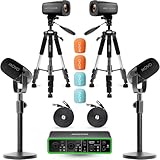
Movo Video Podcast Equipment Bundle with 2 Microphones
- COMPLETE VIDEO PODCAST SETUP FOR 2: This all-in-one bundle provides everything you need to launch or upgrade your video...
- DUAL 4K UHD CAMERA: Capture every angle of your podcast in stunning ultra-high-definition with two included 4K UHD...
- PROFESSIONAL-GRADE AUDIO INTERFACE: The Movo Phantom USB Audio Interface delivers studio-quality sound with high dynamic...
Experience seamless podcast production with the Movo Video Podcast Equipment Bundle featuring two microphones. This setup is designed to help you create professional-quality audio and stunning 4K video without hassle. Whether you’re recording a co-hosted show or an interview, this bundle simplifies capturing crisp sound and clear visuals.
The bundle includes two XLR dynamic microphones that expertly reduce background noise, ensuring your voices come through clearly. Two 4K UHD cameras on sturdy full-size tripods provide sharp, vibrant video, making your content visually engaging. The Movo Phantom USB audio interface delivers studio-grade sound with 48V phantom power and USB-C connectivity, streamlining your audio workflow.
Setup is quick and easy thanks to its plug-and-play design, compatible with both Windows and macOS. This means less time troubleshooting and more time focusing on your content. Regular maintenance involves gently cleaning the microphones and cameras to keep them performing at their best.
Best for: content creators and podcasters looking for an all-in-one video and audio solution tailored for two hosts or interview settings.
What We Like:
- Dual 4K UHD cameras and XLR dynamic microphones for clear audio and video
- Studio-quality USB audio interface with phantom power and USB-C connection
- Plug-and-play with broad compatibility for effortless setup
Specification:
| Feature | Details |
|---|---|
| Manufacturer | Movo |
| Cameras | 2 x 4K UHD cameras |
| Microphones | 2 x XLR dynamic mics |
| Audio Interface | USB with 48V phantom power |
| Connectivity | USB-C |
| Tripods | Full-size, included |
| Compatibility | Windows, macOS |
Zoom Q2n-4K Video Recorder for Musicians, Streamers & Filmmakers
- 4K ULTRA HD FOR MUSICIANS AND CREATORS – Captures stunning 4K video with a 150° wide-angle lens and five...
- X/Y MICS RATED TO 120DB SPL – Handles up to 120dB SPL, ensuring your audio stays clean and distortion-free whether...
- HDR WITH 12 SCENE PRESETS – Automatically adjusts exposure and contrast for any lighting environment, from bright...
Capture your creative moments in stunning detail with the Zoom Q2n-4K Video Recorder. Perfect for musicians, streamers, and filmmakers, this device solves common recording challenges by delivering sharp 4K UHD video combined with clear, high-quality audio. Its 150° wide-angle lens ensures you never miss the full scene, making your recordings more immersive and engaging.
Designed for ease of use, the Zoom Q2n-4K features automatic HDR with 12 scene presets, adapting quickly to different lighting conditions. This means you get well-exposed footage even in dim environments without fiddling with manual settings. Its X/Y stereo microphones capture rich sound and can handle loud volumes up to 120 dB SPL, ideal for live performances or energetic streams.
Maintenance is simple with its compact, lightweight design powered by two AA batteries. While it requires battery changes, this setup keeps the recorder ready without complex charging routines. The included tripod mount adds versatility, allowing for stable setups in various recording situations.
Though it lacks image stabilization and water resistance, the Zoom Q2n-4K excels in providing straightforward, high-quality video and audio capture with easy USB streaming to platforms like YouTube and Twitch. This makes it a practical tool for creators who want a reliable, portable recorder that integrates seamlessly into their workflow.
Best for: Musicians, streamers, and filmmakers seeking a compact, easy-to-use 4K video recorder with excellent audio capture and streaming features.
What We Like:
- Sharp 4K UHD video with wide 150° field of view for immersive footage.
- High-quality X/Y stereo microphones that manage loud sounds up to 120 dB SPL.
- Simple USB streaming compatibility with popular platforms like YouTube and Twitch.
- Automatic HDR with multiple scene presets for consistent exposure.
- Lightweight, pocket-sized design with tripod mount for versatile use.
Specification:
| Feature | Details |
|---|---|
| Manufacturer | Zoom |
| Dimensions | Compact, pocket-sized |
| Weight | Lightweight |
| Lens | 150° wide-angle |
| Video Resolution | 4K UHD |
| Microphones | X/Y stereo, 120 dB SPL |
| Power Source | 2 AA batteries |
| Connectivity | USB streaming |
| Additional Features | Automatic HDR, tripod mount |
Factors to Consider When Choosing a Camera for Podcast Recording
When choosing a camera for podcast recording, you’ll want to focus on video resolution quality and how well the autofocus performs during your sessions.
Don’t forget to check the audio capture features and connectivity options to guarantee smooth integration with your setup.
Also, consider the camera’s portability and size so it fits your recording space comfortably.
It’s all about making sure your gear works seamlessly so you can focus on creating great content without any technical hiccups.
Video Resolution Quality
Video resolution plays a pivotal role in how your podcast looks and feels to viewers. For most talking-head podcasts, recording at 1080p with 30 to 60 frames per second strikes the right balance between clear, natural video and manageable file sizes.
While 4K offers more flexibility for cropping and future-proofing, it demands substantially more storage and powerful editing gear. Keep in mind many streaming platforms downscale video to 1080p or lower, so ultra-high resolution might not enhance viewer quality.
Also, higher resolutions can expose noise and compression artifacts if your lighting, sensor, or bitrate aren’t up to par. Ultimately, choose a resolution that matches your content style, delivery platform, and editing capabilities to guarantee crisp, professional-looking videos without unnecessary technical burdens.
Autofocus Performance
Autofocus performance often determines how polished your podcast videos look, especially when hosts move or gesture naturally. Fast autofocus systems, like phase-detection or hybrid PDAF, lock focus in under 0.3 seconds. This prevents distracting hunting that contrast-only AF systems often cause.
Continuous AF tracking with face and eye detection plus predictive motion keeps framing steady as hosts lean or move across the set. Since many podcast setups have dim lighting, choose cameras with reliable low-light AF performance that maintain focus even in low contrast.
Look for smooth, damped AF changes to avoid jerky focus shifts triggered by small movements. Finally, manual-focus override and customizable AF zones let you lock focus quickly or maintain consistent depth-of-field. This is especially helpful in multi-person setups.
Audio Capture Features
Capturing sharp visuals is only part of making your podcast stand out; clear audio plays an equally important role. When choosing a camera, prioritize models with built-in directional or stereo microphones that specify polar patterns like cardioid or X/Y. This helps reject unwanted room noise and focuses on your voice.
Check the maximum sound pressure level (SPL) to avoid distortion from loud sounds—higher SPL ratings around 120 dB are ideal. Also, look for cameras offering audio modes with noise reduction, wind filters, or low-cut options for clearer speech.
To elevate sound quality, make sure your camera supports external mic inputs (3.5 mm, XLR, or digital) or USB audio passthrough. Finally, confirm it can output clean, uncompressed audio via USB or HDMI for seamless post-production and multi-track editing.
Connectivity Options
When selecting a camera for podcast recording, connectivity options play a crucial role in guaranteeing smooth setup and high-quality output. You’ll want a camera with USB plug-and-play or UVC support so it works as a webcam without needing extra drivers. This makes live streaming hassle-free.
Cameras offering single-cable USB video and audio streaming reduce latency and eliminate the need for separate audio gear. If you aim for broadcast-quality footage, choose one with HDMI output and clean HDMI support to pair with capture cards.
Also, check power options—USB bus power is convenient, but make sure it can run indefinitely on mains power for long sessions. Don’t forget to verify compatibility with your platform (Windows, macOS, Linux) and access to software for exposure control and firmware updates.
Portability and Size
Besides connectivity, portability and size matter a lot for podcast cameras, especially if you move between locations or record for hours. Choose a compact camera under 500 grams to keep handheld use comfortable and avoid fatigue.
Look for small form factors with integrated mounting points or a 1/4″ screw thread, so your camera easily fits tripods, gimbals, or desktop arms without extra adapters. Prioritize models with built-in microphones or simple USB/3.5 mm inputs to skip carrying bulky audio gear.
Also, consider cameras powered by standard AA batteries or USB-C charging, letting you recharge from power banks during extended off-grid shoots. Check physical dimensions to make certain your camera fits in a pocket or pouch, and opt for protective features like flip screens or lens caps for safe, convenient transport.
Mounting and Stability
For podcast recording, securing your camera with the right mount guarantees stable framing and minimizes vibrations that can disrupt your audio and video quality. Choose a mount type—desk clamp, desktop tripod, boom arm, or wall stand—that fits your posture and space to keep your setup steady.
Make sure its load capacity exceeds your camera’s weight plus accessories by at least 25% to prevent sagging or slips. Look for mounts with adjustable heads and locking mechanisms so you can fine-tune framing and keep it consistent between takes.
If you record near keyboards or HVAC units, use vibration isolation or add shock-absorbing pads to reduce noise. Finally, verify mounting hardware compatibility and test quick-release features for fast repositioning without losing alignment.
Lighting Adaptability
Lighting plays a pivotal role in how your podcast camera captures every detail, so you’ll want to pick one that can handle a variety of conditions without losing quality. Look for a camera with a wide dynamic range, so it retains detail in bright highlights and deep shadows, especially when your studio lighting fluctuates.
Strong low-light performance is essential—choose models with larger sensors, fast apertures like f/1.8 or lower, and good noise control at high ISO. Reliable auto-exposure and fast autofocus keep framing sharp when guests move or lighting shifts.
Adjustable field of view and image stabilization help maintain consistent exposure and composition during shot changes. And, make sure manual controls let you lock settings like white balance and ISO to prevent unwanted exposure shifts during recording. That way, your video stays looking great no matter what happens.
Software Compatibility
When choosing a camera for podcast recording, you’ll want to make sure it plays well with your software setup. Check for native OS driver support like UVC/UAC compliance so your camera works plug-and-play on Windows, macOS, and Linux without extra drivers.
Also, confirm it offers webcam mode or UVC streaming for single-cable USB output. This way, you can avoid virtual camera converters that add latency.
Make sure it’s compatible with your recording or streaming software—OBS, Zoom, Riverside, or Adobe Premiere. It should support your desired resolutions and frame rates.
Don’t forget to verify the camera exposes controls such as exposure, white balance, focus, and zoom through APIs or DirectShow. This helps ensure smooth, automated workflows.
If you plan multi-camera setups, make certain your software handles multiple inputs, camera switching, and sync features. Keeping audio and video perfectly aligned is key.
Frequently Asked Questions
How Do Lighting Conditions Affect Podcast Video Quality?
Lighting conditions directly impact your podcast video quality by influencing clarity, color accuracy, and mood.
Poor lighting causes grainy, dull footage, while good lighting highlights details and creates a professional, vibrant look that keeps viewers engaged.
It’s pretty straightforward—better lighting means your video looks sharper and more appealing.
Plus, the right lighting sets the tone and makes your podcast feel more inviting.
What Is the Ideal Camera Placement for Podcast Recording?
You should place your camera at eye level, about 3 to 5 feet away, facing you directly. This setup captures natural expressions, avoids distortion, and keeps your video engaging and professional-looking during your podcast recordings.
It’s a simple trick, but it makes a big difference. When the camera is right at eye level, it feels like you’re looking straight at your audience, which helps create a connection. Plus, keeping it a few feet away means the framing looks natural without any weird angles.
Can These Cameras Be Used for Live Streaming Simultaneously?
Yes, you can use these cameras for live streaming simultaneously. Just connect them via HDMI or USB to your streaming setup.
Make sure your software supports multiple inputs. This way, you’ll get smooth, crystal-clear video during your podcast broadcasts.
How Important Is Audio Syncing With Video in Podcasts?
Audio syncing with video is essential for podcasts because it keeps your content professional and engaging.
If audio lags or leads, your audience will notice and lose interest quickly. So, don’t overlook syncing. It really makes a big difference!
Are There Any Recommended Software for Video Editing With These Cameras?
You’ll love knowing 85% of podcasters use Adobe Premiere Pro or Final Cut Pro for editing.
These softwares perfectly sync audio and video from your cameras, letting you create polished podcasts with crystal-clear visuals and sound effortlessly.
They really make the editing process smooth and intuitive.
Conclusion
Choosing the right camera for your podcast is like picking the perfect lens to focus your story—it brings your vision into crystal-clear view. Whether you want the AI-powered precision of the EMEET PIXY or the sharp autofocus of the C60E, there’s something for every creator.
Maybe you prefer the all-in-one convenience of the Movo bundle, or the versatile Zoom Q2n-4K for dynamic shooting. Each option elevates your content in its own unique way.
Keep your needs and style in mind when selecting your gear. By choosing the best camera for podcast recording, you’ll capture videos that truly connect with your audience and make your podcast stand out with crystal-clear video quality.