3 Best Video Cameras for 2027 That Capture Every Moment Perfectly
For capturing every moment perfectly in 2027, you’ll want video cameras that balance sharp 4K quality, smooth stabilization, and clear audio for the best results. Whether you’re shooting family events, travel adventures, or professional projects, having the right gear makes all the difference.
The Kefalyn 4K Video Camera delivers detailed 96MP imaging and includes an external mic for pro sound, making it a great choice for creators who want crisp visuals and clear audio. Then there’s the Mini Camcorder Q7, which fits right in your pocket—perfect for travel and quick shoots on the go.
Meanwhile, the DJI Osmo Pocket 3 offers a 1-inch sensor combined with gimbal stabilization and slow-motion 4K at 120fps. It’s ideal for vloggers and filmmakers who want smooth, cinematic footage. Keep going to explore which camera fits your filming style best.
| Image | Name | Editor's Rating | Price |
|---|---|---|---|

|
|
||
|
|
||

|
|
4K Video Camera Camcorder, 96MP Vlogging Camera for YouTube with Microphone
- 96MP Ultra-Clear Image & 4K UHD Video: Equipped with a 96MP image sensor and 4K ultra-high-definition video recording...
- 18X Digital Zoom & Anti-Shake Stabilization: 18x digital zoom lets you capture distant scenes clearly, while the...
- IR Night Vision & Pro-Grade Audio: Advanced IR night vision technology ensures clear shooting in low-light or nighttime...

Step up your vlogging with the Kefalyn 4K Video Camera Camcorder. Designed for creators who want sharp, detailed footage, its 96MP sensor captures vivid images and stunning 4K UHD video. The detachable microphone ensures professional audio quality without extra gear.
This camera simplifies shooting with a 3-inch rotatable touchscreen for easy framing and an 18x digital zoom for versatile shots. The handheld stabilizer and built-in anti-shake technology keep your videos smooth, even when moving. Features like night vision and face detection expand your creative options.
Maintenance is straightforward, but note it uses nonstandard rechargeable batteries, which may require careful replacement. The camera is not water resistant, so avoid exposure to wet conditions. It charges while recording, making long shoots more manageable.
With USB webcam mode, this camcorder doubles as a high-quality webcam for streaming or video calls. Its user-friendly design and flexible features make it a smart choice for vloggers aiming for professional results.
Best for: YouTube creators and vloggers seeking a versatile 4K camera with advanced video and audio capabilities for smooth, creative content production.
What We Like:
- Crisp 96MP sensor with 4K UHD video for detailed visuals
- Detachable external stereo microphone for clear audio
- Handheld stabilizer and anti-shake tech for smooth footage
- Night vision, face detection, and slow motion for creative flexibility
- USB webcam mode supports versatile usage
Specification:
| Feature | Details |
|---|---|
| Manufacturer | Kefalyn |
| Video Resolution | 4K UHD |
| Sensor | 96MP |
| Zoom | 18x Digital |
| Screen Size | 3 inches (rotatable) |
| Microphone | Detachable external stereo |
| Stabilization | Handheld stabilizer + anti-shake |
| Battery Type | Nonstandard rechargeable |
| Connectivity | USB webcam mode |
| Weight | Not specified |
| Water Resistance | None |
Vlogging Camera, Mini Camcorder, Portable Handheld Video Camera
- 【Mini Camcorder, Pocket Size Design】: Measuring only 5.35 × 1.56 inches, this handheld video camera easily fits in...
- 【One-Button Recording, Ready Out of the Box】: Start recording instantly with no app download, no QR code, and no...
- 【7-Hour Long Battery Life】: Built-in 2000mAh rechargeable battery supports up to 7 hours of continuous recording...
Capture your story effortlessly with the Vlogging Camera, Mini Camcorder, Portable Handheld Video Camera (Model Q7). Designed for on-the-go creators, its compact size fits comfortably in your pocket, making it easy to carry for travel or daily use. The simple one-button recording lets you start shooting immediately, eliminating complicated setups.
The camera’s 180° rotating wide-angle lens offers flexibility to frame your shots from different perspectives. A bright 1.3-inch display helps you compose your video with ease. Thanks to the built-in light, low-light environments won’t hold you back from capturing clear footage.
Recording in 1072p AVI format with 16x digital zoom, this camcorder balances quality and convenience. Its long-lasting 7-hour battery and included 32GB memory card let you keep filming without interruption. Plus, the tripod adds stability, perfect for steady travel or POV videos.
While not water resistant and limited to digital zoom, this camera is ideal for beginners and casual vloggers who want a lightweight, easy-to-use device without the fuss of apps or complex tech.
Best for: Content creators and vloggers seeking a straightforward, portable camera for travel and everyday video recording.
What We Like:
- Pocket-sized design with versatile 180° rotating wide-angle lens
- Long 7-hour battery life and essential accessories included
- One-button recording for quick, hassle-free use
Specification:
| Feature | Details |
|---|---|
| Manufacturer | Unspecified |
| Dimensions | Pocket-sized (exact size not specified) |
| Weight | Lightweight (exact weight not specified) |
| Video Resolution | 1072p AVI |
| Zoom | 16x Digital Zoom |
| Display | 1.3-inch screen |
| Battery Life | Up to 7 hours |
| Memory Card | 32GB included |
| Accessories | Tripod included |
| Lens Rotation | 180° wide-angle |
| Water Resistance | No |
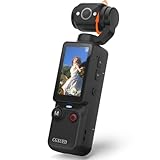
DJI Osmo Pocket 3 Creator Combo, Vlogging Camera With 1” CMOS & 4K/120fps
- Capture Stunning Footage - Osmo Pocket 3 vlogging camera features a 1-inch CMOS sensor and records in 4K resolution at...
- Effortlessly Frame Your Shots - Get the ideal composition with Osmo Pocket 3's expansive 2-inch touch screen that...
- Ultra-Steady Footage - Say goodbye to shaky videos! Osmo Pocket 3's advanced 3-axis mechanical stabilization delivers...
Capture your world with stunning clarity and smoothness using the DJI Osmo Pocket 3 Creator Combo. This compact vlogging camera features a 1-inch CMOS sensor that brings vibrant colors and sharp details to every frame. Filmmakers and vloggers can create impressive slow-motion videos in 4K at 120fps, adding dynamic storytelling to their content.
Designed for ease of use, the Osmo Pocket 3 fits comfortably in your pocket and weighs just 179g. Its 3-axis mechanical gimbal paired with ActiveTrack 6.0 technology keeps your shots steady and subjects perfectly in focus, even on the move. The rotatable touchscreen provides intuitive control, making it simple to frame and review your footage on the go.
The Creator Combo enhances your audio experience with the included DJI Mic 2 transmitter, capturing clear stereo sound that boosts production quality. Quick charging ensures the camera is ready when you are, though longer shoots may require additional battery management since continuous 4K/120fps recording maxes out around 20 minutes.
Best for: Content creators and vloggers seeking a portable, high-quality 4K camera with advanced stabilization and professional audio for versatile video production.
What We Like:
- Vibrant 10-bit color and D-Log M profile for professional-grade video quality
- Smooth stabilization with integrated 3-axis gimbal and ActiveTrack 6.0
- Superior audio capture via DJI Mic 2 included in Creator Combo
- Lightweight, pocket-sized design for ultimate portability
- Fast autofocus and rotatable touchscreen for easy operation
Specification:
| Feature | Details |
|---|---|
| Manufacturer | DJI |
| Sensor | 1-inch CMOS |
| Video Resolution | Up to 4K at 120fps |
| Stabilization | 3-axis mechanical gimbal |
| Weight | 179 g |
| Included Audio | DJI Mic 2 transmitter |
Factors to Consider When Choosing a Video Camera for
When choosing a video camera, you’ll want to focus on key factors like video resolution quality and image stabilization to guarantee smooth, clear footage.
Don’t forget to check audio recording options and battery life, since these impact your shooting experience. Also, consider the camera’s portability and size to match your shooting style and mobility needs.
Video Resolution Quality
Video resolution plays a crucial role in determining the clarity and detail of your footage. Higher resolutions like 4K offer roughly four times more pixels than 1080p, giving you sharper images and more flexibility for cropping or post-production tweaks.
However, shooting 4K at high frame rates (60–120 fps) demands more processing power and storage. Keep in mind, sensor size and pixel density affect the effective detail; smaller sensors packed with megapixels might produce noisy images in low light despite high resolution.
Think about where your audience watches your videos—1080p suits phones and streaming, while UHD benefits platforms that support it. Higher resolution means larger file sizes and more demanding editing requirements, so balance image quality with your workflow and storage capabilities.
Image Stabilization Features
High-resolution footage looks best when it’s steady, so understanding image stabilization features can greatly improve your final results. Optical stabilization, whether in-lens or in-sensor IBIS, corrects motion at the source and usually preserves image quality better than digital-only options.
Mechanical gimbals offer full 3-axis stabilization, perfect for smooth walking or action shots where handheld shake is excessive. Electronic stabilization crops and interpolates images, which may reduce resolution and the field of view, so expect a tradeoff between sharpness and smoothness.
Look for hybrid systems combining optical, mechanical, and electronic methods with predictive algorithms to get the best of both worlds. Always check specs like degrees of correction and real-world test results, as stabilization effectiveness varies greatly depending on shooting conditions.
Audio Recording Options
Don’t overlook audio quality when choosing a camera, as sound can make or break your footage. Look for models with external mic inputs like 3.5mm or XLR if you want clear, directional sound beyond built-in mics.
Built-in microphones are handy but often pick up too much ambient noise, so consider cameras featuring stereo mics with wind reduction or the ability to add a windscreen for outdoor shoots.
If you plan dual-system audio, make sure your camera supports timecode sync or manual audio clamping and includes a reliable headphone jack for real-time monitoring.
Also, check the maximum audio sample rate and bit depth—48 kHz/16-bit or higher is ideal—and whether audio records embedded or as separate tracks for easier editing.
Battery Life Duration
Although battery life varies widely depending on settings and usage, understanding how long a camera can record continuously at your desired resolution and frame rate is essential. Higher resolutions and frame rates, like 4K/60fps, drain batteries faster than 1080p/30fps.
Check battery capacity (mAh and voltage) and compare it to runtime claims—larger capacity usually means longer recording. But keep in mind, sensor power use and features like in-body stabilization or continuous autofocus also impact endurance.
Look for hot-swapping or dual-battery support, and USB Power Delivery charging so you can film while powering the camera externally. It’s also smart to factor in temperature drops and accessory power draws, such as external mics or monitors, when planning spare batteries or charging for extended shoots.
This way, you won’t miss those essential moments.
Portability and Size
When choosing a video camera, you’ll want to take into account its size and weight carefully since these affect how easily you can carry and use it during shoots. Pocketable models typically weigh under 400 grams and stand about 5–6 inches tall, making them ideal for travel and quick setups.
Hand-held camcorders and gimbals tend to be larger and heavier, which can cause fatigue over long sessions. Battery type plays a role too—built-in batteries simplify packing, while removable ones let you swap quickly but add bulk.
Don’t forget accessories; integrated screens and mics keep things compact, but external gear increases your load. Also, look for cameras with handy mounting options like wrist straps or tripod threads to maintain versatility without lugging heavy rigs around.
Connectivity and Compatibility
Besides size and portability, you’ll want to make sure your video camera connects seamlessly with your other gear and software. Check the camera’s output ports—USB-C, micro-USB, or HDMI—and confirm they match your capture device or if adapters are necessary.
HDMI is usually essential for high-quality external recording and streaming. Verify supported connection modes like UVC webcam over USB, clean HDMI output, Wi-Fi streaming, or Bluetooth control to guarantee compatibility with your streaming platform or conferencing app.
Don’t overlook memory card standards and file systems, as some cameras require in-camera formatting to avoid errors. Also, confirm power options and whether the camera can record while charging.
Finally, make certain firmware, driver, and app support for your OS and look for API or SDK availability if you need advanced remote control or integration.
Low-Light Performance
Low-light performance can make or break your video quality in dim environments, so you’ll want a camera that excels at capturing clear, noise-free footage without relying on excessive lighting. Look for larger sensors and bigger pixel pitches, as they gather more light per pixel, reducing noise at high ISO settings.
Choose lenses with wide maximum apertures (like f/1.8) to let in more light. This enables faster shutter speeds and cleaner images.
A high native ISO range with proven low noise performance lets you brighten scenes without grain. Effective image stabilization helps you shoot at slower shutter speeds without blur, improving exposure.
Finally, prioritize cameras with strong low-light autofocus systems and fast lenses to maintain sharp focus when light is limited. It really makes a difference in challenging lighting conditions!
Included Accessories Bundle
Capturing great footage in challenging lighting is only part of the equation; the accessories that come with your camera can greatly influence your shooting experience. Check which essential items are included—like external microphones, tripods, stabilizers, lens hoods, extra batteries, and memory cards—so you avoid unexpected extra purchases.
Pay attention to battery type and quantity; removable batteries let you hot-swap and extend runtime, while built-in ones might limit you. Confirm memory card capacity and max supported size to guarantee smooth recording at your preferred resolution and frame rate.
Look for mounting or handling gear such as mini tripods or handheld grips that boost versatility for vlogging or travel. Finally, make certain audio and connectivity accessories—like detachable mics, windscreens, or USB cables—are included if you want high-quality sound or live-stream capabilities without hunting for extras.
Frequently Asked Questions
How Do Video Cameras Handle Low-Light Shooting Conditions?
Video cameras handle low-light by using larger sensors and wider apertures to capture more light. They also boost ISO sensitivity and apply noise reduction, so you get clearer, brighter footage even in dim conditions.
It’s pretty clever how they do this. By adjusting these settings, the camera can still deliver good video even when there isn’t much light around. Makes shooting in tricky lighting a lot easier!
What Are the Best Accessories for Enhancing Video Camera Performance?
You’ll want a gimbal—studies show it reduces shaky footage by 70%.
Also, invest in external microphones, extra batteries, and ND filters to boost audio, extend shooting time, and control light.
These accessories really enhance your video quality instantly.
How Do Different Video Formats Affect Editing and Sharing?
Different video formats impact your editing ease and sharing options. Some offer higher quality but larger files, while others compress more efficiently.
Choose formats compatible with your software and platforms to guarantee smooth workflow and quick sharing. It’s all about finding the right balance for what you need.
What Is the Average Battery Life of These Video Cameras?
You’ll find the average battery life ranges between 2 to 4 hours, depending on usage and camera settings.
Always carry extra batteries or a power bank so you won’t miss capturing any important moments.
Are These Cameras Compatible With Smartphone Apps for Remote Control?
Yes, you can connect, control, and customize these cameras through smartphone apps. They let you preview shots, adjust settings, and start recording remotely.
This gives you full creative freedom without ever touching the camera itself. It’s super convenient and makes capturing the perfect shot way easier.
Conclusion
Choosing the perfect video camera for 2027 is like finding the right brush to paint your stories vividly. Whether you’re capturing every vivid detail with a 96MP camcorder or weaving smooth motion with the DJI Osmo Pocket 3, these tools are your creative wings.
Don’t just record moments—bring them to life, frame by frame. Let your vision soar beyond the lens.
Your perfect shot awaits; grab it and let your story unfold. With the best video cameras for 2027, you can capture every moment perfectly and tell your story exactly how you imagine it. So, get ready to create stunning videos that truly stand out!