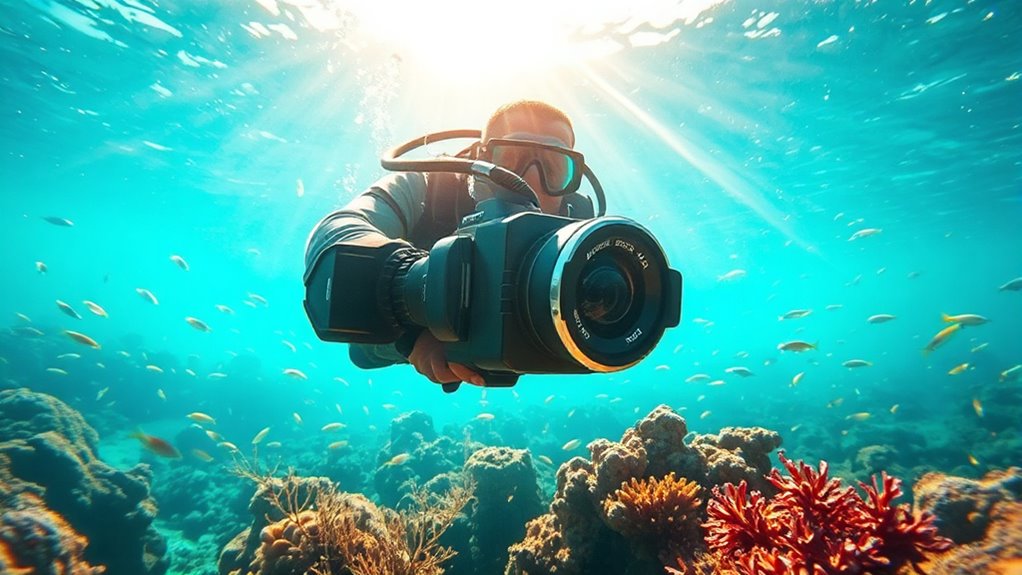
3 Best Scuba Video Cameras for 2027 to Capture Underwater Magic
For capturing underwater magic in 2027, you’ll want rugged, high-quality gear like the OM SYSTEM Olympus Tough TG-7. It offers sharp 12MP photos and macro close-ups as close as 1 cm, perfect for detailed shots beneath the waves.
The DJI Osmo Action 4 Standard Combo delivers smooth 4K video at 60fps with strong stabilization. If you want even more features, the Essential Combo adds ultra-wide 155° views, 10-bit color, and slow-motion up to 120fps.
Each camera handles water and depth toughly, making them ideal for scuba diving adventures. Keep exploring to find your perfect dive camera match and capture every breathtaking moment underwater.
| Image | Name | Editor's Rating | Price |
|---|---|---|---|

|
|
||

|
|
||
|
|
OM SYSTEM Olympus Tough TG-7 Underwater Camera
- Waterproof 15 meters (50 feet), Dustproof, Shockproof 2.1 meters (7 feet), Crushproof 100 kilogram-force...
- High resolution F2.0 lens, maximum 4x zoom, true pic VIII, back illuminated CMOS image sensor
- Variable macro system comprised of 4 macro modes, magnified capturing up to 1 centimeter from the end of the lens

Dive into adventure with the OM SYSTEM Olympus Tough TG-7, a camera designed to handle the challenges of underwater photography. Its rugged build means you can focus on capturing stunning images without worrying about damage. The camera is waterproof up to 50 feet and resistant to shocks, crushing, freezing, and dust, making it reliable in harsh environments.
This compact camera weighs just 9 ounces, offering great portability without sacrificing performance. Its 12 MP sensor and bright f/2.0 lens deliver sharp, vibrant photos even in low light. The Variable Macro System lets you shoot as close as 1 cm, making it easy to capture fine underwater details.
Recording in 4K at 30 fps and shooting continuously at up to 20 fps ensures you won’t miss fast-moving underwater scenes. Maintenance is straightforward due to its sealed design, which helps prevent water and dust intrusion, simplifying cleaning after use in wet or sandy conditions.
Though the fixed LCD limits some shooting angles and the 4x optical zoom is modest, this camera’s durability and image quality make it a solid choice for novice divers. Its digital image stabilization helps reduce blur, although it may not be as effective as optical systems in certain situations.
Best for: Amateur divers and outdoor enthusiasts seeking a rugged, easy-to-use underwater camera with strong macro capabilities and 4K video.
What We Like:
- Tough, waterproof, and shock-resistant design for harsh conditions
- Excellent close-up photography with macro modes down to 1 cm
- High-quality 12 MP sensor and bright f/2.0 lens for sharp images
- 4K video recording and fast continuous shooting up to 20 fps
Specification:
| Feature | Details |
|---|---|
| Manufacturer | OM SYSTEM Olympus |
| Weight | 9 oz (255 g) |
| Waterproof Depth | 50 feet (15 meters) |
| Sensor | 12 MP back-illuminated CMOS |
| Lens Aperture | f/2.0 |
| Optical Zoom | 4x |
| Video Resolution | 4K at 30 fps |
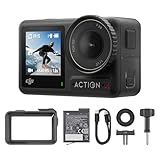
DJI Osmo Action 4 Standard Combo, Waterproof Action Camera Vlogging Camera
- Superior Low-Light Performance with 1/1.3-inch Sensor - Struggling with grainy footage in low light? Osmo Action...
- Pro-Grade Color Science - Worried your videos lack real-life colors? 10-bit color depth captures subtle shades, while...
- See More, Feel More - Want to capture more action and scenery? Shoot in 4K at 120fps with a 155° ultra-wide field of...
Capture your most adventurous moments with the DJI Osmo Action 4 Standard Combo, designed for those who demand crisp 4K footage and rugged durability. This action camera excels underwater, offering an ultra-wide 155° view that brings your scenes to life with vibrant detail and smooth motion.
Its IP68 waterproof rating allows safe dives up to 18 meters, making it ideal for underwater exploration. The camera’s advanced stabilization technologies, RockSteady+ and HorizonBalancing, ensure steady shots even in dynamic environments, though ultra-wide views may require stabilization off for optimal results.
The dual full-color touchscreens simplify framing and settings, while quick-release mounts let you switch angles effortlessly. Supporting external microphones, the Osmo Action 4 captures crystal-clear audio, enhancing your vlogs and underwater storytelling. Maintenance is straightforward, with durable construction that resists water and wear, so you can focus on your adventures without worry.
Best for: Enthusiasts and vloggers seeking a durable, waterproof 4K action camera with advanced stabilization for capturing immersive underwater footage.
What We Like:
- Large 1/1.3-inch sensor delivers sharp, vivid 4K video with 10-bit color depth
- Robust IP68 waterproof design supports dives up to 18 meters
- Dual touchscreens and quick-release mounts enhance usability and creative flexibility
- Long battery life enables up to 150 minutes of continuous shooting
- Supports external microphones for superior audio quality
Specification:
| Feature | Details |
|---|---|
| Manufacturer | DJI |
| Dimensions | Not specified |
| Weight | Not specified |
| Sensor Size | 1/1.3-inch CMOS |
| Waterproof Rating | IP68 (up to 18 meters) |
| Frame Rate | 4K at 60fps |
| Field of View | 155° ultra-wide |
| Battery Life | Up to 150 minutes |
| Screens | Dual full-color touchscreens |
DJI Osmo Action 4 Essential Combo, Waterproof Action Camera Vlogging Camera
- Superior Low-Light Performance with 1/1.3-inch Sensor - Struggling with grainy footage in low light? Osmo Action...
- Pro-Grade Color Science - Worried your videos lack real-life colors? 10-bit color depth captures subtle shades, while...
- See More, Feel More - Want to capture more action and scenery? Shoot in 4K at 120fps with a 155° ultra-wide field of...
Capture your most thrilling moments underwater and beyond with the DJI Osmo Action 4 Essential Combo, designed to deliver vibrant, clear footage even in tough conditions. Its advanced sensor and color depth bring your adventures to life with sharp, true-to-life colors. Say goodbye to shaky videos; enjoy smooth, immersive 4K footage thanks to multiple stabilization modes.
This action camera is built for durability and ease. Waterproof to 18 meters and cold-resistant down to −20°C, it adapts to extreme environments without compromising performance. Dual ultra-bright touchscreens and magnetic mounts simplify framing and angle changes, so you can focus on the action.
Maintenance is straightforward, with quick-release mounts enabling easy attachment and removal. Battery life lasts up to 150 minutes, ideal for most sessions, though extra batteries may be needed for longer shoots. While some users might need time to master its advanced features, the rewards are impressive, making it a reliable companion for any adventure.
Best for: Outdoor enthusiasts and vloggers seeking a rugged, high-quality waterproof camera that captures stunning 4K footage in challenging environments.
What We Like:
- Crisp, detailed images with a 1/1.3-inch sensor and 10-bit color depth
- Waterproof up to 18 meters and functional in cold weather down to −20°C
- Dual bright touchscreens for easy framing and quick angle adjustments
- Magnetic quick-release mounts for effortless setup and maintenance
Specification:
| Feature | Details |
|---|---|
| Manufacturer | DJI |
| Dimensions | Not specified |
| Weight | Not specified |
| Sensor Size | 1/1.3 inch |
| Video Resolution | 4K up to 120 fps |
| Waterproof Depth | 18 meters |
| Operating Temp | Down to −20°C |
| Color Depth | 10-bit |
Factors to Consider When Choosing a Scuba Video Camera
When choosing a scuba video camera, you’ll want to check its waterproof depth rating to match your needs. Don’t forget to take into account video resolution, image stabilization, and battery life for the best footage.
Also, think about the mounting options and accessories that make your underwater experience easier and more creative. These little extras can really boost your filming game and help you capture those amazing moments below the surface.
Waterproof Depth Ratings
Waterproof depth ratings play a crucial role in selecting the right scuba video camera for your dives. You should pick a camera rated at least 20–30% deeper than your maximum planned depth. This provides a safety margin against pressure changes and accessories.
Look for ratings expressed in meters or feet that guarantee continuous submersion, not just brief splashes. Since recreational dives typically max out around 30–40 meters (100–130 feet), choose gear rated beyond that if you plan technical or deeper dives.
Also, note whether the rating applies with or without a waterproof housing, as many cameras require separate cases to extend depth capability. And remember, saltwater, temperature, and pressure cycles degrade seals over time.
Video Resolution Quality
Choosing a scuba video camera isn’t just about how deep it can go; the quality of your footage underwater depends heavily on video resolution. Higher resolutions like 4K capture more detail and let you zoom or stabilize without losing clarity, but they require more storage and powerful editing gear.
Pair resolution with frame rate—4K at 30–60 fps guarantees smooth motion, while lower resolutions at 120 fps enable slow-motion shots. Don’t overlook bit depth and color sampling; 10-bit color retains richer tones, vital for grading underwater scenes.
Also, consider sensor size and low-light performance—noise at high ISOs can ruin sharpness. Finally, think about your workflow, since higher-res videos need faster memory cards and more editing power to handle large files efficiently.
Image Stabilization Features
Although capturing smooth underwater footage can be challenging, effective image stabilization plays a crucial role in reducing motion blur and rolling shutter effects caused by currents and swimming.
You’ll want optical or mechanical stabilization—like gyroscopic gimbals or lens-based systems—since they outperform digital-only methods underwater, especially in strong currents or fast movements.
Wide-angle lenses amplify camera shake, so choose stabilization that handles high angular motion or offers horizon-leveling to keep your shots steady and level.
Keep in mind stabilization can weaken at higher frame rates or resolutions, so check its performance at settings like 4K/60fps or 1080p/120fps.
Also, remember advanced stabilization modes increase power use and heat, potentially limiting recording time.
Always test your camera in real dive conditions to spot weaknesses you won’t see on land.
Battery Life Endurance
Image stabilization helps you capture steady footage, but it also draws power from your camera’s battery. When choosing a scuba video camera, check the actual continuous recording runtime at your preferred resolution and framerate—shooting 4K60 uses far more power than 1080p30.
Remember, cold water and diving in chilly climates can markedly reduce battery capacity, so factor in extra margin. Features like Wi-Fi, bright displays, and front-facing screens also drain power faster.
Always carry spare batteries or an external power source sized to cover your total planned dive time plus a safety buffer. Finally, consider how quickly you can charge and swap batteries between dives, and whether your camera allows wet battery swaps or requires drying.
This planning makes certain you won’t miss capturing those magical underwater moments.
Mounting and Accessories
When gearing up for underwater filming, you’ll want to lock down mounts that can handle the pressures and forces you’ll face beneath the surface. Choose mounts with depth and shock ratings suited to your dive conditions to keep your camera secure during descents, currents, and impacts.
Quick-release or magnetic systems let you switch angles fast, perfect for shifting between handheld and helmet setups. Add floating handgrips or tethered lanyards to prevent losing your camera in surge or strong currents.
Pick extension arms and poles that balance reach with hydrodynamic drag. Pair longer poles with stabilizing foregrips or buoyant tips to reduce wobble.
Carry various mounting adapters and spare locking screws to fit different gear and replace worn parts. This way, your setup stays reliable dive after dive.
Frequently Asked Questions
How Do I Maintain My Scuba Camera After Diving?
You should rinse your scuba camera with fresh water immediately after diving to remove salt and debris. This helps prevent corrosion and keeps your gear in good shape.
Dry it thoroughly, check seals carefully, and store it in a cool, dry place. This way, you avoid moisture buildup that could damage the camera.
Don’t forget to regularly inspect and service your camera to keep it performing at its best. Taking these steps will make sure your underwater memories stay clear and sharp!
Can Scuba Cameras Be Used for Deep-Sea Exploration?
Yes, you can use scuba cameras for deep-sea exploration if they’re rated for high pressure and depth. Always check the camera’s specifications and use proper housings to protect your gear during deep submersions.
It’s super important to make sure your equipment can handle the conditions down there. Otherwise, you might risk damaging your camera or losing it altogether. So, do a little homework before you dive!
What Accessories Improve Underwater Video Stability?
You’ll improve underwater video stability by using accessories like handheld stabilizers, weighted grips, and floating arms. These tools help keep your camera steady even in moving water.
Also, consider mounting your camera on a tripod or using a gimbal designed specifically for underwater use. These options can really help you get smooth, professional-looking shots every time.
Are There Special Lenses for Macro Underwater Filming?
Yes, there are special macro lenses designed for underwater filming that let you capture tiny creatures in stunning detail.
You’ll want a lens that attaches easily to your camera housing and maintains sharp focus close-up. These lenses make it way easier to get those crisp, close shots of underwater life.
How Do Temperature Changes Affect Underwater Camera Performance?
Temperature changes can affect your underwater camera’s battery life and cause condensation inside the housing.
While some believe it distorts image quality, modern cameras usually handle these shifts well if you warm them gradually and seal them properly.
Conclusion
Plunging into underwater videography is like exploring a hidden treasure chest—each camera opens a new world beneath the waves. Whether you choose the rugged OM SYSTEM Olympus Tough TG-7 or the versatile DJI Osmo Action 4 combos, you’ll capture your aquatic adventures in stunning detail.
Keep your needs and environment in mind, and you’ll find the perfect gear to turn every dive into a dazzling story worth sharing. With the best scuba video cameras for 2027, you can effortlessly capture the vibrant colors and mesmerizing movements underwater.
So, gear up and dive in—these top underwater video cameras ensure your scuba experiences are recorded with crystal-clear quality, making every moment magical and unforgettable.