5 Best Cameras for Enthusiasts to Own in 2027
If you’re aiming for premium image quality and versatile features in 2027, there are some fantastic cameras to consider.
Enthusiasts will love options like the FUJIFILM X-T5, which delivers high-res APS-C shots with stunning detail. Then there’s the Nikon D780, perfect if you want that classic full-frame DSLR feel and reliability.
Sony’s a6700 is another great pick, especially with its powerful zoom and smart AI autofocus that really steps up your game.
Looking for something more pro-style? The Canon EOS R5 stands out with 8K video capabilities and advanced stabilization to keep your footage smooth. Meanwhile, the Sony α7 III offers excellent autofocus and dual batteries, making it perfect for longer shoots without interruption.
Take your time exploring how each camera matches your shooting style and tech needs. Finding the right fit can make all the difference in capturing amazing photos and videos.
| Image | Name | Editor's Rating | Price |
|---|---|---|---|

|
|
||

|
|
||

|
|
||
|
|
||

|
|
FUJIFILM X-T5 Mirrorless Digital Camera XF16-80mm Lens Kit – Silver
- 40.2 Megapixel X-Trans CMOS 5 HR BSI Imaging Sensor
- 15 Frames per second in Mechanical Shutter
- Up to 7 stops of Internal Body Image Stabilization (IBIS)

Experience the power of professional-grade imaging with the FUJIFILM X-T5 Mirrorless Digital Camera, paired with the versatile XF16-80mm lens. This camera elevates your photography by combining a high-resolution 40.2 MP APS-C sensor with advanced 7-stop in-body image stabilization. It ensures crisp, detailed shots even in challenging light or motion conditions.
Designed for seamless creativity, the XF16-80mm lens covers a broad zoom range, ideal for capturing everything from sweeping landscapes to intimate portraits. The camera’s intuitive controls and tilting touchscreen simplify operation, letting you focus on composition rather than settings.
Video creators will appreciate the internal 6.2K 10-bit recording and external ProRes RAW support via HDMI, expanding your options for high-quality footage. Despite its compact size, the X-T5 balances portability with rugged performance, making it suitable for travel and everyday shooting.
Maintenance is straightforward due to its durable build and easy-to-clean lens. While the lens’s maximum aperture ranges from f/3.5 to f/5.6, which may limit low-light and depth-of-field control, this kit offers a solid foundation for enthusiasts aiming to grow their skills.
Best for: Enthusiasts and serious photographers seeking a high-resolution APS-C mirrorless camera with versatile video capabilities and excellent image stabilization.
What We Like:
- High-resolution 40.2 MP sensor with effective 7-stop in-body stabilization.
- Comprehensive video options including 6.2K 10-bit internal recording and external ProRes RAW.
- Classic manual dials paired with a responsive tilting touchscreen.
- Compact, lightweight design suitable for travel and everyday use.
Specification:
| Feature | Details |
|---|---|
| Manufacturer | FUJIFILM |
| Sensor Resolution | 40.2 Megapixels |
| Sensor Type | APS-C CMOS |
| Lens Included | XF16-80mm f/3.5-5.6 |
| Image Stabilization | 7-stop in-body |
| Video Recording | Up to 6.2K 10-bit internal |
| External Video Output | ProRes RAW via HDMI |
| Controls | Manual dials, tilting touchscreen |
| Color | Silver |
| Weight | Approx. 607 g (camera body) |
Nikon D780 Body
- The D780 features 24.5 MP resolution and robust EXPEED 6 image processing engine
- Capture full frame still images and 4K UHD video
- Wireless connectivity with the easy to use SnapBridge app
The Nikon D780 Body offers a powerful solution for photographers who need a camera that adapts to various shooting situations. Its 24.5 MP full-frame sensor and EXPEED 6 engine work together to deliver crisp, vibrant images even in challenging low-light conditions. This means you can capture stunning photos without worrying about noise or loss of detail.
Autofocus performance is a standout feature, with a 51-point Multi-CAM 3500 II AF system ensuring sharp focus and reliable subject tracking. For live view and video, the 273-point hybrid AF improves accuracy, making it easier to maintain focus on moving subjects. This flexibility enhances your creative control whether shooting stills or video.
Designed for convenience, the D780 includes a 3.2-inch tilting touchscreen that simplifies composition from various angles. Dual SD card slots provide ample storage and backup options, reducing downtime during shoots. While it lacks a built-in flash, external units can be used for additional lighting when needed.
The camera suits enthusiasts who want a traditional DSLR experience combined with modern features. Maintenance is straightforward, and its robust build supports demanding workflows. However, its weight of 710 g may affect portability compared to lighter mirrorless models, and video clips are limited to 30 minutes.
Best for: Enthusiast photographers and videographers seeking a versatile full-frame DSLR with advanced autofocus and high image quality.
What We Like:
- Sharp 24.5 MP full-frame sensor with excellent low-light capability
- Reliable 51-point autofocus system with enhanced live view tracking
- 4K UHD video and dual SD card slots for efficient storage
- 3.2-inch tilting touchscreen for flexible shooting angles
Specification:
| Feature | Details |
|---|---|
| Manufacturer | Nikon |
| Sensor Resolution | 24.5 Megapixels |
| Autofocus Points | 51-point Multi-CAM 3500 II |
| Video | 4K UHD with HDR |
| Display | 3.2-inch tilting touchscreen |
| Storage | Dual SD card slots |
| Weight | 710 g |
Sony Alpha a6700 Mirrorless Camera with 18-135mm Lens Black
- 26.0MP APS-C format Exmor R back-illuminated CMOS sensor
- BIONZ XR processing power for exceptional image quality
- Dedicated AI Processor and Real-time Recognition for accurate subject tracking
Capture your world with precision and clarity using the Sony Alpha a6700 Mirrorless Camera. Designed to meet the demands of creative professionals and passionate photographers, this camera combines powerful imaging with intuitive controls. Its 26 MP APS-C sensor ensures vibrant, detailed photos from every shot.
The included 18-135mm lens covers a wide range of focal lengths, allowing you to switch effortlessly from sweeping landscapes to distant subjects. The camera’s advanced AI autofocus system, featuring 759 points with eye and face detection, keeps your subjects sharp and in focus, even in challenging conditions.
Video creators will appreciate the ability to record 4K footage at up to 120fps, along with professional tools like log profiles and LUT support. Optical stabilization helps maintain steady shots, reducing blur during handheld shooting. The 3-inch articulating touchscreen provides easy framing and quick access to settings.
Maintenance is straightforward with a durable design, but note that the camera lacks a built-in flash and has a single SD card slot, which may affect backup options during extended shoots. The lens’s aperture range (F3.5–5.6) is suitable for most lighting but might limit low-light and depth-of-field control.
Best for: Enthusiasts and professionals seeking a versatile APS-C mirrorless camera with strong autofocus and advanced video capabilities.
What We Like:
- High-resolution 26 MP sensor paired with versatile 18-135mm zoom lens
- 4K video recording at up to 120fps with professional color grading support
- AI-powered autofocus with 759 points and eye/face detection for accurate tracking
- Optical image stabilization for steady shots during handheld use
- Articulating touchscreen for flexible shooting angles
Specification:
| Feature | Details |
|---|---|
| Manufacturer | Sony |
| Sensor | 26 MP APS-C |
| Lens | 18-135mm zoom |
| Video Recording | 4K up to 120fps |
| Autofocus Points | 759 points with AI |
| Screen | 3-inch articulating touchscreen |
| Stabilization | Optical image stabilization |
| Flash | No built-in flash |
| Memory Card Slots | Single SD card slot |
| Color | Black |
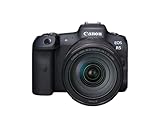
Canon EOS R5 Mirrorless Camera RF24-105mm F4 L is USM Lens Kit
- High Image Quality featuring a New 45 Megapixel Full-frame CMOS Sensor.
- DIGIC X Image Processor with an ISO range of 100-51200; Expandable to 1024001.
- High-Speed Continuous Shooting of up to 12 fps with Mechanical Shutter and up to 20 fps Electronic (Silent) Shutter.
Experience the power and precision of the Canon EOS R5 Mirrorless Camera paired with the RF 24-105mm f/4 L IS USM lens, designed to elevate your photography and videography. This camera combines a high-resolution 45 MP sensor with advanced autofocus to deliver sharp, vibrant images even in challenging conditions.
Its fast Dual Pixel CMOS AF II system tracks eyes and animals, ensuring you capture every moment with clarity. The 5-axis in-body image stabilization provides up to 8 stops of shake correction, allowing for steady handheld shots without a tripod.
Designed for professionals, the EOS R5 handles both stills and video effortlessly. Shoot up to 12 fps mechanically or 20 fps silently, and record stunning 8K video with the ability to extract 35 MP stills. The camera’s robust body and lens are built for durability but require careful maintenance to keep the image stabilization and autofocus performing at their best.
While the camera is heavier than some mirrorless models and has a 30-minute video recording limit per clip, its versatility and image quality make it a top choice for demanding creative projects.
Best for: Professional photographers and videographers needing a versatile, high-resolution mirrorless camera with advanced autofocus and in-body stabilization.
What We Like:
- Exceptional 45 MP resolution with vibrant color reproduction.
- Dual Pixel CMOS AF II for fast, accurate eye and animal tracking.
- 5-axis IBIS offering up to 8 stops of handheld stability.
- High-speed continuous shooting up to 20 fps silently.
- 8K video capture with still photo extraction.
Specification:
| Feature | Details |
|---|---|
| Manufacturer | Canon |
| Dimensions | Approx. 5.5 x 3.9 x 3.0 in |
| Weight | Approx. 3.2 lb (1.45 kg) |
| Sensor | 45 MP Full-frame CMOS |
| Lens | RF 24-105mm f/4 L IS USM |
| Image Stabilization | 5-axis in-body (up to 8 stops) |
| Video Recording | 8K UHD |
Sony α7 III Camera with 28-70mm Lens & Battery Bundle
- Sony USA Authorized. Sony Alpha a7 III with 28–70mm Lens, mini LED light, two NP-FZ100 batteries, 64GB Extreme PRO...
- Complete Full-Frame Camera Kit – The Sony α7 III kit includes the FE 28–70 mm f/3.5–5.6 OSS lens, offering a...
- 24.2 MP BSI Sensor with Pro Imaging – Featuring a back-illuminated 24.2 MP Exmor R CMOS sensor and the BIONZ X...
Capture stunning moments with the Sony α7 III Camera, designed for those who demand precision and versatility in every shot. Its powerful 24.2 MP full-frame sensor delivers crisp images and vibrant colors, helping you create professional-quality photos and videos with ease.
The included 28-70mm lens offers flexibility for everyday photography, from wide-angle landscapes to detailed portraits. While its aperture range suits most lighting, consider additional lenses for low-light scenarios. The camera’s advanced autofocus with 693 phase-detection points and Real-Time Eye AF ensures sharp focus on your subject, even in fast-moving scenes.
Built for reliability, this mirrorless camera features 5-axis in-body stabilization to reduce blur and a broad ISO range for shooting in diverse conditions. Maintenance is straightforward, with a durable body designed for frequent use. The bundle comes with two NP-FZ100 batteries, a 64GB memory card, and essential accessories to keep you ready for any shoot.
Though the kit weighs 7.7 pounds and lacks a built-in flash, its professional-grade performance and comprehensive setup make it a solid choice for serious photographers and videographers.
Best for: Enthusiasts and professional photographers seeking a high-performance full-frame mirrorless camera with versatile lens options and advanced video capabilities.
What We Like:
- Precise and fast autofocus system with 693 phase-detection points and Real-Time Eye AF
- Dual NP-FZ100 batteries and 64GB memory card included for extended shooting
- 5-axis in-body stabilization ensures sharp images across varied lighting
- Comprehensive accessory kit supports immediate use out of the box
Specification:
| Feature | Details |
|---|---|
| Manufacturer | Sony |
| Camera Sensor | 24.2 MP Full-Frame |
| Lens Included | 28-70mm f/3.5–5.6 |
| Autofocus Points | 693 Phase-Detection |
| Image Stabilization | 5-Axis In-Body |
| Memory Card | 64GB Included |
| Batteries | 2 x NP-FZ100 |
| Weight | 7.7 pounds (3.5 kg) |
Factors to Consider When Choosing a Camera for Enthusiast
When choosing a camera, you’ll want to take into account how sensor size affects image quality and low-light performance. Autofocus speed, video features, and lens compatibility also play key roles in meeting your creative needs.
Don’t forget to check the type of image stabilization to keep your shots sharp, especially when shooting handheld. It really makes a difference, especially if you’re out and about without a tripod.
Sensor Size Impact
Although choosing the right sensor size might seem technical, it plays a crucial role in your camera’s performance and the images you capture. Larger sensors, like full-frame, gather more light, giving you better low-light performance and less noise at higher ISOs.
They also create shallower depth of field, making subject isolation and background blur easier. Plus, they offer a wider field of view at the same focal length, affecting your lens choices and composition.
Beyond image quality, sensor size impacts your gear’s size, weight, and cost—bigger sensors mean bulkier bodies and lenses, plus higher prices. Keep in mind, for the same megapixel count, larger sensors have bigger photosites, improving dynamic range and shadow detail.
Choosing sensor size is about balancing image quality with portability and budget. So, think about what matters most for your shooting style and gear preferences before deciding.
Autofocus Performance
Because autofocus performance directly impacts your ability to capture sharp images, especially in fast-paced or challenging conditions, it’s crucial to understand the system’s type and coverage. Look for hybrid AF systems with dense phase-detection points spread widely across the frame—they lock focus faster and more accurately.
Continuous AF tracking depends on sensor readout speed and algorithm responsiveness; cameras with high burst rates and low inter-frame delay excel at following moving subjects. Eye, face, and subject-detection improve focus reliability for portraits and wildlife.
Also, consider low-light AF sensitivity to make certain sharp focus in dim settings or with slow lenses. Finally, explore AF customization options like selectable focus-area modes and tracking sensitivity so you can tailor autofocus behavior to your preferred shooting scenarios.
Video Capabilities
Autofocus plays a significant role not just in still photography but also in video, where maintaining sharp focus on moving subjects can make or break a shot. When choosing a camera, check its maximum internal video resolution and frame rates—4K at 60p or even 8K—and color depth like 10-bit for richer grading and extracting high-quality stills.
Look closely at codec support, favoring intra-frame codecs such as ProRes or RAW for cleaner editing. Confirm if the camera offers internal 10-bit recording or clean external RAW output via HDMI.
Stabilization matters too; in-body or lens stabilization combined with low rolling shutter enhances handheld footage. Don’t forget continuous AF with subject tracking, high-speed burst frame rates for slow motion, and recording limits that affect long takes—these features guarantee your video capabilities meet your creative ambitions.
Lens Compatibility
When picking a camera, you’ll want to zero in on lens compatibility since it directly impacts your photography options. First, check the mount type—like EF, RF, E, F, or Z—to make certain it matches your camera or that a reliable adapter exists.
Remember, mounts control mechanical and electronic connections, affecting autofocus and aperture control. Some lenses may lose features like AF or electronic aperture when adapted.
Consider sensor size too; full-frame and APS-C sensors influence effective focal lengths and may cause vignetting with mismatched lenses. Also, investigate native lens options for your mount across focal lengths and apertures to cover wide-angle, telephoto, or macro needs.
Finally, make certain lens communication supports features like EXIF reporting and stabilization coordination to maintain full functionality in-camera and during RAW processing. It’s all about making sure your lenses and camera work smoothly together.
Image Stabilization Types
Lens compatibility sets the foundation, but image stabilization plays a big role in how sharp and clear your shots turn out, especially in low light or at longer focal lengths. You’ll encounter three main types: In-body image stabilization (IBIS) shifts the sensor across multiple axes, offering 3–8 stops of compensation regardless of lens.
Optical image stabilization (OIS), built into lenses, moves lens elements to counteract shake, excelling at telephoto ranges but requiring stabilized lenses. Electronic stabilization (EIS) adjusts images digitally, smoothing video but often cropping or reducing resolution.
Hybrid systems combine IBIS and OIS, delivering superior stabilization by sharing correction duties. When choosing, weigh the stabilization stops, effectiveness at different focal lengths, and trade-offs like cropping or rolling shutter to find what fits your shooting style best.
Build and Ergonomics
Consider how a camera feels in your hands before you buy—it can make all the difference during long shoots. Pay attention to body material; magnesium-alloy or metal chassis offer durability but add weight, which might tire you.
The grip’s size, shape, and texture are vital for secure handling—if it feels awkward, you may need a battery grip for vertical shooting. Check the control layout; dedicated dials for shutter speed, aperture, and exposure compensation let you adjust settings quickly without diving into menus, keeping you responsive.
Weather sealing and a sturdy mount are must-haves if you shoot outdoors often, protecting against dust and moisture. Finally, evaluate the viewfinder type and rear LCD articulation to guarantee comfortable shooting angles and easy composition regardless of your posture.
Connectivity Options
After evaluating how a camera feels and functions in your hands, you’ll want to examine how it connects to other devices and accessories. Check for wireless options like Wi‑Fi, Bluetooth, and NFC—Wi‑Fi handles fast image transfers, while Bluetooth maintains low-power connections for remote control.
Confirm physical ports you’ll need: USB-C supports fast tethering and charging, micro or mini HDMI connects to external monitors, and 3.5 mm jacks handle audio gear. Dual card slots or high-speed memory interfaces like UHS‑II or CFexpress prevent bottlenecks during long shoots or high-bitrate video.
Make sure the camera’s apps support RAW transfer, remote shutter, and image editing. Finally, consider power delivery over USB and wired tethering stability, especially if you work in studio environments needing uninterrupted power and reliable connections.
Frequently Asked Questions
How Do Camera Sensor Sizes Impact Photo Quality?
Sensor size impacts photo quality because larger sensors capture more light, improve detail, and reduce noise.
You’ll get better dynamic range and low-light performance, helping your photos look sharper and more vibrant in various conditions.
What Accessories Are Essential for Photography Enthusiasts?
You don’t really need accessories—except maybe a sturdy tripod, extra batteries, a versatile lens, and a reliable camera bag.
Oh, and don’t forget cleaning kits and memory cards, because who likes running out of storage or power mid-shoot?
How Does Weather Resistance Affect Camera Durability?
Weather resistance boosts your camera’s durability by protecting it from moisture, dust, and harsh conditions. It lets you shoot confidently in rain or dusty environments without worrying about damage or malfunction.
This feature keeps your gear reliable, so you can focus on capturing great shots no matter the weather. Pretty handy, right?
What Are the Best Settings for Low-Light Photography?
You’ll want to use a wide aperture, high ISO, and slower shutter speed to capture more light.
Don’t forget to stabilize your camera with a tripod or steady surface to avoid blur in low-light conditions.
This way, your shots come out sharp and clear even when the lighting isn’t great. Give it a try next time you’re shooting in dim light!
How to Maintain and Clean Camera Lenses Properly?
You should use a blower to remove dust, then gently wipe with a microfiber cloth in circular motions. Avoid touching lenses with fingers, and use lens cleaning solution sparingly to keep your camera lenses clear and well-maintained.
It’s a good idea to be gentle throughout the process. That way, you won’t risk scratching or damaging the lens surface. Just take your time and handle everything with care.
Conclusion
Choosing the perfect camera for your passion doesn’t have to be overwhelming. Each of these top picks offers a unique blend of features that gently nudge your creativity forward without complicating your journey.
Whether you crave speed, versatility, or stunning image quality, you’ll find a trusty companion here that fits your style like a well-worn glove. Embrace the possibilities, and let your photography adventure unfold with ease and excitement.
Finding the best cameras for enthusiasts means balancing performance and ease of use. These models are designed to inspire and support your growth as a photographer. So, dive into the world of photography with confidence, knowing you have the right tools for capturing breathtaking moments in 2027.