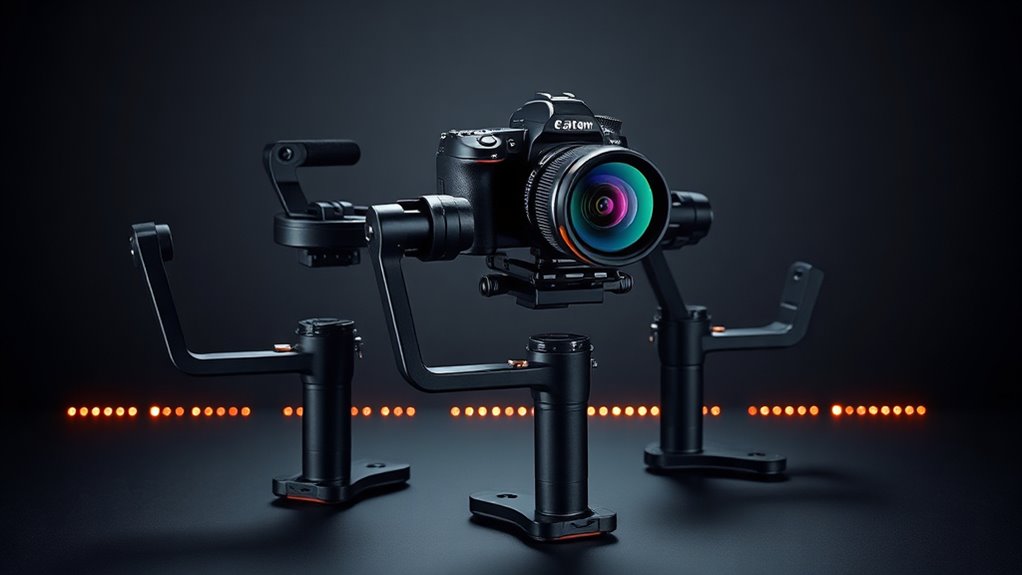
3 Best Z Axis Stabilizers for Cameras to Steady Every Shot in 2027
If you want steady shots in 2027, start with the SMICH 4th Axis Stabilizer. It’s perfect for Osmo Mobile 3 users thanks to its smooth Z-axis spring damping, which really helps keep your footage stable and professional-looking.
For heavier camera setups, the Z Axis Spring Gimbal Dual Handle Grip is a great choice. It supports up to 11 lbs and reduces vertical vibrations with a sturdy NATO clamp, making it ideal for more demanding shoots.
If you want versatility and advanced features like AI tracking, then the ZHIYUN Weebill 5 Combo is the way to go. It offers a range of options to enhance your filming experience. Keep these picks in mind as you explore how to choose the right stabilizer for your needs.
| Image | Name | Editor's Rating | Price |
|---|---|---|---|

|
|
||

|
|
||

|
|
SMICH 4th Axis Stabilizer for Osmo Mobile 3
- Can meet a variety of shooting, stability performance increased by 30%, expand a variety of handheld mode, more...
- Using spring damping design is used to improve the picture vibration caused by the natural movement of the hand up and...
- Expand a variety of handheld methods, can be held in one hand, can be both hands, but also can used as a desktop tripod.
Enhance your Osmo Mobile 3’s stability effortlessly with the SMICH 4th Axis Stabilizer. This innovative Z-axis stabilizer reduces vibrations caused by natural hand movements, delivering noticeably smoother footage. Its spring damping design improves your shooting experience by cutting down unwanted shake and jitter.
The stabilizer adapts to various handle shapes, whether square, round, or oval, expanding your handheld shooting options. You can comfortably shoot one-handed, two-handed, or even set up your gimbal on a desktop tripod for stable stationary shots. Its versatile design offers practical flexibility during use.
Crafted from durable ABS material, the stabilizer is lightweight and comes with a convenient storage bag for easy portability. While it’s robust, note that the device is not water resistant, so it’s important to keep it dry to maintain performance and longevity.
This accessory is tailored specifically for the Osmo Mobile 3, enhancing its stability but limiting compatibility with other models. Its focused design ensures optimal performance for your gimbal, making it a valuable addition for those seeking steadier handheld shots.
Best for: Osmo Mobile 3 users aiming to improve video stability and capture smooth, vibration-free footage.
What We Like:
- Boosts stability by 30% with effective spring damping.
- Fits multiple handle shapes for versatile shooting options.
- Lightweight ABS build with a storage bag for portability.
Specification:
| Feature | Details |
|---|---|
| Manufacturer | SMICH |
| Compatibility | Osmo Mobile 3 |
| Material | ABS Plastic |
| Color | Black |
| Weight | Lightweight (exact weight not specified) |
Z Axis Spring Gimbal Dual Handle Grip with NATO Clamp
- Widely Compatible with DJI RS Series etc.: Fully compatible with DJI RS 4/RS 4 Pro/RS 3 Pro/RS 3 Mini/RS 4 Mini/RS 2/RSC...
- Z-axis Damping Reduces Vertical Vibration by 30%: The upgraded ARES-SE dual handle reduces vertical vibration by...
- Quick Release Installation System: The dual handle comes with a NATO guide rail that can be directly connected to the...

The Z Axis Spring Gimbal Dual Handle Grip with NATO Clamp is designed to take your handheld shooting to the next level. If you struggle with vertical vibrations that ruin your footage, this grip offers a practical solution by reducing shake by 30%. This means smoother, more professional-looking videos without the need for heavy post-production fixes.
Its ergonomic dual-handle design helps distribute the camera’s weight evenly across both hands. This reduces fatigue during long shoots, allowing you to maintain steady control over your gimbal. Made from durable CNC-machined aluminum, the grip feels solid and reliable without adding unnecessary bulk.
The quick-release NATO clamp simplifies mounting and removal, saving you time on set. Although it’s mainly compatible with DJI RS series and select stabilizers, its robust build supports equipment up to 11 lbs. Keep in mind, this grip is not water resistant, so it’s best used in dry environments.
Best for: Professionals and content creators who need to reduce vertical vibrations for smooth, cinema-quality footage during extended handheld shooting sessions.
What We Like:
- Cuts vertical vibrations by 30% for improved stability
- Ergonomic dual handles reduce operator fatigue
- Durable aluminum build supports heavy setups
- Quick-release NATO clamp for fast mounting
Specification:
| Feature | Details |
|---|---|
| Manufacturer | Not specified |
| Material | CNC-machined aluminum |
| Compatibility | DJI RS series, select stabilizers |
| Weight Capacity | Up to 11 lbs (5 kg) |
| Mounting | Quick-release NATO clamp |
ZHIYUN Weebill 5 Combo Gimbal Stabilizer with AI Track, 3rd.Gen Sling Grip
- 【AI Intelligent Tracking System】WB5 Combo features a high-performance AI visual tracking module for people...
- 【Integrated – 3rd 3rd.Gen Sling Grip】WB5 Combo features an integrated, stowable sling grip that requires no...
- 【Fast Precision Balancing】The quick-release system has been redesigned around a dual-layer plate. The upper and...
Experience effortless, smooth footage with the ZHIYUN Weebill 5 Combo Gimbal Stabilizer, crafted for solo creators who demand precision and flexibility. Its advanced AI tracking locks onto subjects like people, pets, or vehicles within 10 meters, ensuring your shots stay sharp even when obstacles momentarily block the view.
The innovative 3rd-generation sling grip offers versatile handling, easily switching between standard and briefcase modes. It extends for dynamic low-angle shots, letting you capture unique perspectives without extra gear. The built-in 1.8″ touchscreen provides intuitive control over customizable 3-gear modes and native vertical shooting.
Designed for easy maintenance, the gimbal integrates a fill light and multiple accessory ports to streamline your setup. Compatible with Canon, Sony, Nikon, and Fujifilm cameras, it supports a range of devices while maintaining reliability. Though slightly heavy at 1.08 kg, its ergonomic design helps reduce fatigue during longer shoots.
Best for: Solo content creators and videographers seeking a compact, versatile gimbal with advanced AI tracking and effortless one-hand operation for professional-quality footage.
What We Like:
- Precise AI tracking with quick lock-on and occlusion recovery
- Versatile 3rd-gen sling grip with extension for varied shooting angles
- Native vertical shooting and built-in adjustable fill light
- Multiple accessory ports for a streamlined setup
- Broad compatibility with major camera brands
Specification:
| Feature | Details |
|---|---|
| Manufacturer | ZHIYUN |
| Dimensions | Compact, ergonomic design |
| Weight | 1.08 kg (approx. 2.38 lbs) |
| Material | Durable, lightweight alloy |
| Color Options | Standard black |
Factors to Consider When Choosing a Z Axis Stabilizer for Camera
When choosing a Z axis stabilizer for your camera, you’ll want to take into account how well it works with your specific device and how smooth the stabilization is.
Pay attention to the build quality and whether the stabilizer feels comfortable and easy to use. Also, think about its size and portability to make sure it fits your shooting style and travel needs.
Compatibility With Devices
How do you guarantee a Z axis stabilizer fits seamlessly with your camera setup? Start by confirming its load capacity exceeds your camera, lens, and accessories combined to assure smooth Z-axis damping without stressing motors.
Next, check the handle or mounting diameter and attachment type—like NATO clamp, Arca-Swiss, or 1/4-20 threads—to ensure physical compatibility with your gimbal, tripod, or grips. Verify if the stabilizer supports your gimbal model, whether universal or model-specific, so it mounts and balances correctly.
Also, confirm it accommodates your preferred shooting orientations and modes, such as portrait, landscape, briefcase, or low-angle, without extra adapters. Finally, consider build materials and ergonomics—weight, grip shape, single or dual handles—to match your setup and maintain operator comfort during long shoots.
Stabilization Performance
Although many factors influence your choice, stabilization performance is key when selecting a Z axis stabilizer for your camera. These stabilizers reduce vertical shake by using damping or spring mechanisms, improving stability by about 20–30%.
You’ll want to evaluate how well the stabilizer minimizes vertical displacement and vibrations, often measured by peak-to-peak displacement or RMS motion. Keep in mind, load capacity and proper balance are vital—an underloaded or unbalanced setup can overwhelm the damper, causing bounce or oscillation.
Also, consider the damping design: passive springs offer smooth motion, while faster dampers reduce blur from quick moves. Finally, make certain the Z-axis damping integrates well with your gimbal’s pitch and roll controls to avoid resonance and maintain sharp, stable footage every time.
Build Material Quality
Since your stabilizer must endure constant movement and stress, choosing the right build materials directly impacts its durability and performance.
Opt for high-strength, lightweight materials like CNC‑machined aluminum or carbon fiber to keep your stabilizer sturdy without adding excess weight that could unbalance your gimbal.
While ABS or engineering plastics lower costs and resist corrosion, they typically lack the rigidity and heat resistance metals offer, potentially affecting precision over time.
Make sure metal parts have corrosion-resistant finishes or anodizing to protect bearings and moving components.
Check that load-bearing joints and clamps use hardened metal inserts or bushings instead of pure plastic to maintain alignment and reduce wobble.
Finally, prioritize materials with vibration damping properties or combined constructions to absorb Z-axis shocks without compromising stability.
Ease of Use
When choosing a Z axis stabilizer for your camera, ease of use plays a key role in guaranteeing a smooth shooting experience. Look for simple, tool-free mounting and quick-release plates to speed setup and rebalancing.
Intuitive controls—like clear mode buttons, an accessible joystick, and responsive touchscreens or physical record buttons—let you operate one-handed and switch modes quickly. Built-in balancing aids, such as fore-aft micro-adjustment knobs or dual-layer plates, help you achieve precise balance without trial and error.
Ergonomic, lightweight handles or sling grips reduce fatigue during long shoots, especially dual-handle designs. And fast firmware with reliable auto-calibration or AI tracking minimizes manual tuning, letting you start filming within seconds.
Prioritizing these features guarantees your stabilizer feels natural, efficient, and ready whenever you are. So, keep these in mind to make your shooting experience as smooth as possible!
Portability and Size
Because you’ll often carry your stabilizer to various locations, its portability and size become essential factors to keep in mind. Check the folded and operational dimensions to make certain it fits your camera bag without adding bulk.
Compare the weight to your carry limits; lighter stabilizers ease handheld use but might dampen less effectively on heavy rigs. Look for detachable or collapsible parts like removable handles or sling grips to reduce packed volume and speed setup.
Also, verify if extra mounting plates or adapters are needed—they add to what you carry. Consider transport accessories such as storage pouches or foam protectors, and whether the stabilizer’s shape and materials resist impacts and fit standard backpacks or hard cases.
This makes certain your gear stays safe and travel-ready.
Additional Features
Beyond basic support, a Z axis stabilizer offers several additional features that can enhance your shooting experience and workflow. Look for built-in quick-release plates with Arca-Swiss compatibility and micro-adjustment knobs to speed setup and keep your camera balanced.
Integrated fill lights or LED indicators with adjustable brightness and color temperature help maintain proper exposure in low-light or portrait shots. NATO clamps, quick-release rails, and adapters let you mount your stabilizer swiftly and connect it with various gimbals and rigs.
Multiple control interfaces—like touchscreens, joysticks, trigger locks, and gesture controls—make one-person operation smoother and customizable. Plus, expansion ports and numerous 1/4-20 mounting points allow you to add microphones, monitors, lights, and handles, creating a modular and versatile shooting setup tailored to your needs.
Price and Warranty
The additional features you choose can impact the overall cost and value of a Z axis stabilizer. Higher-priced models often use CNC‑machined aluminum and dual‑handle designs with greater load capacity, while budget options rely on ABS plastic and simpler spring systems.
When choosing, check warranty length and coverage—longer warranties (1–2 years) usually cover manufacturing defects and show manufacturer confidence. Also, consider return policies and trial periods, like a 30-day return window, so you can test the stabilizer risk-free.
Don’t forget to factor in accessory costs and potential repairs if wear-and-tear or accidental damage isn’t covered. Finally, compare service networks and claim processes—warranties with clear registration and authorized repair centers help reduce downtime and hidden costs after purchase.
Frequently Asked Questions
Can Z Axis Stabilizers Be Used With Drones?
Yes, you can use Z axis stabilizers with drones to reduce vertical shake and improve footage stability.
Just make sure the stabilizer is compatible with your drone’s camera and weight for peak performance and smooth shots.
Do Stabilizers Affect Battery Life of Cameras?
Yes, stabilizers can drain your camera’s battery faster since they require extra power to operate motors and sensors.
You’ll want to carry spare batteries or plan shorter shoots to avoid unexpected power loss during filming.
It’s always better to be prepared so you don’t miss any important shots!
Are Z Axis Stabilizers Waterproof or Weather Resistant?
Most Z axis stabilizers aren’t fully waterproof, but many do offer some weather resistance.
They can usually handle light rain or dust without any issues.
If you’re planning to shoot in harsher conditions, though, it’s a good idea to check the specific model.
That way, you can make sure your gear stays protected.
How Do Stabilizers Handle Sudden Movements or Impacts?
Like a tightrope walker, your stabilizer quickly absorbs sudden movements and impacts, using advanced sensors and dampening systems.
This keeps your shots smooth and steady, so you won’t miss a single frame or moment.
Can Z Axis Stabilizers Support Heavy Cinema Lenses?
Yes, you can rely on many z axis stabilizers to support heavy cinema lenses. Just make sure to check their weight capacity and balance adjustments.
This way, you won’t strain the motor or lose smoothness during your shots. It’s all about keeping things balanced and within limits.
Conclusion
Choosing the right Z axis stabilizer is like finding the perfect pair of shoes—they need to fit your style and needs comfortably. Whether you pick the SMICH 4th Axis for smooth Osmo Mobile shots or the versatile Dual Handle Grip, you’re already on the path to better stability.
And if you want something more advanced, the ZHIYUN Weebill 5 is a fantastic option. It really helps boost your camera’s stability and ensures you capture steady, professional-quality footage every time.
With the right Z axis stabilizer, your shots will flow as effortlessly as a gentle breeze. Investing in one can truly transform your filming experience, making every shot smooth and cinematic. So, in 2027, whether you’re a pro or just starting out, these stabilizers will help you steady every shot and elevate your camera work to the next level.