

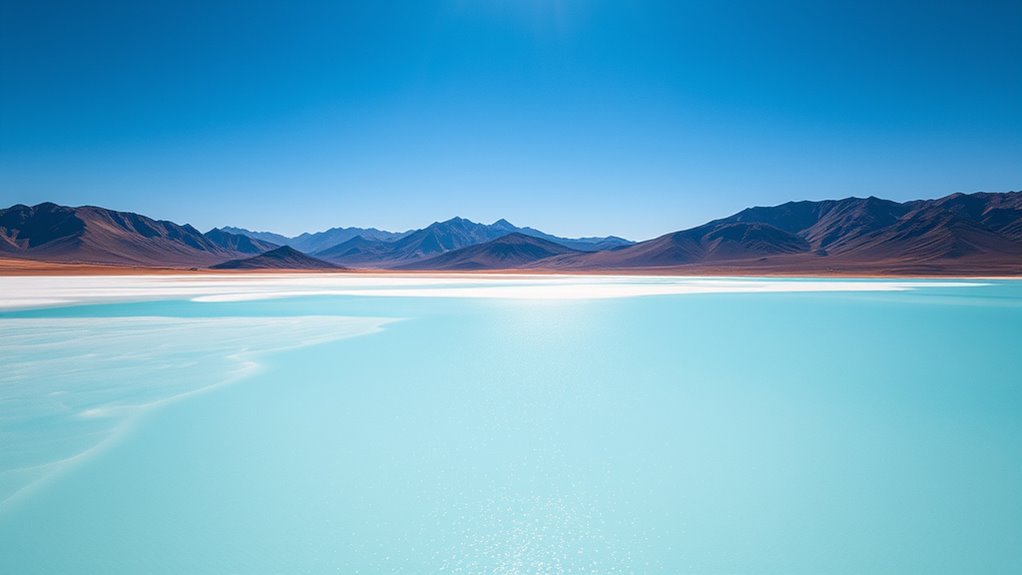
What Type of Salt Water Does Pyramid Lake Contain?
Pyramid Lake contains moderately saline water—about one-sixth as salty as the ocean—making it a salty but not hypersaline lake. This type of salt water is characterized by its moderate salinity levels, which result from minerals dissolved from the surrounding geology, such as calcium carbonate. The lake’s salinity is influenced by evaporation, which concentrates these minerals since the inflow has decreased due to water diversions.
The Truckee River still supplies fresh water to Pyramid Lake, which helps keep the salinity lower than you might expect for a terminal lake. This balance of freshwater inflow and mineral concentration creates a unique aquatic environment. If you want to understand how this unique mix shapes the lake’s ecosystem and mineral formations, there is much more to uncover.
What Is the Salinity Level of Pyramid Lake Water?

How salty is Pyramid Lake? The salinity level of Pyramid Lake is about 0.7 ounces of salt per gallon, making it saline water but much less salty than seawater—roughly one-sixth as salty.
Since Pyramid Lake sits in an endorheic basin, it doesn’t have an outlet, so water only leaves through evaporation. This evaporation concentrates the dissolved salts, gradually increasing the lake’s salinity level over time.
Pyramid Lake’s water leaves only by evaporation, concentrating salts and slowly raising its salinity.
While it’s saltier than typical freshwater lakes, it’s not as salty as the ocean. You’ll find that the balance between inflow and evaporation plays a vital role in maintaining this unique salinity.
Understanding these factors helps you grasp why Pyramid Lake holds its distinct saline water characteristics.
Why Does Pyramid Lake Have Low Salinity Despite Being a Saline Lake?
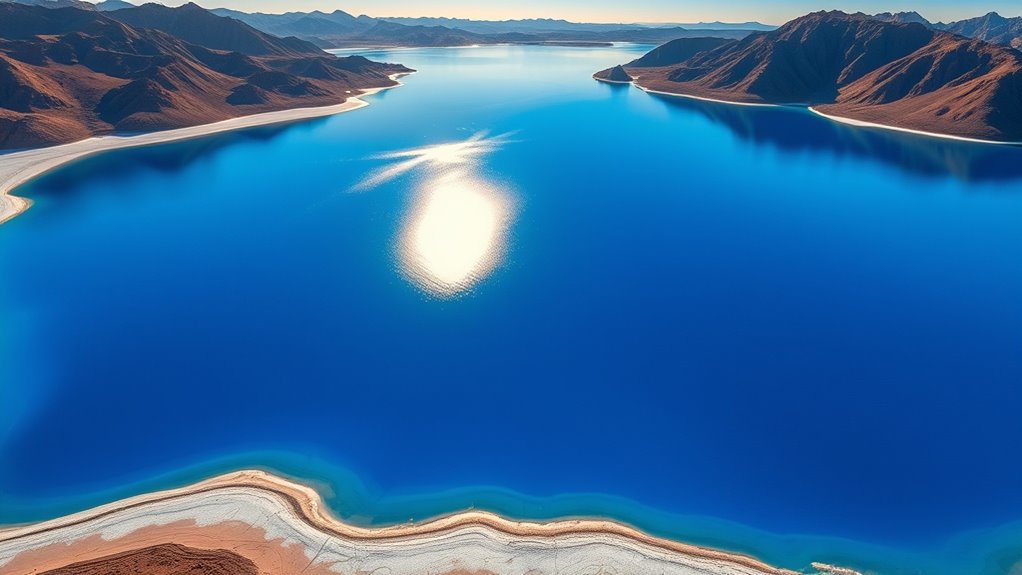
You might wonder why Pyramid Lake’s salinity stays low despite its saline nature. The fresh water flowing in from the Truckee River dilutes salt levels.
While evaporation isn’t strong enough to concentrate salts to oceanic levels.
Plus, the specific minerals present balance out the overall salinity you find in the lake.
Freshwater Inflow Influence
Although Pyramid Lake is classified as a saline lake, its salinity remains relatively low because it receives a steady inflow of freshwater from the Truckee River. This river originates from Lake Tahoe, carrying water with minimal salt content.
As the lake sits in an endorheic basin, water leaves only through evaporation, which does concentrate salts. However, the continuous freshwater inflow dilutes these salts, keeping overall salinity much lower than seawater.
The mineral content from surrounding geology, including calcium carbonate deposits, adds to the lake’s chemistry but doesn’t dramatically raise its salt levels.
Limited Evaporation Effects
Because Pyramid Lake loses water mainly through evaporation, you might expect its salinity to be very high. However, the lake’s salinity remains relatively low because freshwater inflow from the Truckee River balances evaporation, preventing excessive salt buildup.
As an endorheic basin, Pyramid Lake has no outlet, so evaporation concentrates salts, but limited evaporation rates and consistent inflow maintain hydrological balance. Mineral deposits and tufas show past high evaporation periods, yet today’s conditions keep salinity moderate.
| Factor | Effect on Salinity | Explanation |
|---|---|---|
| Evaporation | Increases | Concentrates salts by removing water |
| Freshwater Inflow | Decreases | Dilutes salt concentration |
| Endorheic Basin | Increases | No outflow to remove salts |
| Mineral Deposits | Indicate | Past evaporation, not current balance |
| Hydrological Balance | Maintains | Keeps salinity lower than expected |
Mineral Composition Balance
While Pyramid Lake is classified as saline due to its mineral content, it maintains a surprisingly low salinity compared to seawater because freshwater from the Truckee River continuously dilutes the salts. You can see that this freshwater inflow plays a vital role in maintaining the mineral balance within the lake’s endorheic basin, preventing excessive salt buildup.
Evaporation does increase salinity somewhat, but the lake’s large volume and steady inflow keep it in check.
Mineral deposits form as calcium carbonate tufas, indicating minerals are precipitated rather than accumulated.
This natural flushing and precipitation process ensures that salinity remains about one-sixth that of seawater, making Pyramid Lake an unusual saline lake with a balanced mineral composition and moderate salinity levels.
How the Truckee River Maintains Pyramid Lake’s Freshwater Status
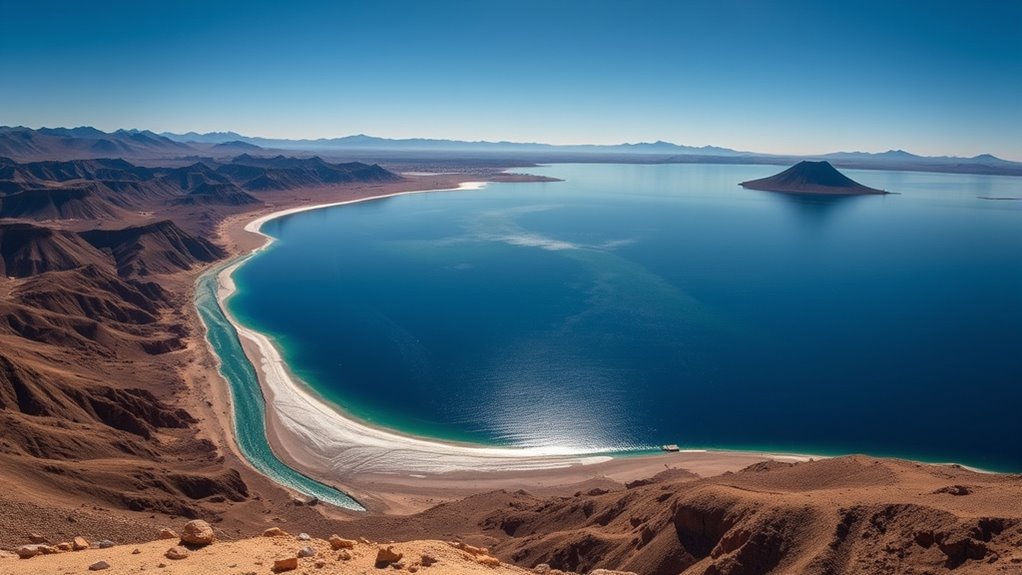
Since the Truckee River supplies about 85% of Pyramid Lake’s water, it plays an essential role in keeping the lake fresh. As an endorheic basin, Pyramid Lake has no natural outlet, so the continuous freshwater inflow from the Truckee River balances evaporation and controls salinity.
Even with diversions at Derby Dam reducing water flow, the river’s steady input prevents the lake from becoming too salty. You can envision this process as:
- Freshwater from Lake Tahoe flowing into Pyramid Lake via the Truckee River
- Water levels maintained despite high evaporation rates
- Reduced inflow at Derby Dam causing temporary salinity increases
- Overall freshwater status sustained through constant river inflow
This dynamic keeps Pyramid Lake’s salinity roughly one-sixth that of seawater, preserving its unique ecosystem.
How Mineral Deposits Affect Pyramid Lake’s Salinity and Water Chemistry
Although Pyramid Lake receives a steady flow of freshwater from the Truckee River, its salinity remains remarkably high due to mineral deposits from ancient limestone beds. These mineral deposits, rich in calcium carbonate, dissolve into the water, gradually increasing the lake’s salinity.
As evaporation intensifies in this endorheic basin, water volume decreases while minerals concentrate, further elevating salinity and altering the lake’s water chemistry.
This process also raises the alkalinity, pushing the pH to around 9.2.
The mineral-rich environment creates a unique chemical balance that supports specialized aquatic life adapted to high salinity and alkalinity.
How Pyramid Lake’s Water Chemistry Forms Calcium Carbonate Tufa Structures
You’ll notice calcium carbonate plays a key role in shaping Pyramid Lake’s unique tufa structures.
As the lake’s alkaline water fluctuates, calcium and carbonate ions crystallize and build these formations.
Let’s explore how this chemical process creates the stunning tufas along the shore.
Calcium Carbonate Formation
When you explore Pyramid Lake, you’ll notice its highly saline and alkaline waters play a key role in forming calcium carbonate tufa structures. The lake’s unique saltwater chemistry, marked by high pH and abundant carbonate ions, drives mineralization.
This process causes calcium carbonate to precipitate, gradually building tufa deposits.
Key factors include:
- Alkaline water with a pH around 9 that promotes carbonate stability
- High concentrations of dissolved calcium and carbonate ions
- Saline conditions about one-sixth that of seawater, enhancing precipitation
- Mineral-rich flows during lake overflow that deposit calcium carbonate layers
Together, these elements of lake chemistry facilitate continuous calcium carbonate formation, shaping Pyramid Lake’s distinctive tufas, including its famous pyramidal structures.
Tufa Structure Development
The unique chemistry of Pyramid Lake’s saline, alkaline waters doesn’t just support calcium carbonate formation—it shapes the striking tufa structures you see along its shores. Because Pyramid Lake sits in an endorheic basin, evaporation concentrates minerals, raising alkalinity and calcium levels. This saline water fosters mineral precipitation, causing calcium carbonate to solidify into intricate tufa formations.
Over thousands of years, calcium-rich waters deposit these natural sculptures, especially around submerged vegetation.
| Emotion | Reason |
|---|---|
| Awe | Witnessing towering tufa formations |
| Wonder | Nature’s slow mineral artistry |
| Serenity | Calm waters reflecting stone shapes |
| Curiosity | How saline water crafts these wonders |
| Respect | For enduring geological processes |
How Water Diversion Impacts Pyramid Lake’s Salinity and Volume
Although Pyramid Lake naturally holds highly saline water, water diversion from the Truckee River at Derby Dam since 1905 has drastically lowered its volume and raised salinity levels.
This endorheic basin depends on Truckee River inflow, which water diversion has severely reduced.
As a result, you’ll notice dramatic drops in lake volume and concentration of salts increasing salinity. The salinity is approaching hypersaline conditions, which has altered aquatic habitats and ecological balance.
Because less water enters Pyramid Lake, salts concentrate more, making the water saltier over time. This process pushes the lake toward hypersaline status, far saltier than before.
Understanding how water diversion impacts Pyramid Lake helps you see the delicate balance between inflow and salinity in this unique ecosystem.
What Native Fish Species Indicate About Pyramid Lake’s Water Quality
How can native fish species reveal the health of Pyramid Lake’s water? You can look at native fish like the Lahontan cutthroat trout and Cui-ui sucker as living indicators of water quality and ecological status.
When these native species thrive, it signals that salinity levels and habitat conditions support diverse aquatic life.
However, if you notice a decline in these sensitive fish, it often points to problems like increased salinity or habitat disruption.
Fortunately, efforts to recover endangered populations show that water quality is improving.
Seasonal Changes in Pyramid Lake’s Water Temperature and Chemistry
As you observe Pyramid Lake throughout the year, you’ll notice its water temperature swings dramatically—from near freezing in winter to over 68°F (20°C) in summer. This seasonal temperature shift influences the lake’s chemistry and biology.
The alkaline pH of about 9 reflects its nature as a saline lake, where salinity rises as water levels drop, especially during dry seasons.
Dissolved oxygen levels vary with temperature and depth, shaping aquatic life and nutrient cycles. You’ll witness:
- Increased salinity from 0.5 to 0.7 ounces per gallon during dry periods
- Warmer waters triggering vibrant algal blooms
- Colder, deeper layers supporting diverse microbial communities
- Fluctuating dissolved oxygen affecting fish and other organisms
These seasonal changes create a dynamic environment in Pyramid Lake’s salt water ecosystem.
How Pyramid Lake’s Unique Geology Shapes Its Water and Ecosystem
When you explore Pyramid Lake, you’ll find its unique geology plays a crucial role in shaping the water’s high salinity and the diverse ecosystem it supports. The lake sits in an endorheic basin, meaning water has no natural outlet, so evaporation concentrates mineral concentrations, raising salinity.
Calcium carbonate tufas and limestone formations add to these minerals, creating a distinctive saline environment.
This hydrological isolation fosters specialized life adapted to such conditions, including salt-tolerant algae and unique fish like the Cui-ui lakesucker. Because of this geology and isolation, Pyramid Lake is the deepest saline terminal lake in the western hemisphere.
Pyramid Lake’s isolation nurtures unique salt-tolerant species like the Cui-ui lakesucker.
Its water chemistry and ecosystem reflect these geological factors, demonstrating how geology directly shapes both the lake’s salinity and the organisms thriving within it.
Frequently Asked Questions
Does Pyramid Lake Have Salt Water?
Yes, Pyramid Lake has salt water, but it’s not like the ocean’s. You’ll find it’s a hypersaline freshwater lake with salt concentrated from minerals and evaporation, making it about one-sixth as salty as seawater.
Is Pyramid Lake Brackish Water?
Yes, Pyramid Lake contains brackish water. You’ll find its salinity is higher than freshwater but lower than seawater, making it neither fully salty nor fresh.
This is due to minerals accumulating in its closed basin.
What Kind of Water Is Pyramid Lake?
Pyramid Lake contains highly saline water with a unique chemical makeup. You’ll find it’s much saltier than freshwater but less salty than seawater, making it a distinct inland saltwater lake with concentrated dissolved minerals.
Why Can’t You Swim in Pyramid Lake?
You can’t swim in Pyramid Lake because its high salinity irritates your skin and can cause dehydration.
Plus, the mineral-rich water can damage your gear, making swimming unsafe and uncomfortable for you.
Conclusion
So, you’ve learned Pyramid Lake isn’t your average salty pond—it’s a quirky mix of low salinity and mineral magic, thanks to the Truckee River’s stubborn freshwater deliveries and those dramatic calcium carbonate tufa towers.
Sure, water diversions try to mess with the party, but native fish keep giving it a thumbs-up. In other words, Pyramid Lake’s saltwater is the rebellious type—not too salty, not too fresh, just perfectly confused.
Cheers to nature’s weird little cocktail! Pyramid Lake contains a unique type of salt water characterized by its low salinity and rich mineral content, making it a fascinating example of saline lake ecosystems.