3 Best Old Point and Shoot Digital Cameras for 2027 Photo Fans
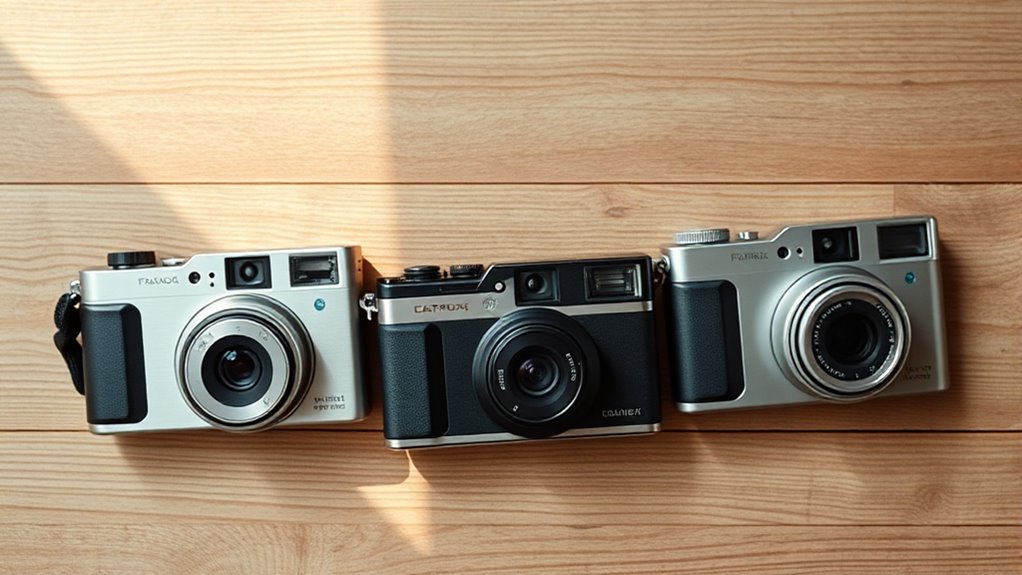
If you’re on the lookout for reliable old point-and-shoot digital cameras for 2027, you’ve got some great options to consider. These cameras blend classic convenience with solid performance, perfect for photo fans who appreciate simplicity but still want quality shots.
Whether you’re snapping everyday moments or exploring your creative side, these models deliver just what you need.
Take the KODAK PIXPRO FZ45, for example. It features a 16MP sensor and a 4x optical zoom. Plus, it runs on AA batteries, which is super handy when you’re out and about.
Then there’s the Nikon COOLPIX S3500, which ups the ante with a 20.1MP sensor and a versatile 7x wide-angle zoom. It also includes optical stabilization to help keep your photos sharp.
Don’t overlook the Canon PowerShot ELPH 130 IS. It packs a 16MP sensor, an 8x optical zoom, and even Wi-Fi sharing for quick uploads.
Each of these cameras balances image quality, zoom capabilities, and portability differently. Keep exploring to find the one that fits your photography style best!
| Image | Name | Editor's Rating | Price |
|---|---|---|---|

|
|
||

|
|
||

|
|
KODAK PIXPRO FZ45 16MP Compact Digital Camera, 4X Optical Zoom, AA, Black
- 16MP Sensor: Captures detailed photos with a CMOS sensor for everyday shooting
- Optical Zoom: 4x optical zoom with a 27mm wide angle lens for flexible framing indoors or outdoors
- Full HD Video: Records 1080p video for travel clips, family moments, or simple vlogging

Capture your adventures effortlessly with the KODAK PIXPRO FZ45, a compact camera designed for travel and everyday moments. Its lightweight body ensures it won’t weigh you down, while using standard AA batteries means you can power up anywhere without worrying about charging.
Equipped with a 16MP sensor and a versatile 4x optical zoom paired with a 27mm wide-angle lens, this camera lets you frame landscapes and close-ups with ease. The 2.7″ LCD screen features clear menus and tactile buttons, making navigation simple and intuitive even for beginners.
The camera supports 1080p Full HD video, allowing you to record sharp, memorable footage. It accepts SD cards up to 512GB, so you have plenty of space for photos and videos. While the digital image stabilization helps reduce blur, the modest f/3.0 aperture means low-light shots may need extra care.
Maintenance is straightforward since you don’t need to recharge batteries; just swap out AAs as needed. Its user-friendly design makes it ideal for casual photographers who want good image quality without complexity.
Best for: Novice photographers and travelers seeking a lightweight, easy-to-use compact camera with reliable AA battery power and versatile zoom.
What We Like:
- Lightweight and portable for hassle-free travel
- 16MP sensor with 4x optical zoom and wide-angle lens
- Simple controls with real buttons and clear menus
- Uses standard AA batteries—no charging required
- Supports large SD cards up to 512GB for ample storage
Specification:
| Feature | Details |
|---|---|
| Manufacturer | KODAK |
| Dimensions | Compact size (approx.) |
| Weight | Lightweight (unspecified) |
| Sensor | 16 Megapixels CMOS |
| Optical Zoom | 4x |
| Lens | 27mm wide-angle |
| Display | 2.7″ LCD |
| Video | 1080p Full HD |
| Storage Support | SD cards up to 512GB |
| Power Source | AA batteries |
| Color | Black |
Nikon COOLPIX S3500 20.1MP Digital Camera Purple
- 7x wide-angle NIKKOR glass lens
- 720p HD video recording
- Vibration Reduction helps keep shots steady
Discover the ease of capturing crisp, vibrant photos with the Nikon COOLPIX S3500. This compact digital camera is tailored for adults who want simplicity without sacrificing image quality. Its 20.1MP CCD sensor ensures your pictures come out detailed and clear every time.
The camera’s 7x wide-angle NIKKOR lens covers from 26mm to 182mm, letting you frame wide landscapes or zoom in on distant subjects smoothly. Optical Vibration Reduction helps keep your shots steady, reducing blur caused by hand movements. This makes it perfect for everyday moments.
Navigating through different shooting modes like Portrait or Night Landscape is straightforward, enabling you to adapt to various lighting and scenes. While the camera records videos in 720p HD, it excels at still photography rather than high-definition video capture.
Maintenance is simple with SD card storage and USB connectivity, making photo transfer hassle-free. Its lightweight purple body combines style with portability, ideal for casual outings or travel.
Best for: Adults and casual photographers who want an easy-to-use compact camera with reliable zoom and stabilization for everyday photos.
What We Like:
- Detailed 20.1MP sensor delivers sharp images.
- 7x optical zoom with vibration reduction for steadier shots.
- User-friendly shooting modes adapt to various conditions.
- Lightweight and stylish design for easy carrying.
Specification:
| Feature | Details |
|---|---|
| Manufacturer | Nikon |
| Sensor Resolution | 20.1 Megapixels |
| Lens | 7x Wide-Angle NIKKOR |
| Video Resolution | 720p HD |
| LCD Screen Size | 2.7 inches |
| Weight | Lightweight (exact weight not specified) |
| Color Options | Purple |
Canon PowerShot ELPH 130 IS Digital Camera Gray
- Built in Wi-Fi for wireless transfer of images to social networking sites
- 8X Optical Zoom with 28mm Wide-Angle lens
- 16.0 MP sensor and DIGIC 4 Image Processor and 720p HD video recording
Capture your everyday moments with ease using the Canon PowerShot ELPH 130 IS. Its compact design fits comfortably in your hand or pocket, making it effortless to carry on any outing. The built-in Wi‑Fi lets you share photos wirelessly, so you can instantly connect with friends and family without dealing with cables.
This camera’s 16MP CMOS sensor and DIGIC 4 processor work together to deliver clear, sharp images. Optical image stabilization helps reduce blur, especially in low light or while on the move. With an 8x optical zoom and 28mm wide-angle lens, you can frame everything from sweeping landscapes to close-up details without changing lenses.
User-friendly features like the fixed 3.0-inch LCD touchscreen simplify navigation and shooting, perfect for beginners or casual photographers. While video recording is limited to 720p HD, it covers basic needs for capturing short clips. The lightweight design and smart auto modes make it a reliable companion for everyday photography.
Maintenance is straightforward—just keep the lens clean and recharge the battery as needed to ensure consistent performance. Although the continuous shooting speed is slow, this camera excels in capturing still moments with ease.
Best for: Casual photographers looking for a portable, easy-to-use camera with wireless sharing and solid image quality for everyday snapshots.
What We Like:
- Compact and lightweight for easy portability
- Built-in Wi‑Fi for quick, wireless photo sharing
- 16MP sensor with optical image stabilization for clear photos
- Simple touchscreen interface enhances usability
- Versatile 8x optical zoom for varied shooting scenarios
Specification:
| Feature | Details |
|---|---|
| Manufacturer | Canon |
| Dimensions | Approx. 3.7 x 2.3 x 0.9 in |
| Weight | Approx. 133 g (4.7 oz) |
| Sensor | 16MP CMOS |
| Zoom | 8x Optical Zoom |
| Lens | 28mm Wide-Angle |
| LCD Screen | 3.0-inch Fixed Touchscreen |
| Video Resolution | 720p HD |
| Connectivity | Built-in Wi‑Fi |
| Color Options | Gray |
Factors to Consider When Choosing an Old Point and Shoot Digital Camera
When picking an old point-and-shoot camera, you’ll want to check the sensor resolution to make certain clear images. Don’t forget to take into account the optical zoom range and what type of image stabilization it offers.
Battery life and video recording quality are also key factors that affect your shooting experience. These details can make a big difference when you’re out capturing moments. So, it’s worth paying attention to them before making your choice.
Sensor Resolution Importance
Many factors affect how sensor resolution impacts your photos, especially with older point-and-shoot cameras. Higher megapixels let you make bigger prints or crop images more aggressively.
But on small 1/2.3″ sensors, going beyond 16–20 MP often leads to more noise and diffraction, which can hurt image quality. Smaller photosites mean less light per pixel, so lower-megapixel sensors can actually deliver cleaner shots at high ISO.
Sensor size matters just as much. A larger sensor with the same megapixels typically produces better detail, less noise, and wider dynamic range.
For most web use and standard prints like 4×6 or 8×10, 8–12 MP is enough. When choosing, also check sensor type—CCD or CMOS—as this affects noise, power consumption, and readout speed, which influences overall image quality.
Optical Zoom Range
Optical zoom lets you bring distant subjects closer without sacrificing image quality, making it a key feature to look for in old point-and-shoot cameras. It reflects the true focal length range of the lens, like 4x or 8x zoom, letting you magnify subjects without pixelation.
A wider-angle minimum focal length, around 27–28mm, suits landscapes and group shots, while a longer maximum, say 100–180mm, works best for portraits and distant objects. Keep in mind, higher zoom levels often mean bigger, heavier lenses and narrower apertures at telephoto ends, which can hurt low-light performance.
Always check both the 35mm-equivalent focal range and maximum aperture across that range to understand how versatile and practical the zoom will be for your shooting needs. It’s all about balancing zoom power with image quality and usability.
Image Stabilization Types
Zooming in on distant subjects is great, but without proper image stabilization, your shots can end up blurry. Optical image stabilization (OIS) physically moves lens or sensor elements to counteract shake, giving you sharp photos and smooth video without quality loss.
Sensor-shift stabilization moves the image sensor itself. It often outperforms OIS in low light and at long zooms.
Digital stabilization uses software to crop or shift the image. This reduces blur but sometimes lowers resolution or field of view.
Hybrid systems blend optical or sensor methods with digital tweaks. They improve video smoothness but might sacrifice some image detail.
When choosing a camera, consider the stabilization type and focal length. Also, check if it supports multi-axis correction to get the best steady shots in various shooting conditions.
Battery Life Options
You’ll often find that battery life plays a pivotal role in how long your old point-and-shoot camera can keep up during shoots. First, check whether the camera uses proprietary rechargeable batteries or replaceable AA/AAA cells.
Replaceable batteries let you swap quickly in the field, while proprietary ones typically last longer per charge. Compare the rated shot counts or run times to fit your shooting habits, as some models offer under 200 shots per charge and others over 400.
Also, consider how power-hungry features like large LCDs, image stabilization, and high video resolution can drain batteries faster. Take a look at your charging options—USB charging, external chargers, and spare battery availability.
And don’t forget, lithium-ion batteries perform better than alkalines in cold weather, keeping their capacity when temperatures drop. So, it’s worth thinking about that if you’re shooting outdoors in chilly conditions.
Video Recording Quality
When choosing an old point-and-shoot camera, you should always examine its video recording quality closely. Check the maximum resolution and frame rates—1080p at 60 fps offers smoother, sharper footage and more editing flexibility than 720p at 30 fps.
Also, verify the video codec and file format; modern codecs like H.264 compress files efficiently without sacrificing quality, unlike older Motion-JPEG formats.
Pay attention to audio capture quality, including built-in microphone performance and noise reduction, since poor audio can ruin your videos. It’s something people often overlook but trust me, it makes a big difference.
Look for optical or digital image stabilization to reduce shake during handheld shooting. Nobody wants shaky footage, right?
Finally, consider continuous recording limits and whether the camera supports high-capacity SD cards. Many older models restrict recording time to about 29 minutes due to file size or thermal constraints, so keep that in mind before you buy.
Lens Aperture Size
Although small sensors limit depth-of-field effects, choosing a point-and-shoot with a larger maximum aperture (a smaller f-number) can markedly improve low-light performance and allow faster shutter speeds.
You’ll want to look for cameras with apertures around f/2.8 or wider, as these let more light reach the sensor.
Keep in mind, many older models have variable apertures that narrow as you zoom—f/3.0 wide-angle might close to f/6.6 telephoto—so low-light ability drops at longer focal lengths.
Also, while wider apertures create shallower depth of field, the effect is subtle on compacts due to their small sensors and short focal lengths.
Avoid stopping down too far, since diffraction can reduce sharpness; aim for a moderate aperture to balance clarity and light intake.
Connectivity and Ports
Since transferring and sharing your photos is essential, pay close attention to the connectivity options and ports on old point-and-shoot cameras. Look for models with at least a USB 2.0 port for speedy image transfer and HDMI or analog AV/video-out connections if you want to play back directly on a TV.
Check if the camera supports wireless transfer via Wi-Fi or wireless SD cards for hassle-free sharing without cables. Also, verify the memory card type and maximum supported capacity to guarantee smooth recording.
Don’t forget to confirm the battery type and charging options, as some older cameras use removable batteries that you can’t charge via USB. Finally, make sure the camera’s ports and mounting options match your existing accessories and playback devices for seamless use.
Storage Compatibility Limits
Beyond connectivity, storage compatibility plays a key role in choosing an old point-and-shoot camera that meets your needs. First, check the maximum SD card capacity your camera supports—most older models handle up to 32 GB SDHC but not larger SDXC cards.
Confirm which card formats (SD, SDHC, SDXC) and speed classes (Class 4, 6, 10, or UHS) it accepts, especially if you want to shoot HD video or burst shots. Also, verify if your camera works with FAT32 or exFAT file systems; many older cameras can’t read exFAT used on bigger cards.
Keep in mind, very large cards may slow down write speeds and buffer clearing. Finally, if your camera uses both internal memory and removable cards, check how it manages storage overflow and defaults.
Frequently Asked Questions
Can Old Point and Shoot Cameras Connect to Modern Smartphones?
Old point and shoot cameras usually can’t connect directly to modern smartphones because they lack wireless features.
You’ll need a card reader or USB adapter to transfer images. Then, you can view or edit them on your phone easily.
Are Replacement Batteries for These Cameras Easy to Find?
You’ll usually find replacement batteries for old point and shoot cameras online or at specialty stores. They’re not always easy to track down, but with some searching, you can score compatible batteries.
It might take a bit of patience, but it’s definitely possible to keep your camera powered up. Just hang in there and keep looking!
Do Old Digital Cameras Support RAW Image Format?
Most old digital cameras don’t support RAW image format since it wasn’t common then.
You’ll find a few higher-end models might, but generally, you’ll be shooting JPEGs with limited editing flexibility afterward.
What File Formats Do These Cameras Use for Photos?
Like peeling layers off an onion, these cameras usually save photos in JPEG format, keeping files small and easy.
Some rare models support TIFF or RAW, but most stick to JPEG for quick sharing and simple editing.
Can These Cameras Record High-Definition Video?
Most old point and shoot digital cameras don’t record high-definition video. You’ll find basic VGA or 480p clips at best.
If you want HD video, you’ll need a newer model designed with that capability. It’s just how the technology has evolved over time.
Conclusion
Choosing one of these old point and shoot cameras is like finding a trusty compass on a nostalgic journey. Each model—Kodak’s reliable FZ45, Nikon’s vibrant S3500, or Canon’s sleek ELPH 130 IS—guides you back to simpler times, capturing memories with ease.
As you hold these cameras, you’re not just snapping photos; you’re preserving moments, like timeless treasures in a digital chest. They’re ready to inspire your 2027 adventures with classic charm.
If you’re a photo fan looking for the best old point and shoot digital cameras in 2027, these models offer a perfect blend of ease and nostalgia. Their simplicity lets you focus on the moment, while their vintage appeal adds a special touch to every shot. So, whether you’re exploring new places or revisiting old favorites, these cameras make every click count.