3 Best Gases for MIG Welding Stainless Steel in 2026
For MIG welding stainless steel in 2026, choosing the right gas mix is crucial for achieving optimal results.
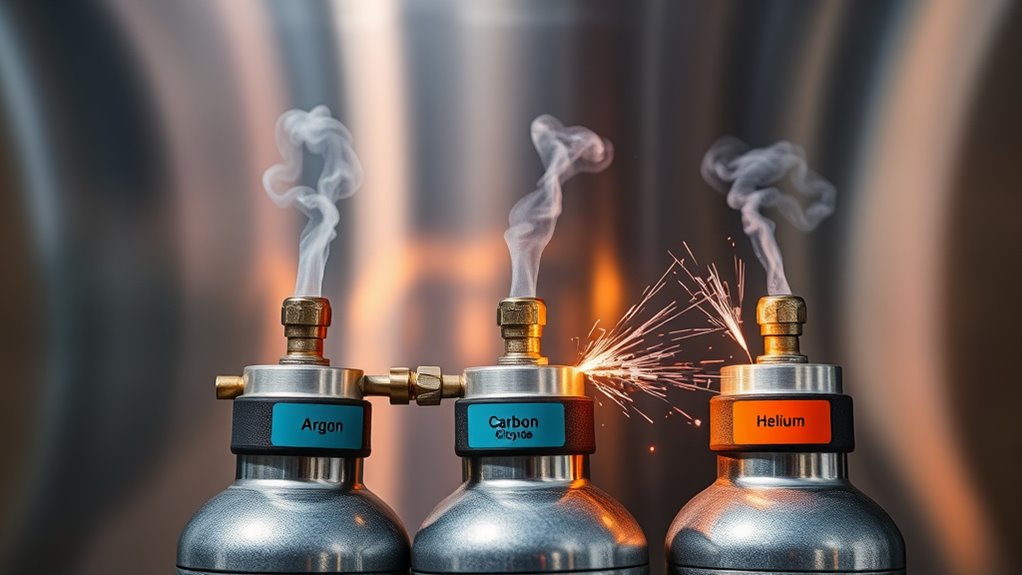
One of the best options is a 75% Argon and 25% CO2 gas blend, such as the PrimeWeld Welding Gas Cylinder. This combination provides a stable arc and minimizes spatter, making your welding process smoother.
Pairing this gas mix with the YESWELDER 160A MIG Welder adds versatility to your welding projects.
Also, using the Yeswelder Argon/CO2 Gas Regulator ensures accurate flow control, which is essential for producing cleaner and stronger welds.
Stick around to uncover more about ideal techniques and equipment that can elevate your stainless steel welding game!
| Image | Name | Editor's Rating | Price |
|---|---|---|---|

|
|
||

|
|
||

|
|
PrimeWeld 75% Argon 25% CO2 Welding Gas Cylinder
- Welding Gas to Your Door - Get PrimeWeld's industrial grade 75 %Argon 25% CO2 gas cylinder delivered right to your door....
- The Specs - Our 125CF Argon CO2 welding gas tank arrives full and ready to go. Unlike competitors, our cylinders come...
- Best Gas for MIG - Our blend of Argon CO2 is the perfect all-purpose MIG welding gas. It's a cost-effective option that...
Discover the power of precision welding with the PrimeWeld 75% Argon 25% CO2 Welding Gas Cylinder. This high-performance gas mix is designed specifically for MIG welding enthusiasts who demand reliability and quality when working with stainless steel and other metals.
Say goodbye to the hassle of rental fees and frequent supply runs. The PrimeWeld cylinder arrives fully charged, ready for immediate use, allowing you to focus on your projects without interruptions. Its optimal blend of gases creates a stable arc and enhances puddle control, resulting in cleaner welds with minimal spatter.
Maintaining the cylinder is straightforward, as it complies with DOT 3AA standards, assuring you of its safety and reliability. However, remember to handle and store it properly due to its high-pressure nature. This cylinder is perfect for those who want to maximize their welding capabilities while minimizing frustration.
Best for: MIG welding enthusiasts requiring a dependable gas mix for stainless steel and other metals.
What We Like:
- Arrives ready to use, eliminating rental fees.
- Optimal 75% Argon, 25% CO2 blend for superior arc stability.
- Fully certified for safety and compliance.
Specification:
| Specification | Details |
|---|---|
| Manufacturer | PrimeWeld |
| Dimensions | 24 x 6 inches |
| Weight | 35 lbs |
| Material | Steel |
| Color Options | Green (for gas identification) |
YESWELDER 160A MIG Welder (Dual Voltage)
- MULTIFUNCTIONAL: A 4-in-1 welder, capable of Flux Core MIG/Gas MIG/ Stick/Lift TIG (need to purchase extra tig lift...
- WELDING CAPACITY: With a robust 160A output, 110V/220V dual voltage, this welder is in possess of reliable quality and...
- SMART CONTROL: Smart control refers to Synergic control, when selecting different thicknesses or adjust the amperage,...
The YESWELDER 160A MIG Welder is the ideal solution for anyone looking to elevate their welding projects, whether you’re a beginner or a seasoned pro. With its dual voltage capabilities of 110V and 220V, you can easily switch between various welding modes, including Flux Core MIG, Gas MIG, Stick, and Lift TIG. This versatility ensures you can tackle any project with confidence.
Designed with portability in mind, this welder weighs only 19.4 lbs and features a convenient carrying handle. This makes it easy to transport to job sites or workshops. The smart control feature automatically adjusts voltage and wire speed, simplifying the welding process for novices while still allowing experienced users to make manual tweaks as needed.
Safety is also a top priority; the welder includes protections against voltage fluctuations and overheating, enabling you to work efficiently and securely. This combination of functionality and thoughtful design makes the YESWELDER a reliable partner for your welding endeavors.
Best for: Hobbyists and professionals seeking a versatile and portable solution for various welding tasks.
What We Like:
- Multifunctionality: Supports multiple welding modes for diverse applications.
- Smart Control Feature: Automatic adjustments enhance user experience.
- Lightweight Design: Easy to transport for on-the-go welding projects.
Specification:
| Feature | Details |
|---|---|
| Manufacturer | YESWELDER |
| Dimensions | 20 x 12 x 10 in |
| Weight | 19.4 lbs |
| Material | Steel |
| Color Options | Black/Red |
Yeswelder Argon/CO2 Gas Regulator with 8ft Hose
- Wide Application: Effortlessly connect to Argon, Helium, and Argon/CO2 mixed gas tanks with the CGA-580 inlet nut. No...
- Accurate Gas Flow Gauge: The Square flow tube reads from 0 - 60 CFH, which is indicated by a ball which moves up and...
- Multiple Outlet: Will fit both the female 9/16" x 18 nut or the male 5/8" x 18 fitting. It also comes with a standard...
Elevate your MIG welding experience with the Yeswelder Argon/CO2 Gas Regulator. Designed for those who demand precision and reliability, this regulator connects effortlessly to various gas tanks. Its compatibility with Argon, Helium, and mixed gas tanks makes it a versatile choice for any project.
This regulator features a square flow tube that accurately measures gas flow from 0 to 60 CFH. The pressure gauge, which reads up to 4000 PSI, ensures you have the information needed for optimal performance. With this level of accuracy, you can focus on your work without worrying about gas inconsistencies.
Proper maintenance is essential for long-term reliability. Ensure all connections are secure to prevent gas leaks during setup. The included accessories, such as an 8ft hose and quick connect fitting, allow you to position your tank safely away from your work area, enhancing both efficiency and safety.
Best for: Professionals and hobbyists engaged in MIG and TIG welding requiring a flexible and precise gas regulator.
What We Like:
- Compatible with various gas types for diverse applications.
- Accurate gas flow measurement for reliable performance.
- Essential accessories included for easy setup and safe usage.
Specification:
| Specification | Details |
|---|---|
| Manufacturer | Yeswelder |
| Dimensions | 10 x 6 x 4 inches |
| Weight | 2.5 lb |
| Material | Durable metal |
| Color Options | Silver |
Factors to Consider When Choosing Gas for MIG Welding Stainless Steel
When choosing gas for MIG welding stainless steel, you’ll want to contemplate several key factors.
The gas composition, including the argon to CO2 ratio, plays an essential role in your weld quality.
Additionally, think about the metal thickness, welding position, and the appearance you want for the final weld.
Gas Composition Importance
Choosing the right gas composition for MIG welding stainless steel is essential, as it directly impacts the quality and integrity of your welds.
The most common mixture is 98% Argon and 2% Carbon Dioxide, which promotes a stable arc and minimizes oxidation. A higher percentage of Argon enhances arc stability, producing cleaner welds with less spatter.
This is vital for maintaining the material’s integrity without distorting its properties. Your gas blend also influences heat input, penetration, and fusion of the weld.
Argon offers better control over the molten puddle compared to pure CO2. Finally, consider the specific stainless steel grade you’re working with, as different compositions can affect mechanical properties and corrosion resistance.
Argon vs. CO2 Ratio
How do you determine the right argon to CO2 ratio for MIG welding stainless steel?
You’ll want a higher percentage of argon, typically between 75% and 95%.
This blend enhances arc stability and minimizes spatter, giving you a cleaner weld.
A lower CO2 content is essential, as it reduces oxidation and discoloration, ensuring your stainless steel welds maintain their aesthetic appeal.
While a 75% argon and 25% CO2 mix works well for mild steel, stainless steel usually benefits from a higher argon ratio for improved bead appearance and penetration.
Adjusting the ratio based on the specific thickness and type of stainless steel you’re welding can notably affect the strength and quality of your weld, so keep that in mind.
Metal Thickness Considerations
Metal thickness plays an important role in selecting the right gas for MIG welding stainless steel.
For thinner materials (typically less than 1/8 inch), using a gas blend with a higher percentage of Argon helps improve arc stability and minimizes burn-through risks.
As the thickness increases beyond 1/8 inch, combining Argon with CO2 enhances penetration and puddle control, making it ideal for thicker sections.
Additionally, you’ll need to adjust the gas flow rate; thicker materials usually require higher flow rates to guarantee proper shielding from oxidation.
Conducting test welds on scrap pieces of the same thickness is vital.
This practice helps you identify the best gas composition and settings for achieving peak weld quality in your projects.
Welding Position and Technique
When welding stainless steel, the position and technique you use can greatly influence your choice of shielding gas.
For instance, if you’re working in vertical or overhead positions, opting for a gas mixture with a higher percentage of Argon can enhance arc stability and control.
This reduces spatter and improves penetration.
Your welding technique also matters; stringer beads may need different gas flow rates compared to wider weave patterns to achieve ideal shielding.
Additionally, the angle of your torch affects how effectively the gas covers the weld pool.
Adjusting gas flow to maintain proper coverage is essential to protect against oxidation.
Understanding these interactions is vital for producing high-quality welds on stainless steel.
Desired Weld Appearance
Choosing the right shielding gas is essential for achieving the desired weld appearance when MIG welding stainless steel.
A gas mixture with 75% argon and 25% CO2 is popular because it provides a smoother, cleaner finish while enhancing arc stability.
If you want a polished look, using pure argon can improve the color and brightness of your welds.
Pay attention to the flow rate; too low can cause oxidation and a dull finish, while too high may create turbulence and spatter.
Ensuring proper gas coverage is vital, as insufficient shielding can lead to contamination, resulting in discoloration and roughness.
Spatter Control Efficiency
Achieving a polished weld appearance is closely tied to spatter control efficiency in MIG welding stainless steel.
Using a gas mix of 75% Argon and 25% CO2 can greatly improve your spatter control. The Argon enhances arc stability, reducing erratic spatter that often occurs with pure CO2.
A lower spatter rate not only elevates the aesthetic quality of your welds but also cuts down on post-weld cleanup time and costs.
To optimize spatter control, adjust your gas flow settings to between 15-20 CFH. This ensures a consistent shielding effect without turbulence.
Cost and Availability
While you focus on perfecting your MIG welding technique for stainless steel, understanding the cost and availability of gases is vital.
The price of gas can vary considerably, especially for the common 90% Argon and 10% CO2 blend, which is typically pricier than standard options.
Availability also fluctuates based on local suppliers, so it’s important to research and secure a reliable source for your projects.
If you’re a frequent user, buying a full cylinder may be more economical than renting, as rental costs can add up.
Keep in mind that some regions have restrictions on cylinder refills or purchases, which could affect both cost and availability.
Always compare prices from different suppliers to get the best deal.
Flow Rate Adjustments
When it comes to MIG welding stainless steel, selecting the right flow rate for your shielding gas can greatly impact the quality of your welds.
Typically, you’ll want to set the flow rate between 20 to 30 CFH for ideal coverage.
If it’s too low, you risk oxidation and contamination; too high, and you’ll create turbulence that can draw in unwanted air.
Always monitor and adjust the flow based on material thickness, welding position, and environmental conditions like drafts.
Using a flow meter with a ball indicator can help you visually maintain the desired flow rate.
Regularly checking and calibrating your gas flow system is essential for consistent performance, especially since stainless steel is particularly sensitive to oxidation.
Frequently Asked Questions
Can I Use Pure Argon for MIG Welding Stainless Steel?
You can use pure argon for MIG welding stainless steel, but it’s not ideal.
While it provides a stable arc, mixing argon with CO2 or other gases often yields better penetration and overall weld quality.
What Is the Difference Between MIG and TIG Welding Gases?
MIG welding gases typically include a mix of argon and carbon dioxide, promoting faster welds.
On the other hand, TIG welding gases primarily use pure argon for a cleaner, more precise weld.
Each serves different applications effectively.
How Do Gas Mixtures Affect Weld Appearance?
Gas mixtures greatly affect weld appearance by influencing bead shape, penetration, and overall finish.
Using the right combination can enhance aesthetics, reduce spatter, and improve fusion.
This ensures your welds look professional and clean.
Is Gas Shielding Necessary for All MIG Welding Processes?
Yes, gas shielding’s necessary for most MIG welding processes.
It protects the molten weld pool from contamination, ensuring better penetration and a cleaner finish.
Without it, your welds might suffer from defects and poor quality.
Can I Refill Welding Gas Cylinders at Home?
Picture a vintage gas station, but no, you can’t refill welding gas cylinders at home.
It’s dangerous and illegal.
Always take your cylinders to a certified supplier for safe refilling and proper handling.
Conclusion
In the world of MIG welding stainless steel, the right gas can make all the difference.
By choosing a blend like PrimeWeld’s 75% Argon and 25% CO2, you’re not just welding; you’re crafting a masterpiece.
Isn’t it fascinating how such a simple choice can elevate your work?
So, as you gear up for your next project, remember that the right gas is your unsung hero.
It’s the element that transforms the ordinary into extraordinary with every weld.
In 2026, selecting the best gas for MIG welding stainless steel is crucial for achieving flawless results.
Whether you opt for a standard mix or a more specialized blend, the right choice will enhance your welding experience and the quality of your work.
So, don’t underestimate the importance of gas selection—it’s the key to unlocking your welding potential.