2 Best Graphics Cards for Blender in 2026: Power Your Renders
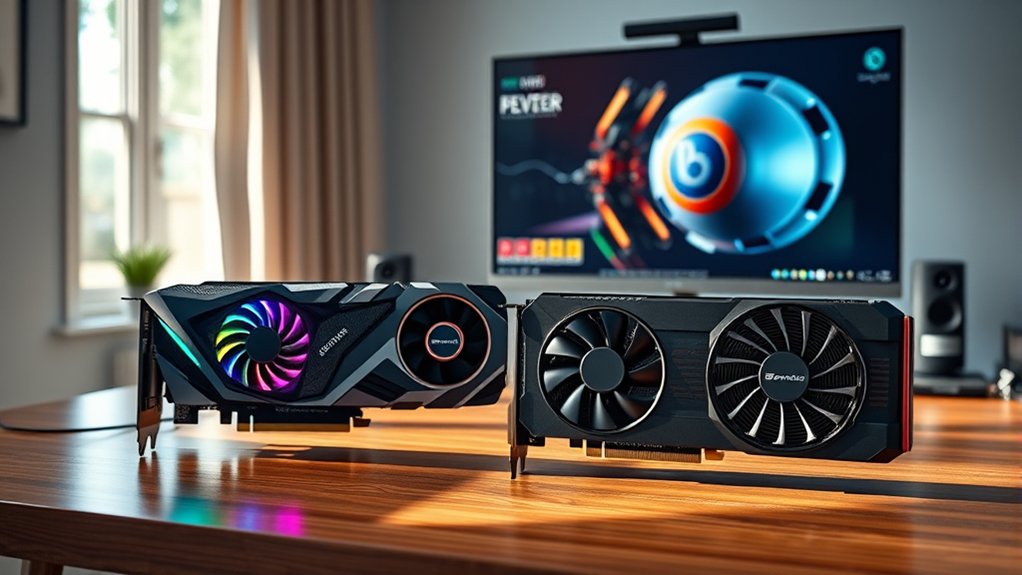
If you’re looking for smooth and powerful Blender performance in 2026, you should consider the RX 580 8GB and the RTX 2080 Super.
The RX 580 is a reliable choice for mid-range projects. It features 8GB of GDDR5 memory and efficient cooling, making it suitable for various tasks.
On the other hand, the RTX 2080 Super takes things up a notch. With faster GDDR6 memory, real-time ray tracing capabilities, and superior rendering speed, it excels in handling complex projects.
Both graphics cards support multi-display setups and maintain low heat levels, but their power requirements differ.
Understanding how these features align with your unique Blender workflow is essential. This way, you can future-proof your setup while ensuring optimal performance for your creative projects.
| Image | Name | Editor's Rating | Price |
|---|---|---|---|

|
|
||

|
|
RX 580 8GB Gaming Graphics Card with HDMI/DP
- Exceptional Gaming Performance:The RX 580 8GB is a powerful mid-range GPU built on a 14nm architecture, featuring...
- Multiple Display & High-Resolution Support:Enjoy a multi-monitor setup with the RX 580, which supports up to two...
- Advanced Cooling Technology: The RX 580 features the HyperRender cooling system with dual fans and a copper heat pipe to...
Experience the power of creativity with the RX 580 8GB Gaming Graphics Card. Designed for both gamers and Blender users, it delivers reliable mid-range performance that transforms rendering tasks into smooth experiences. With 2048 stream processors and 8GB of GDDR5 memory, this graphics card is your ticket to efficient workflows and stunning visuals.
Multitasking becomes effortless with its dual-display support, featuring HDMI and DisplayPort outputs that cater to your productivity needs. Whether you’re rendering complex scenes or gaming, the RX 580 ensures that you can switch between tasks seamlessly. Its HyperRender cooling system keeps temperatures low and noise to a minimum, allowing you to focus on your work without distractions.
Built on a robust 14nm architecture, this card strikes a balance between power and durability, making it an excellent choice for users on a budget. While it supports up to two displays, this may limit some multi-monitor setups. Nevertheless, its performance and efficiency make it a valuable addition to any creative toolkit.
Best for: Mid-range gamers and Blender users seeking an efficient, budget-friendly graphics card with strong performance and effective cooling.
What We Like:
- Exceptional rendering capabilities with 2048 stream processors.
- Dual-display support enhances multitasking efficiency.
- Advanced cooling system ensures quiet operation during heavy use.
Specification:
| Specification | Details |
|---|---|
| Manufacturer | AMD |
| Memory | 8GB GDDR5 |
| Stream Processors | 2048 |
| Architecture | 14nm |
| Interface | PCIe 3.0 |
| Cooling System | HyperRender |
| Outputs | HDMI, DisplayPort |
EVGA 08G-P4-3081-KR, GeForce RTX 2080 Super Black Gaming, 8GB GDDR6
- Real boost clock: 1815 MHz; Memory detail: 8192 MB GDDR6.
- Real-time ray tracing in games for cutting-edge, hyper-realistic graphics.
- Dual HDB fans offer higher performance cooling and much quieter acoustic noise.
Experience the power of the EVGA 08G-P4-3081-KR, GeForce RTX 2080 Super Black Gaming graphics card, designed for those who demand top-tier performance in their creative endeavors. With 8GB of GDDR6 memory, this card tackles even the most complex Blender projects, ensuring that your rendering times are minimized and your workflow is maximized.
The card’s impressive 1815 MHz real boost clock enhances responsiveness, making it a reliable choice for professionals in need of speed. It features real-time ray tracing technology, which elevates your 3D scenes with stunningly realistic lighting and shadows, allowing you to bring your visions to life like never before.
Maintenance is a breeze thanks to the card’s dual HDB fans, which efficiently manage heat while keeping noise levels to a minimum. This means you can focus on your work without distractions, even during long rendering sessions.
While the EVGA GeForce RTX 2080 Super does consume more power than older models, its exceptional performance justifies the energy requirements. This card is a perfect companion for users looking to push the boundaries of their creative projects.
Best for: 3D artists and Blender users seeking high-performance graphics for demanding rendering tasks.
What We Like:
- 8GB GDDR6 memory for seamless performance on intricate projects.
- Fast rendering capabilities with a boost clock of 1815 MHz.
- Efficient dual HDB fans that ensure quiet cooling during intense workloads.
Specification:
| Specification | Details |
|---|---|
| Manufacturer | EVGA |
| Dimensions | 10.5 x 4.4 x 1.5 inches |
| Weight | 4.5 lbs |
| Material | Aluminum & Plastic |
| Color Options | Black |
Factors to Consider When Choosing a Graphics Card for Blender
When choosing a graphics card for Blender, you need to focus on GPU architecture, VRAM capacity, and rendering speed to guarantee smooth performance.
Don’t forget to take into account cooling efficiency, as it affects the card’s longevity and stability.
Also, make certain the card is fully compatible with Blender’s software to avoid any hiccups.
GPU Architecture Importance
Since GPU architecture shapes how efficiently Blender handles rendering tasks, it plays a critical role in your graphics card choice.
A modern architecture with features like ray tracing and enhanced shader performance can boost both rendering speed and quality.
You’ll want to pay close attention to the number of stream processors, as they determine how well your GPU handles the parallel calculations Blender demands.
Memory type and bandwidth also matter—GDDR6 offers faster data handling over GDDR5, which is a big help with large textures and complex projects.
Don’t overlook thermal management, either; efficient cooling prevents overheating and throttling. This way, your renders stay smooth during long sessions.
Choosing a GPU with an advanced architecture means you’re investing in better performance and stability for your Blender workflows.
VRAM Capacity Needs
Selecting the right VRAM capacity is essential for Blender users aiming to handle diverse projects smoothly.
If you’re working on basic modeling and rendering, 4GB of VRAM will get you started. However, as your scenes grow in complexity—with high-resolution textures or detailed geometry—you’ll want at least 8GB to avoid memory bottlenecks.
For simulations or large models, consider graphics cards with 10GB or more to maintain performance during demanding workflows.
Blender’s real-time rendering engine, Eevee, also benefits from additional VRAM, improving preview quality and responsiveness.
To future-proof your setup, choose a card with ample VRAM that can handle upcoming software updates and increasingly complex projects. This way, you won’t need frequent upgrades as your Blender skills advance.
Rendering Speed Impact
Although VRAM capacity is essential, the rendering speed of your graphics card plays an equally important role in Blender’s performance.
You’ll want a GPU with a high number of stream processors—like 2048 or more—since they handle multiple tasks simultaneously, speeding up rendering.
A faster memory bandwidth, such as GDDR6 over GDDR5, boosts data transfer between the GPU and memory, making your renders more efficient.
Don’t overlook the GPU’s clock speed; a boost clock around 1815 MHz means your card performs more calculations per second, directly enhancing rendering times.
Additionally, if you use real-time ray tracing, verify your GPU supports it without sacrificing speed.
These factors combined will make your workflow smoother and your renders quicker in Blender.
Cooling Efficiency Role
When you push your graphics card hard during long Blender renders, efficient cooling is essential. It keeps temperatures in check and prevents performance drops caused by thermal throttling.
Choosing a GPU with advanced cooling features like dual fans and copper heat pipes helps dissipate heat effectively. This ensures stable performance throughout extended sessions.
Intelligent fan systems that adjust speed based on workload reduce noise and extend your card’s lifespan. This is especially helpful if you work in quiet environments.
Since Blender projects often demand sustained GPU usage, you need a graphics card that can handle high loads without overheating.
Enhanced cooling not only maintains consistent rendering quality but also boosts overall system reliability. This allows you to focus on your work without interruptions or unexpected slowdowns.
Compatibility With Software
Because Blender regularly updates with new features, you’ll want a graphics card that supports the latest version to guarantee smooth performance and access to all tools.
Check that your GPU has enough VRAM—8GB or more is ideal for complex scenes and large textures.
Also, consider the GPU architecture; newer models often optimize Blender’s rendering engines like Cycles and Eevee better.
Make sure your card supports CUDA or OpenCL, as these technologies accelerate rendering by tapping into the GPU’s parallel processing power.
Don’t overlook driver compatibility, since outdated or unsupported drivers can cause crashes or reduced performance.
Ensuring your graphics card aligns well with Blender’s evolving software requirements will keep your workflow efficient and your renders speedy.
Multi-Display Support
Multiple displays can transform your Blender workspace by letting you spread out your tools, views, and references across several screens.
Choosing a graphics card with strong multi-display support means you get multiple output ports, like HDMI and DisplayPort, to connect more monitors effortlessly.
This setup boosts your productivity by letting you keep your 3D viewport on one screen while managing reference images or render settings on another.
Also, verify the card supports high resolutions across all displays to maintain sharp textures and model details.
Some cards include advanced cooling systems that handle the extra heat from running multiple screens, preventing performance dips during long sessions.
With the right multi-display graphics card, you’ll create a more efficient and immersive Blender environment tailored to your workflow.
Power Consumption Considerations
Although high-performance graphics cards deliver impressive Blender rendering speeds, they often demand more power.
This can affect your system’s energy efficiency and cooling requirements.
When choosing a GPU, consider its thermal design power (TDP).
Lower TDP models help build quieter, more energy-efficient workstations.
Make certain your power supply unit (PSU) can handle the card’s wattage to avoid instability during intense rendering sessions.
Striking a balance between performance and power consumption is key.
Mid-range GPUs might offer adequate speed while using less electricity than top-tier options.
Also, effective cooling reduces fan workload, which indirectly lowers power use and keeps temperatures ideal.
Frequently Asked Questions
Can I Use Integrated Graphics for Blender Rendering?
You can use integrated graphics for Blender rendering, but it’ll be much slower and less efficient than a dedicated GPU.
For complex projects or faster renders, you’ll want a powerful graphics card to boost your workflow.
Having a good GPU can really make a difference in your rendering times and overall experience. So, if you’re serious about your projects, consider investing in a dedicated graphics card!
How Does VRAM Affect Blender Performance?
VRAM affects Blender performance by determining how large and complex your scenes can be before slowing down.
You’ll want enough VRAM to handle textures, models, and simulations smoothly.
This helps avoid crashes or lag during rendering.
Are AMD Cards Better for Blender Than NVIDIA?
You might think AMD outshines NVIDIA for Blender, but it depends.
NVIDIA’s CUDA cores still dominate many rendering tasks, while AMD excels in OpenCL.
Your choice hinges on specific Blender workloads and software updates.
What Drivers Are Best for Blender Compatibility?
You’ll want to use the latest stable drivers from NVIDIA or AMD, as they optimize Blender compatibility.
Keeping your GPU drivers updated helps avoid bugs and ensures smooth rendering performance with Cycles and Eevee engines.
Does Blender Support Multi-Gpu Setups?
Yes, Blender supports multi-GPU setups, letting you speed up rendering by using multiple graphics cards simultaneously.
You’ll need compatible drivers and proper configuration, but once set, your render times can drop considerably.
It’s definitely worth considering if you’re looking to enhance your workflow!
Conclusion
Choosing the right graphics card for Blender is like picking the perfect brush for a masterpiece—it shapes your creative flow.
Whether you opt for the RX 580’s reliable performance or the RTX 2080 Super’s impressive power, it’s crucial to consider several factors.
Balancing VRAM, cooling, and compatibility will ensure that your renders are fueled without a hitch.
Keep these elements in mind, and your projects will run as smoothly as a well-oiled machine.
This approach will help bring your visions vividly to life, enhancing both your workflow and creativity.
In conclusion, selecting the right graphics card is essential for optimal performance in Blender.
By weighing options like the RX 580 and the RTX 2080 Super, you can make an informed choice that suits your needs.
Prioritize VRAM, cooling, and compatibility to elevate your rendering experience and unleash your creative potential!