

How Can You Tell If a Chicken Egg Is Fertile?
You can tell if a chicken egg is fertile by candling it—shine a bright light through the egg in a dark room around day 7 to spot spider-like veins and a visible embryo. This method is a reliable way to identify fertile chicken eggs before they hatch.
If you crack the egg, look for a distinct white germinal disc with possible blood vessels, unlike infertile eggs that lack these signs. Handle eggs gently and candle at proper times for accuracy.
Keep exploring to understand more about spotting and managing fertile eggs. Proper care and observation can help ensure successful incubation.
What Does It Mean for a Chicken Egg to Be Fertile?

Although all chicken eggs look similar, only those laid by hens mated with a rooster are fertile, meaning they contain an embryo that can develop into a chick if incubated properly. When an egg is fertile, it has a tiny white spot called a germinal disc, which marks where the embryo begins forming.
You can spot this disc when you candle the egg or crack it open. Fertile eggs show developing veins around this disc, indicating the embryo is growing. On the other hand, infertile eggs lack this germinal disc and won’t develop into chicks.
Understanding fertility helps you know which eggs have the potential for life and which are simply for eating. So, when you check eggs, focus on the presence of an embryo and the germinal disc to tell if they’re fertile.
How Roosters Fertilize Hens and Create Fertile Eggs
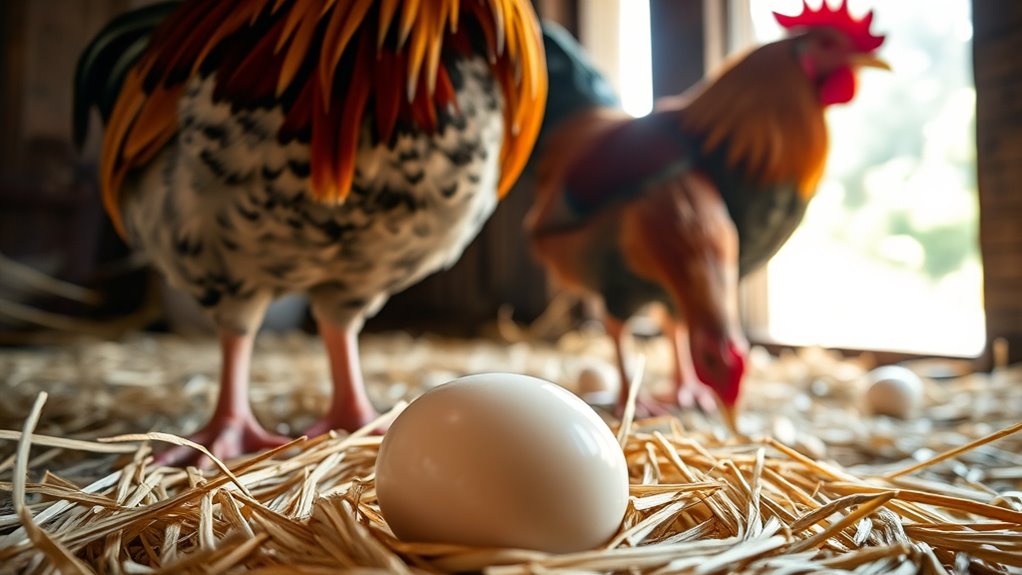
When a rooster mates with a hen, he transfers sperm through a quick cloacal contact known as a “cloaca kiss.”
You should know that hens can store this sperm inside their bodies for weeks, allowing fertilization to happen over time.
Fertilization occurs when the sperm meets the hen’s ovum during egg formation in the oviduct.
Rooster-Hen Mating Process
Before a hen lays a fertile egg, a rooster must fertilize her by mounting and making cloacal contact—often called a “cloacaic kiss”—to transfer sperm. This essential step is how Backyard Chicken owners ensure eggs are fertilized. When the rooster mounts the hen, he aligns his cloaca with hers to pass sperm efficiently.
Here’s what happens next: Sperm travels into the hen’s oviduct, where fertilization occurs. The hen’s oviduct produces eggs ready for fertilization. Fertilized eggs develop a germinal disc on the yolk, signaling embryo potential.
This process enables hens to lay fertile eggs over time after mating. Understanding this natural mating process helps you recognize how fertile eggs are created in your flock.
Sperm Storage In Hens
After a rooster fertilizes a hen through cloacal contact, his sperm don’t just disappear—they get stored inside the hen’s oviduct in special tubules. This sperm storage allows the hen to produce fertilized eggs over several weeks from just one mating.
As eggs develop and travel through her reproductive tract, stored sperm meet the ovum, enabling fertilization. Because of this, you might notice a hen laying fertilized eggs even if she hasn’t mated recently.
Understanding sperm storage helps you realize that a single encounter with a rooster can result in multiple fertilized eggs. This natural mechanism ensures efficient reproduction and explains why you don’t need frequent rooster visits to have fertilized eggs in your flock.
Fertilization Timing Explained
Although mating may seem brief, the rooster’s sperm quickly travel into the hen’s oviduct, where they can fertilize eggs over several weeks. When you observe egg formation, fertilization happens as the sperm meets the ovum before the eggshell forms. This process creates a fertile egg, capable of embryo development if properly incubated.
Here’s what you should know about fertilization timing:
- Roosters transfer sperm via cloacal contact during mating.
- Sperm can remain viable in the hen’s oviduct for weeks, fertilizing multiple eggs.
- Only eggs laid after mating are fertile; others remain unfertilized.
- Fertilization initiates embryo development when sperm meets the ovum.
Understanding this timing helps you identify when eggs are fertile and ready for incubation.
How to Identify Fertile Eggs by Cracking Them Open

When you crack open an egg, you’ll want to look closely at the yolk for a small white circle called the germinal disc. Fertile eggs show a distinct bullseye pattern on this disc, while nonfertile eggs have just a plain yolk without any markings.
This visual check quickly tells you if the egg has potential life inside, though it means the egg can’t be used afterward.
Visual Signs On Yolk
If you crack open a chicken egg, you can often spot a small white “bullseye” on the yolk that signals fertility. This white spot, known as the germinal disc, marks where the embryo would develop if fertilized.
Here’s how you can identify fertile eggs by examining the yolk:
- A distinct white spot (germinal disc) appears on fertile yolks.
- Unfertilized eggs lack this white spot, showing a uniform yellow yolk.
- Fertile yolks may have a slight shadow or ring surrounding the white spot.
- The size and clarity of the white spot help confirm fertility.
Germinal Disc Appearance
Because you crack open an egg to check its fertility, you’ll want to focus on the germinal disc—the small white spot on the yolk. In fertilized eggs, the germinal disc appears larger, circular, and slightly raised compared to non-fertile eggs. This disc holds both male and female cells, signaling the potential for embryo development.
When you see a distinct, enlarging germinal disc with a clear outline, it’s a strong indicator the egg is fertilized and capable of developing into a chick. On the other hand, non-fertile eggs show a tiny, solid white germinal disc that remains unchanged.
Fertile Vs. Nonfertile Eggs
Although cracking an egg destroys it, you can quickly tell if it’s fertile by examining the yolk. Fertile eggs display a distinct germinal disc, appearing as a small white circle with a bullseye pattern, while nonfertile eggs lack this feature. Here’s what to look for:
- A white germinal disc with a bullseye pattern confirms fertility.
- Fertile eggs may show tiny blood spots or streaks near the germinal disc.
- Nonfertile eggs have a uniform yellow yolk without white spots or patterns.
- Absence of the germinal disc indicates no embryo development.
How to Use Candling to Check Egg Fertility Without Breaking
When you candle an egg, you shine a bright light through it in a dark room to see inside without breaking the shell. This technique lets you check for fertile eggs by revealing their internal features. Around day 7 of incubation, gently rotate the egg while candling to spot a network of blood vessels and a dark embryo, clear signs of fertility.
Infertile eggs will appear mostly clear or show only the yolk. Be careful not to handle the eggs excessively during candling to avoid damage. Limit your candling sessions, and avoid candling after day 14, as too much light exposure can disrupt embryo development.
Using candling properly helps you identify fertile eggs without harming them.
Spotting Fertile vs. Infertile Eggs When Candling
If you want to accurately spot fertile eggs during candling, focus on identifying distinct features like dark veins and a developing embryo inside the shell. When the egg is fertilized, you’ll notice spider-like veins branching out clearly.
In contrast, infertile eggs look mostly clear or show just the yolk. To tell the difference, look for:
- Visible spider-like veins indicating early embryo growth
- A dark spot or embryo near the center of the egg
- Uniform, translucent yolk with no veins for infertile eggs
- Clear areas without blood vessels signifying no fertilization
Rotate the egg gently while candling to reveal these features. This method helps confirm if the egg is fertilized without cracking it open, giving you a reliable way to monitor embryo development.
When and How Often to Candle Eggs for Best Results
To get the most accurate read on your eggs’ fertility, you should candle them around day 7 of incubation. At this stage, the developing embryo is visible, making it easier to distinguish fertile eggs from infertile ones. Perform candling in a dark room using a bright light held against the egg’s large end for the clearest view.
Limit yourself to candling no more than twice during incubation to avoid disturbing the embryo. Avoid candling after day 14 unless absolutely necessary, as the embryo becomes more fragile. Before each candling session, consistently turn your eggs to prevent the yolk from sticking to the shell, which ensures a more accurate observation of internal development. This careful timing and technique will give you the best results when monitoring fertile eggs.
Common Mistakes When Testing Fertile Eggs
Although testing fertile eggs might seem straightforward, many people make mistakes that can harm the embryo or lead to inaccurate results. Avoid these common mistakes when candling your eggs to ensure better accuracy and embryo safety:
- Cracking eggs open too early instead of candling first, which risks damaging the embryo.
- Candling too often or at improper times, causing confusion about development stages.
- Handling eggs roughly during candling, which can rupture the yolk or harm the embryo.
- Using poor lighting or not candling in a dark environment, making it hard to see veins or embryo presence clearly.
Why Some Fertile Eggs Don’t Hatch and What to Do
Even when you start with fertile eggs, not all of them will hatch successfully. Various factors like improper temperature, humidity, or handling can disrupt embryonic development. Cracks, contamination, or early embryo death also lower hatching success.
Genetic issues or poor hen health may cause abnormalities or failure.
| Cause | Impact on Fertile Eggs |
|---|---|
| Temperature Fluctuations | Embryo death |
| Contamination | Infection risk |
| Genetic Problems | Abnormal development |
| Handling Errors | Cracks or damage |
To improve hatching success, monitor incubation conditions closely and handle eggs gently. Remember, even fertile eggs need the right care to develop properly and hatch healthy chicks.
Essential Tips for Incubating Fertile Chicken Eggs Successfully
When you start incubating fertile chicken eggs, maintaining the right temperature and humidity is essential for embryo development. Proper care increases your chances of hatching healthy chicks. Before incubation, store eggs for about a week at 53-59°F, turning them daily by 45° to keep the yolk from sticking.
During incubation, use candling around day 7 to check for dark spider-like veins and a visible embryo, signs of fertility. Keep these tips in mind: handle eggs gently during candling to avoid damage. Limit candling to two checks max to reduce risk.
Discard eggs without veining or embryo signs. Maintain stable temperature and humidity throughout incubation. Following these steps ensures you incubate only fertile eggs successfully.
Frequently Asked Questions
How to Tell if a Chicken Egg Is Fertilized Without Cracking It?
You can’t be sure an egg’s fertilized without cracking it. Candling might help spot signs, but it’s not reliable.
Only by opening it can you directly see the germinal disc or embryo for confirmation.
How to Tell if an Egg Is Fertile With a Flashlight?
Just shine a flashlight through the egg’s large end in a dark room after a week—if you see spiderweb-like veins or a blood ring, it’s fertile.
If it’s clear, well, it’s just playing hard to get.
How to Identify if an Egg Is Fertilized?
You can identify a fertilized egg by checking for a larger, circular germinal disc on the yolk or blood vessels if incubated.
Candling it with a flashlight also reveals embryo development inside the shell.
What Are the Signs of a Fertile Egg?
Like a tiny sunburst, you’ll spot a larger, defined germinal disc on the yolk. When candled, fertile eggs show dark veins and a developing embryo.
Cracking reveals a bullseye pattern, signaling potential life inside.
Conclusion
Knowing how to tell if a chicken egg is fertile gives you a real edge if you’re hatching chicks. Did you know that about 85% of eggs laid by hens with access to a rooster are fertile? By using candling and understanding what to look for, you can confidently spot fertile eggs without cracking them open.
Remember, patience and careful observation are key to a successful hatch. Keep practicing and enjoy the process! With these tips, identifying a fertile egg becomes easier, helping you achieve a higher hatch rate and healthier chicks.