11 Best Camera Modules for Arduino Projects in 2027
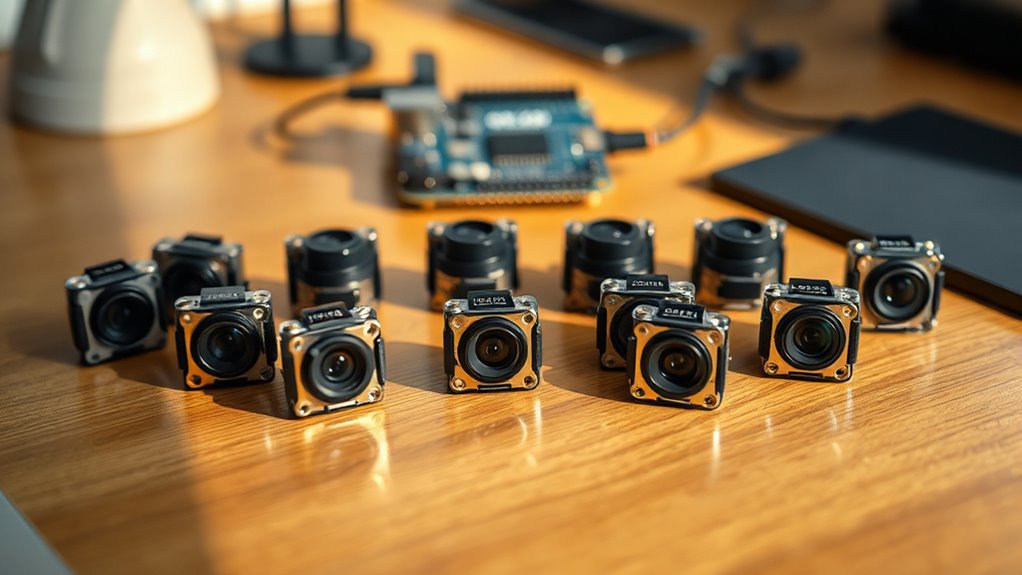
You’ll find the top Arduino camera modules cover everything from budget-friendly VGA options like the HiLetgo OV7670 up to versatile 2 MP Arducam Minis with interchangeable lenses. These modules are perfect for a wide range of Arduino projects, whether you’re just starting out or are a seasoned maker.
For wireless projects, ESP32-CAM boards offer built-in Wi-Fi, Bluetooth, and TF storage, making them super convenient for IoT applications. Need higher resolution? Check out the 5 MP Arducam Mega or ESP32-CAM with the OV5640 sensor.
Each option suits different skill levels and budgets, so you can find exactly what fits your project needs. Keep exploring, and you’ll discover which camera module is the perfect match for your next Arduino build!
| Image | Name | Editor's Rating | Price |
|---|---|---|---|
|
|
||

|
|
||

|
|
||
|
|
||

|
|
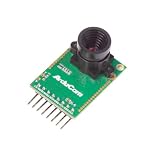
Arducam Mini Camera Module with OV2640 Lens
- Compatible with Arduino, Raspberry Pi Pico, MCU, Raspberry Pi, ARM, DSP, FPGA platforms
- 2 megapixels image sensor OV2640, build-in 650nm IR block filter, visible light only
- M12 mount or CS mount lens holder with changeable lens options
Add precise imaging capabilities to your microcontroller projects with the Arducam Mini Camera Module featuring the OV2640 lens. This compact module provides clear, high-resolution images through its 2-megapixel sensor with an integrated IR block filter. It solves the challenge of capturing detailed visible-light photos where image clarity is crucial.
Designed for versatility, it supports JPEG compression and multiple capture modes such as burst and low power. These features help manage storage efficiently and extend operational duration in battery-powered projects. The module’s small size and multiple interfaces make it easy to integrate into various setups.
Maintenance is straightforward. The lens can be swapped thanks to its M12 or CS mount, allowing manual focus adjustments to suit diverse environments. This flexibility is ideal for IoT devices or robotics where different focal lengths or focus precision might be required.
While it does not include built-in flash, its design optimizes performance in well-lit conditions. Users should be prepared to fine-tune the manual lens for best results. Overall, this module enhances imaging functionality with a balance of quality and adaptability.
Best for: Developers and hobbyists seeking a compact, adaptable camera solution for Arduino and other microcontroller projects.
What We Like:
- Clear 2MP sensor with IR filter for sharp visible-light images
- Multiple capture modes with JPEG compression for efficient image handling
- Interchangeable lenses for tailored focus and versatility
- Compact design compatible with Arduino, Raspberry Pi, and more
Specification:
| Feature | Description |
|---|---|
| Manufacturer | Arducam |
| Sensor | OV2640, 2 megapixels |
| Lens Mount | M12 / CS mount interchangeable |
| Interfaces | I2C, SPI |
| Dimensions | Approximately 38 x 38 mm |
| Weight | About 10 grams |
HiLetgo OV7670 VGA Camera Module 2pcs for Arduino
- Resolution 640x480 VGA
- IO voltage 2.5V to 3.0V (internal LDO power supply to the core 1.8V)
- Power operation 60mW/15fps VGAYUV
Capture clear, basic images for your Arduino projects with the HiLetgo OV7670 VGA Camera Module. This compact camera module brings VGA resolution to your DIY builds, delivering 640×480 images at up to 30 frames per second. Its low power usage of about 60 mW helps keep your project efficient.
Designed for easy integration, the camera connects via SCCB, similar to I2C, and works with Arduino, ARM, and FPGA boards. Automatic controls for exposure, gain, and white balance simplify image tuning, so you get consistent results without manual adjustments.
Maintenance is straightforward: operate the module at 3.3 V to ensure stable performance and avoid potential damage. While it requires pull-up resistors on some microcontrollers for SCCB communication, this setup is manageable for experienced hobbyists.
This module suits projects that need basic imaging capabilities without high resolution. It’s ideal for learning and prototyping but may fall short where detailed image quality is essential.
Best for: Hobbyists and developers looking for an affordable, compact VGA camera module to add simple image capture to Arduino and microcontroller projects.
What We Like:
- VGA (640×480) resolution at 30 fps with low power consumption
- Built-in auto controls for exposure, gain, and white balance
- Compatible with Arduino, ARM, FPGA, and similar boards
- Compact size fits easily into tight DIY setups
Specification:
| Feature | Details |
|---|---|
| Manufacturer | HiLetgo |
| Resolution | VGA (640×480) |
| Frame Rate | Up to 30 fps |
| Power Supply | 3.3 V |
| Power Consumption | Approximately 60 mW |
| Interface | SCCB (I2C-like) |
| Compatibility | Arduino, ARM, FPGA |
| Quantity | 2 Modules |
4-Pack OV7670 VGA CMOS Camera Module, I2C, 640×480
- 640x480 VGA Resolution – 1/6" CMOS sensor with 300k-pixel array for real-time imaging and embedded vision...
- Low-Power Operation – 60mW at 15fps (VGA/YUV) with 2.5-3.0V I/O voltage and integrated 1.8V LDO core...
- Auto-Image Optimization – AE (exposure), AGC (gain), AWB (balance), anti-bloom, and black-level calibration for...
Enhance your microcontroller projects with the 4-Pack OV7670 VGA CMOS Camera Module. These compact cameras deliver clear 640×480 VGA resolution, making real-time imaging both accessible and efficient. The modules address common challenges in embedded vision by offering reliable image capture with minimal power use.
Each camera features a 1/6″ CMOS sensor equipped to handle auto exposure, gain, white balance, and anti-bloom, ensuring consistent image quality in varying lighting conditions. Control over color settings is streamlined through the I²C/SCCB interface, allowing easy integration with Arduino, ARM, or FPGA platforms.
The low power consumption of just 60 mW at 15 fps makes these modules ideal for battery-powered and low-energy applications. Their compact design supports diverse embedded vision tasks without bulky hardware. Maintenance is straightforward, requiring only careful handling of the sensor and connections to sustain performance.
While the resolution suits many applications, it may not fulfill needs for high-definition imaging. Users should be comfortable with I²C/SCCB protocols to maximize functionality, as no additional software libraries are provided.
Best for: Developers and hobbyists seeking affordable, low-power VGA camera modules for real-time imaging in embedded systems.
What We Like:
- Supports multiple output formats (RGB, YUV) for versatile image processing.
- Advanced auto-adjust features improve image quality in changing environments.
- Low power draw fits well in portable or energy-sensitive projects.
- Compatible with a wide range of microcontroller platforms.
- Compact and lightweight design simplifies integration.
Specification:
| Specification | Details |
|---|---|
| Manufacturer | OV7670 |
| Resolution | 640 x 480 pixels |
| Sensor Size | 1/6 inch CMOS |
| Power Consumption | 60 mW @ 15 frames per second |
| Interface | I²C/SCCB |
| Output Formats | RGB, YUV |
| Compatible Platforms | Arduino, ARM, FPGA |
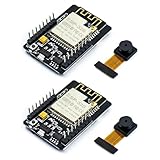
Hosyond ESP32-CAM WiFi Bluetooth Development Board (2Pcs)
- ESP32CAM is based on ESP32 chip and OV camera module, use low-power dual-core 32-bit CPU, which can be used as an...
- The main frequency is up to 240MHz, and the computing power is up to 600 DMIPS.
- Built-in 520 KB SRAM , external 8MB PSRAM ,support UART/SPI/I2C/PWM/ADC/DAC and other interfaces;Support picture...
Unlock the potential of your Arduino projects with the Hosyond ESP32-CAM WiFi Bluetooth Development Board (2Pcs). This compact module brings together wireless connectivity and camera functionality, making it easier to build smart devices with visual capabilities. Whether you want to monitor your home or create interactive IoT applications, this board simplifies the process.
Each board features an OV camera module supporting multiple camera types such as OV2640. The built-in Wi-Fi and Bluetooth allow seamless connection to networks in various modes like STA, AP, or both. This flexibility ensures your project stays connected whether you’re streaming video or sending sensor data.
Designed for efficiency, the board offers 9 I/O ports and supports TF cards up to 4 GB for local data storage. Its compatibility with Arduino and low power modes help maintain longer battery life, although power use increases when the flash is at maximum brightness. Regular maintenance involves handling the TF card with care and ensuring firmware updates to keep performance stable.
The Hosyond ESP32-CAM is ideal for developers who want an affordable, versatile solution to add camera support and wireless communication in their smart home or IoT projects.
Best for: Makers and developers seeking a dual-core Wi-Fi and Bluetooth development board with integrated camera support for Arduino-based IoT and monitoring applications.
What We Like:
- Dual ESP32-CAM modules with versatile OV camera support.
- Flexible Wi-Fi and Bluetooth connectivity modes for various network setups.
- Arduino compatibility with low power modes ideal for wireless projects.
- Compact design with multiple I/O ports for diverse use cases.
Specification:
| Feature | Details |
|---|---|
| Manufacturer | Hosyond |
| Dimensions | Approx. 40 x 27 mm |
| Weight | ~10 g per board |
| Camera Module | OV2640 and other supported types |
| Connectivity | Wi-Fi 802.11 b/g/n, Bluetooth 4.2 |
| Storage Support | TF card up to 4 GB |
| I/O Ports | 9 GPIO pins |
| Power Consumption | Up to 310 mA @ 5 V (max flash brightness) |
Arducam Mega 5MP Autofocus SPI Camera Module
- Easy Using: This Arduino camera shield is extremely easy to use. High-level commands were built in so you manipulate the...
- Programmable Autofocus: This Arduino uno camera is equipped with an Autofocus Lens which can achieve autofocus at...
- Multiplexing: This SPI camera module can support up to 4 cameras running on a single MCU by using an adapter board. They...
Experience precise and sharp imaging with the Arducam Mega 5MP Autofocus SPI Camera Module. Designed for makers and developers, this camera module enhances Arduino and microcontroller projects by offering fine control over image capture. Its autofocus lens ensures clear and detailed photos, improving your project’s visual output.
Connecting the camera is straightforward via the SPI interface, compatible with Arduino UNO, Mega2560, Raspberry Pi, and more. You can even run up to four cameras simultaneously, making it ideal for complex or multi-angle imaging needs. The open-source SDK under an MIT license simplifies programming and customization.
Maintenance is minimal, but note this module does not include image stabilization or built-in flash, so steady handling and adequate lighting are necessary for optimal results. It is also not water resistant, which limits its use in outdoor or harsh environments.
This camera module solves the problem of capturing high-resolution images with precise focus control, making it invaluable for projects requiring sharp, programmable imaging.
Best for: Makers and developers seeking a high-resolution, flexible autofocus camera module for Arduino and other microcontroller projects.
What We Like:
- Sharp 5MP resolution with autofocus for detailed images
- Compatible with multiple microcontrollers via SPI interface
- Supports up to four cameras simultaneously
- Open-source SDK under MIT license for easy programming
Specification:
| Feature | Details |
|---|---|
| Manufacturer | Arducam |
| Resolution | 5MP (2592 x 1458) |
| Interface | SPI |
| Compatibility | Arduino UNO, Mega2560, Raspberry Pi, others |
| Lens | Autofocus |
| SDK License | Open-source, MIT |
| Image Stabilization | No |
| Flash | No |
| Water Resistance | No |
Seeed Studio XIAO ESP32C3 Tiny Wi-Fi MCU Board

- Powerful MCU Board: Incorporate the ESP32-S3 32-bit, dual-core, Xtensa processor chip operating up to 240 MHz, mounted...
- Advanced Functionality: Detachable OV3660 camera sensor for 2048*1536 resolution, compatible with OV5640 camera sensor...
- Great Memory for more Possibilities: Offer 8MB PSRAM and 8MB FLASH, supporting SD card slot for external 32GB FAT memory
The Seeed Studio XIAO ESP32C3 is a compact yet powerful MCU board designed to enhance your Arduino camera and IoT projects. Its small size fits perfectly in tight spaces, allowing you to build sleek, space-efficient devices without sacrificing performance. This board’s 32-bit RISC-V processor and fast clock speed help you manage camera data smoothly, improving responsiveness and reliability.
With built-in Wi-Fi and Bluetooth 5.0, it supports stable, long-range wireless connections, ideal for remote monitoring or data transfer. Its ultra-low-power modes extend battery life, making it suitable for portable or energy-conscious applications. Maintenance is straightforward thanks to widely supported Arduino compatibility, enabling easy programming and quick iterations.
The board offers multiple digital and analog I/O pins to connect various sensors and cameras. This flexibility supports diverse projects, from IoT devices to TinyML applications. While its RAM and single-core processor may limit very large or multitasking applications, it remains a solid choice for most embedded systems needing reliable wireless communication.
Best for: developers and hobbyists seeking a compact, energy-efficient Wi-Fi and Bluetooth MCU for Arduino camera integrations and lightweight IoT projects.
What We Like:
- Tiny form factor ideal for compact designs
- Reliable long-range Wi-Fi and Bluetooth 5.0 connectivity
- Low power consumption with multiple sleep modes
- Arduino compatibility simplifies development and maintenance
Specification:
| Specification | Details |
|---|---|
| Manufacturer | Seeed Studio |
| Dimensions | Approx. 0.7 x 0.4 in (1.8 x 1.0 cm) |
| Processor | 32-bit RISC-V, 160 MHz |
| RAM | 0.4 MB |
| Flash Memory | 4 MB |
| Wireless Connectivity | Wi-Fi, Bluetooth 5.0 |
| I/O Pins | 11 digital, 4 analog |
Arduino Nicla Vision AI Board with 5MP Camera

- Integrated Vision & AI Capabilities: The Arduino Nicla Vision [ABX00051] is a powerful, compact board designed for...
- Edge AI for Low-Latency Inference: With its built-in Arm Cortex-M7 processor, the Nicla Vision performs edge AI tasks...
- Compact and Flexible Design: The Nicla Vision features a small form factor, making it easy to integrate into tight...
The Arduino Nicla Vision AI Board brings advanced vision capabilities into a compact design. Equipped with a sharp 5MP camera, it enables real-time object detection, facial recognition, and motion tracking. This board helps developers build smarter devices that can see and understand their surroundings without relying on cloud processing.
Its small size and built-in Wi-Fi and Bluetooth 5.1 make it easy to integrate into IoT gadgets, robotics, and other smart applications. The board’s Ambarella CV22 AI processor and Arm Cortex-M7 MCU running Linux deliver energy-efficient AI performance at the edge. This combination reduces latency and improves responsiveness for time-sensitive tasks.
Maintenance is straightforward thanks to its compatibility with the Arduino IDE and multiple development platforms. However, users should note its limited 16 MB onboard memory and single-core MCU, which may restrict very large or complex AI models. Despite this, it remains a versatile tool for efficient, localized AI processing.
Best for: developers and engineers focusing on compact, vision-based AI projects for IoT and robotics.
What We Like:
- Advanced AI vision tasks powered by 5MP camera and Ambarella CV22 processor
- Compact design with integrated Wi-Fi and Bluetooth 5.1 for flexible IoT integration
- Compatible with Arduino IDE for easy development and deployment
- Efficient edge processing reduces latency in smart applications
Specification:
| Feature | Description |
|---|---|
| Manufacturer | Arduino |
| Camera | 5 Megapixels |
| Processor | Ambarella CV22 AI |
| MCU | Arm Cortex-M7 (single-core) |
| Connectivity | Wi-Fi, Bluetooth 5.1, I2C |
| Storage | 16 MB onboard |
| Operating System | Linux |
| Dimensions | Compact form factor |
AiTrip 5 Pack ESP32-CAM WiFi Bluetooth Boards

- ESP32-CAM can be widely used in various IoT applications. It is suitable for home smart devices, industrial wireless...
- ESP32-CAM is a WIFI+ bluetooth dual-mode development board that uses PCB on-board antennas and cores based on ESP...
- Esp32cam Built-in 520 KB SRAM , external 8MB PSRAM ,support UART/SPI/I2C/PWM/ADC/DAC and other interfaces;Support...
Unlock the potential of your embedded projects with the AiTrip 5 Pack ESP32-CAM WiFi Bluetooth Boards. These compact modules integrate Wi-Fi, Bluetooth, and a 2MP OV2640 camera, offering seamless wireless connectivity and imaging in one device. This combination simplifies development, enabling you to capture images and stream video without extra hardware.
Powered by the robust ESP32 dual-core processor running at 240 MHz, the boards handle multitasking efficiently. They support multiple interfaces like UART, SPI, and I2C, giving you flexibility to connect various sensors and peripherals. The inclusion of TF card support allows easy local storage of images and data, making it ideal for monitoring applications.
Designed for IoT and smart home solutions, these boards run FreeRTOS and feature multiple sleep modes. This helps conserve power in battery-operated setups, ensuring longer device uptime. The onboard PCB antenna provides convenient wireless access, though it may have a shorter range compared to external antennas.
Maintenance is straightforward as the boards are compatible with popular platforms like Arduino and Raspberry Pi. This ensures access to extensive libraries and community support, easing troubleshooting and upgrades. However, note that the memory is 520 KB, not MB, to avoid confusion.
Best for: Developers and hobbyists creating wireless IoT, smart home, or camera-based projects needing integrated Wi-Fi and Bluetooth.
What We Like:
- Five ESP32-CAM modules with built-in 2MP OV2640 cameras
- Dual-core ESP32 processor with versatile interface options
- Support for FreeRTOS and multiple energy-saving sleep modes
- TF card slot for local data storage and retrieval
- Compatible with Arduino and Raspberry Pi platforms
Specification:
| Feature | Details |
|---|---|
| Manufacturer | AiTrip |
| Processor | ESP32 dual-core, 240 MHz |
| Camera Module | OV2640, 2 Megapixels |
| Memory | 520 KB SRAM |
| Connectivity | Wi-Fi 802.11 b/g/n, Bluetooth |
| Interfaces | UART, SPI, I2C |
| Storage Support | TF card slot |
| Dimensions | Approx. 40mm x 27mm |
| Antenna | Onboard PCB antenna |
ESP32-CAM Board with OV5640 5MP Camera
No products found.
Experience high-quality imaging in a compact form with the ESP32-CAM Board featuring the OV5640 5MP Camera. This module is designed to enhance your projects by providing crisp 5MP photos and smooth 1080p video streaming at 30fps. Its powerful dual-core ESP32 processor handles multitasking efficiently, making it ideal for smart-home and machine learning applications.
The board includes 4 MB flash and 8 MB PSRAM, supporting advanced image processing while maintaining a small footprint. A microSD slot accommodates cards up to 32 GB, allowing easy storage and retrieval of media. Its compatibility with the Arduino IDE simplifies coding and integration, enabling quick deployment in various projects.
Maintenance is straightforward thanks to its robust build and included heatsink, which helps manage temperature during extensive use. However, the fixed-focus lens requires attention to optimal distance for sharp imaging, which may limit close-up shots. The comprehensive kit, including a 16 GB microSD card and jumper wires, ensures you can start developing immediately.
Best for: developers and makers seeking a versatile, compact camera module with strong imaging capabilities for Arduino-based smart-home and machine learning projects.
What We Like:
- Crisp 5MP image capture with 1080p video at 30fps
- Dual-core ESP32 processor with sufficient memory for complex tasks
- MicroSD slot supporting up to 32 GB for ample storage
- Easy integration with Arduino IDE for rapid project development
- Includes essential accessories like a 16 GB card and heatsink
Specification:
| Feature | Details |
|---|---|
| Manufacturer | ESP32 |
| Camera Sensor | OV5640 5MP |
| Processor | Dual-core ESP32 |
| Flash Memory | 4 MB |
| PSRAM | 8 MB |
| MicroSD Support | Up to 32 GB |
| Video Resolution | Up to 1080p at 30fps |
| Included Kit | 16 GB microSD, jumper wires, heatsink |
| Dimensions | Approx. 40 x 27 mm |
Arducam 5MP Mini Camera Module for Arduino

- Arducam Mini Module Camera Shield 5MP Plus OV5642 Camera Module is a general purpose high definition 5MP SPI camera...
- It integrates 5MP CMOS image sensor OV5642, and provides miniature size, as well as the easy to use hardware interface...
- The Arducam Mini is compatible with Arduino, Raspberry Pi, Raspberry Pi Pico,ESP8266, Maple, Chipkit, Beaglebone black...
Experience high-definition imaging in a compact form with the Arducam 5MP Mini Camera Module. Designed to integrate seamlessly with Arduino and similar microcontroller boards, this module enhances your projects by delivering clear, detailed visuals. Its 5MP OV5642 sensor captures quality images, making it ideal for embedded applications where space and performance matter.
The camera supports SPI and I2C interfaces, ensuring compatibility with popular boards like Arduino UNO, Mega2560, and Raspberry Pi. This versatility allows you to easily connect and control the module in various environments, from robotics to IoT devices. Built-in JPEG compression and burst read features reduce data load, optimizing performance and power consumption.
Maintenance is straightforward due to its open-source libraries and clear documentation. These resources simplify development and troubleshooting, so you can focus on your project rather than technical hurdles. The module’s small shield form factor fits standard Arduino setups without requiring additional adapters.
While it offers advanced features and flexibility, the 5MP resolution may not satisfy demands for ultra-high-definition imaging. Also, the package includes only the camera module; you’ll need to provide your own compatible microcontroller board.
Best for: Developers and hobbyists seeking a compact, high-quality camera module for Arduino and similar embedded imaging projects.
What We Like:
- Compatible with Arduino UNO, Mega2560, and Raspberry Pi via SPI and I2C
- Supports JPEG compression and burst read for efficient data handling
- Small form factor fits standard Arduino shields easily
- Open-source libraries facilitate quick integration and development
Specification:
| Specification | Details |
|---|---|
| Manufacturer | Arducam |
| Sensor | 5MP OV5642 |
| Interfaces | SPI, I2C |
| Compatible Boards | Arduino UNO, Mega2560, Raspberry Pi |
| Dimensions | Small shield form factor (approx. Arduino shield size) |
| Weight | Lightweight (module only) |
ESP32-S3-CAM Dev Board with OV3660 Camera

- 【High-performance dual-core processor】Integrated Xtensa 32-bit LX7 dual-core processor, offering powerful computing...
- 【3-megapixel OV3660 Camera】: The OV3660 camera module that comes with this ESP32-S3 development board, to capture...
- 【Wi-Fi and Bluetooth Dual Mode Support】for ESP32-S3 supports Wi-Fi 802.11 b/g/n and Bluetooth 5.0. Its Bluetooth Low...
The ESP32-S3-CAM Dev Board with OV3660 Camera offers a powerful solution for creators focusing on IoT and AI applications. Its integrated 3MP camera delivers real-time image capture, enabling smart surveillance and face recognition with ease. This board tackles common challenges in embedded vision projects by combining processing power and wireless connectivity in a compact design.
Equipped with a dual-core 32-bit LX7 processor and ample memory, it handles complex tasks smoothly. Wireless communication is supported through Wi-Fi 802.11 b/g/n and Bluetooth 5.0, with an external antenna interface to extend range when needed. This flexibility suits projects requiring reliable, long-distance connections.
Maintenance is straightforward but requires attention when setting up the external antenna, as this involves manual adjustments. The dual USB-C ports simplify device connections, though only one USB port is active at a time. This design balances convenience with technical limitations.
Overall, the board’s combination of processing speed, camera functionality, and wireless options makes it a versatile choice for advanced Arduino developers aiming to build intelligent imaging systems.
Best for: Developers and makers seeking a compact, high-performance IoT and AI development board with built-in camera capabilities for tasks like smart surveillance and facial recognition.
What We Like:
- Robust dual-core 32-bit LX7 processor with 8MB PSRAM and 16MB flash memory.
- Built-in 3MP OV3660 camera enabling real-time image streaming.
- Wi-Fi 802.11 b/g/n and Bluetooth 5.0 with optional external antenna for extended wireless range.
- Dual USB-C ports for convenient connectivity, despite single active USB interface.
Specification:
| Feature | Details |
|---|---|
| Manufacturer | ESPRESSIF |
| Processor | Dual-core 32-bit LX7 |
| Camera Module | 3MP OV3660 |
| PSRAM | 8MB |
| Flash Memory | 16MB |
| Wireless | Wi-Fi 802.11 b/g/n, BT 5.0 |
| USB Ports | Dual USB-C (one active) |
| Antenna | External interface (manual setup required) |
Factors to Consider When Choosing a Camera Module for Arduino
When choosing a camera module for your Arduino, you’ll want to focus on resolution and image quality to get the visuals you need. Make sure the module’s interface matches your board’s compatibility. Also, consider power consumption for efficient operation.
Don’t forget to check lens options and supported image formats. This way, you can be sure the module fits your project’s requirements perfectly. It’s all about finding the right match!
Resolution and Image Quality
Although higher resolution camera modules offer more detail, you’ll need to balance this with your Arduino’s memory and processing limits to guarantee smooth performance. Opt for a resolution that fits your project’s needs—2 to 5 MP cameras provide sharp images but consume more memory and processing time.
Pay attention to sensor pixel size and dynamic range; larger pixels and better dynamic range enhance low-light shots and preserve details in challenging lighting. If your microcontroller struggles with bandwidth, choose modules with on-board JPEG compression to reduce data size.
Decide between RAW and JPEG output based on your processing: RAW keeps more image data for computer vision, while JPEG eases storage and transfer. Don’t forget optics—select lenses with suitable focal length and aperture for your desired framing and light conditions.
Interface Compatibility
Since Arduino boards vary widely in their available interfaces, you’ll need to verify which communication protocols and pin configurations your microcontroller supports before selecting a camera module.
Many modules use either a high-speed 8-bit parallel bus or an SPI/I2C combo for control and image transfer. So, check if your board supports SPI, I2C/SCCB, or parallel D0–D7 interfaces. Also, confirm that it has enough pins for signals like PCLK, VSYNC, and HREF if required.
And don’t forget about voltage and logic-level compatibility—most camera IO runs at 3.3 V, while some Arduinos use 5 V. That means level shifting might be necessary.
Finally, take a look at the available drivers and libraries for your chosen interface. This will help you avoid complex firmware development and ensure smooth communication between your Arduino and the camera module.
Power Consumption
Power demands play a big role in selecting the right camera module for your Arduino project. You need to check both active and sleep-mode power specs since modules can draw from tens of milliwatts idle to hundreds during capture or transmission.
Consider how sensor modes affect power—JPEG compression or single-shot capture typically use less energy than continuous raw streaming. Also, factor in extra power from onboard processors, Wi-Fi or Bluetooth radios, and memory like PSRAM or SD cards.
Voltage levels matter too; modules running at 3.3 V from a 5 V supply waste energy through regulators, so calculate current at the module voltage including conversion efficiency. For battery-powered designs, rely on sleep modes with short wake cycles and estimate energy per capture in millijoules to predict realistic runtime under intermittent use.
Lens and Focus Options
When selecting a camera module for your Arduino project, you’ll want to pay close attention to lens and focus options to guarantee peak image quality. Start by choosing the right lens mount type, like M12 or CS, ensuring it fits your sensor and mechanical setup for easy upgrades.
Consider the focal length carefully: shorter lengths (~2–3 mm) give wide-angle views, while longer ones boost magnification but reduce the field of view. Decide if you need fixed-focus lenses for set distances or adjustable/manual or motorized autofocus for varying ranges.
Don’t forget aperture size—larger apertures (smaller f-numbers) help in low light but narrow depth of field. Finally, match the lens’s optical resolution to your sensor’s pixel pitch to avoid image sharpness limits. It’s all about getting the balance right for your specific project needs.
Supported Image Formats
Beyond lens and focus choices, the image format your camera module supports plays a big role in how you handle and process photos. If storage and transmission efficiency matter, choose modules with JPEG compression support—they shrink file sizes markedly, easing flash and bandwidth demands.
You can often adjust compression quality and resolution via I2C registers to balance image clarity and data size. However, if you plan real-time vision or machine learning on your Arduino, raw formats like RGB or YUV are better—they provide uncompressed or minimally processed pixel data that avoids decompression delays and preserves detail for algorithms.
Just remember, raw formats demand more MCU memory and faster interfaces due to high data rates. YUV formats offer a middle ground by reducing color bandwidth while keeping enough detail for many vision tasks.
Size and Form Factor
Although camera performance matters, the physical size and form factor often determine whether a module fits your Arduino setup. You need to check the camera’s dimensions, mounting pattern, and connector placement to guarantee it fits your enclosure or shield stack alongside other components.
Pay attention to the lens type and protrusion since fixed lenses or replaceable mounts like M12/CS can affect overall depth and clearance. Also, verify the interface pinout and connector type to match your Arduino or adapter’s physical connectors.
Don’t forget accessory spaces such as antennas or microSD slots if your module includes wireless or storage features. And if you’re using multiple cameras or multiplexers, confirm stacking and spacing to avoid mechanical interference with connectors and cabling.
This way, you’ll ensure smooth integration into your project without any unexpected fitting issues.
Software and Library Support
Choosing the right camera module means ensuring it comes with solid software and library support tailored for your Arduino platform. You’ll want an open-source or well-maintained library that lets you control capture settings like exposure and white balance, plus retrieve images in JPEG or raw formats.
Make sure the library supports your interface—whether SPI, I2C/SCCB, or parallel—and includes example code for initialization, frame capture, and memory or SD-card streaming. Check that drivers handle the sensor’s image formats and provide decoding tools if your MCU can’t process them natively.
Active community support, regular updates, and clear documentation help you debug and integrate firmware smoothly. Finally, confirm the library’s performance fits your project’s frame rate, memory, and CPU load needs for real-time streaming or image processing.
Price and Availability
When selecting a camera module for your Arduino project, you’ll want to balance price and availability carefully. Entry-level modules range from under $5 for basic VGA sensors to $5–$40 for higher-resolution JPEG or 2–5MP options.
Set your budget based on the resolution and features you need. Availability can vary, so check multiple suppliers for stock and lead times to avoid delays caused by seasonal demand or shortages.
Don’t forget to factor in extra costs for adapters, connectors, and cables, which can add 10–50% to the price. Prioritize modules with open-source libraries and active community support to reduce development time.
If you’re working on production or prototyping, choose parts with consistent part numbers and reliable distributor stock. This helps secure a steady supply and keep costs predictable.
Frequently Asked Questions
How Do I Connect a Camera Module to Arduino IDE?
You connect a camera module to Arduino IDE by wiring the module to your Arduino board and installing the necessary libraries.
Next, make sure to select the correct board and port in the IDE. Then, you can upload example code to test the connection.
It’s pretty straightforward once everything is set up correctly! Just take it step by step.
Can These Camera Modules Work With Raspberry Pi?
Yes, you can use many Arduino camera modules with Raspberry Pi, but compatibility varies. You’ll need appropriate drivers and interfaces.
Check the module’s specs to guarantee it supports Raspberry Pi’s hardware and software requirements before connecting. It’s always a good idea to do a bit of research first!
What Is the Power Consumption of These Camera Modules?
The power consumption varies like a dimmer switch on a lamp; you’ll find most camera modules draw between 100 to 500 milliamps, depending on resolution and features.
Are These Camera Modules Compatible With Arduino Uno?
Yes, these camera modules are compatible with Arduino Uno. You’ll need to connect them properly using the available pins.
You might also require additional libraries or shields to handle communication and power. This will help ensure smooth integration for your project.
How Do I Troubleshoot Camera Module Connection Issues?
You should first check all wiring connections and ensure your camera module’s power supply is stable. Don’t forget to verify correct pin assignments in your code.
If issues persist, try restarting your Arduino and updating the libraries. Sometimes, a simple reset or fresh update can fix unexpected glitches.
Conclusion
Choosing the right camera module can make or break your Arduino project. Imagine building a home security system using the ESP32-CAM Board with the OV5640 5MP Camera—you’ll get clear, high-res images with built-in WiFi for easy monitoring.
Whether you need high resolution, easy integration, or wireless capabilities, there’s a module here for you. Pick the one that fits your project’s needs, and you’ll bring your ideas to life faster and better.
When selecting from the best camera modules for Arduino projects, consider factors like image quality, compatibility, and connectivity options. Modules like the ESP32-CAM offer a great balance of performance and convenience, especially with their wireless features.
In 2027, these camera modules are designed to enhance your Arduino setups, making them smarter and more efficient. So, take your time, choose wisely, and watch your Arduino projects reach new heights with the perfect camera module.