5 Best Camera Settings for Sunrise Photography in 2027
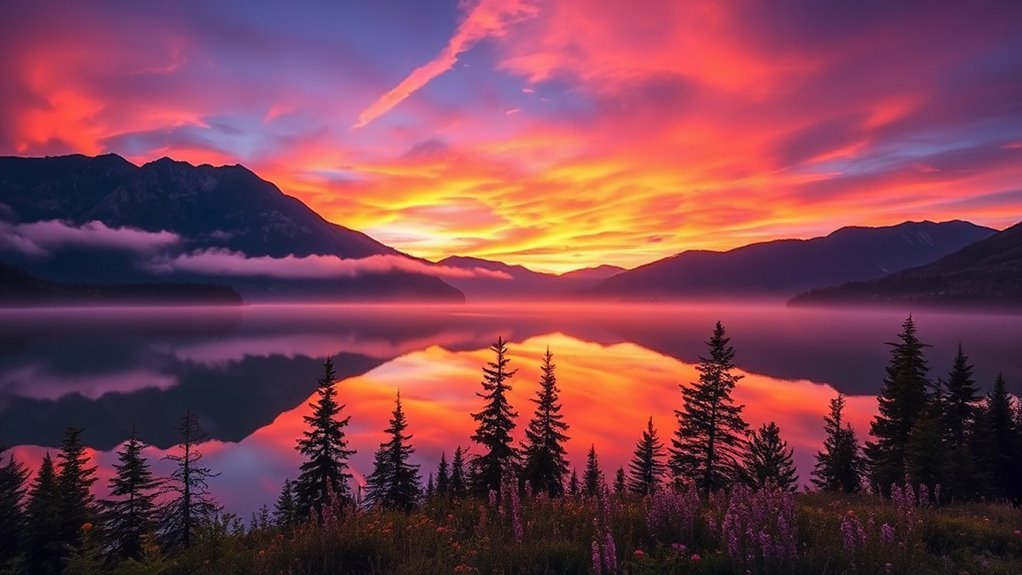
For stunning 2027 sunrise shots, set your aperture between f/8 and f/16 to get sharp landscapes and sunstars. Use a shutter speed from 1/2 to 1/60 seconds depending on light and movement, pairing it with the lowest ISO (100–400) for minimal noise.
Choose Daylight or Cloudy white balance for warm tones, and focus about one-third into the scene or on a key subject with single-point AF. Keep your tripod handy for steadiness.
Explore further to reveal detailed tips and gear advice. Sunrise photography is all about capturing that perfect light and mood, so these camera settings will help you get there easily and beautifully.
| Image | Name | Editor's Rating | Price |
|---|---|---|---|

|
|
||
|
|
||
|
|
||

|
|
||

|
|
Photography Cheat Sheet for DSLR Camera Beginners
- Comprehensive Guide for Nikon, Canon, and Sony DSLRs:This 30-page photography guide is specifically designed for DSLR...
- Easy-to-Use Reference for Every Shooting Situation:Covering exposure, shooting modes, composition, and lighting, this...
- Compact and Portable Design – Ideal for On-the-Go Use:Measuring just 4×3 inches, this durable cheat sheet fits...
Capture stunning sunrises with ease using the OCQOTAT Photography Cheat Sheet, designed specifically for DSLR beginners. This compact tool helps you master essential camera settings quickly, so you can focus on the perfect shot without struggling with complicated controls. Its clear, color-coded cards make learning exposure and manual adjustments straightforward.
The cheat sheet’s durable design fits comfortably in your pocket or clips to your camera bag, making it an ideal companion for outdoor photography sessions. Its 16 double-sided cards cover vital topics like shooting modes, composition, and lighting, helping you solve common challenges photographers face when shooting in changing light conditions.
Maintenance is simple—just keep the cards dry and clean, as their sturdy finish resists everyday wear. The guide is tailored for Canon, Nikon, and Sony DSLR cameras, ensuring compatibility and relevance. While it’s best suited for beginners and intermediate users, it streamlines the learning curve and builds confidence behind the lens.
Best for: DSLR photography beginners and enthusiasts using Canon, Nikon, or Sony who want a portable, easy-to-understand reference for capturing beautiful sunrise photos.
What We Like:
- Compact and durable with a metal carabiner for quick access
- Clear, color-coded cards simplify complex camera settings
- Covers essential topics including exposure, modes, and lighting
- Portable design fits easily in pockets or attaches to bags
Specification:
| Feature | Details |
|---|---|
| Manufacturer | OCQOTAT |
| Dimensions | 4 × 3 inches (10.2 × 7.6 cm) |
| Weight | Lightweight |
| Material | Sturdy laminated cards |
| Color Options | Color-coded cards |
Photography Cheat Sheet Book for Beginner – 4×3 inch Pocket Size for Travel
- Quick reference cards for Sony Canon Nikon Leica Fuji Ricoh digital SLR camera settings: This 30-page photography guide...
- An easy-to-use photography books:covering exposure, aperture settings, shooting modes, histogram interpretation...
- PORTABLE TRAVEL DESIGN: Featuring a 4x3 inch pocket size with a sturdy metal clip and camera lanyard, these photographer...
Discover the Photography Cheat Sheet Book for Beginners, a compact 4×3 inch guide designed to simplify your DSLR experience. This pocket-sized tool helps you quickly master exposure, aperture, and shooting modes, making challenging sunrise shots easier to capture. Its clear, color-coded tables bring essential settings into focus, reducing guesswork during early morning shoots.
Designed for travel, this cheat sheet slips easily into your hand or camera bag. The sturdy metal clip and lanyard ensure it stays within reach, so you can adjust your camera settings on the fly without fumbling through manuals. It’s a practical solution for photographers who want quick, reliable guidance while exploring outdoors.
Maintenance is simple—its durable construction withstands frequent use, and the compact format means you won’t be weighed down. While it targets beginners and covers foundational concepts, this 30-page guide may not meet the needs of advanced users seeking in-depth techniques.
Compatible with major DSLR brands like Sony, Canon, Nikon, Leica, Fuji, and Ricoh, it offers versatile support across popular cameras. This cheat sheet helps you focus more on creativity and less on technical confusion.
Best for: Beginner photographers seeking an easy-to-carry, quick-reference guide to improve DSLR photography skills during travel and outdoor sessions.
What We Like:
- Compact size with metal clip and lanyard for easy portability
- Clear, color-coded tables simplify complex settings
- Durable design suited for on-the-go use
- Broad compatibility with major DSLR brands
Specification:
| Feature | Details |
|---|---|
| Manufacturer | Not specified |
| Dimensions | 4 x 3 inches |
| Pages | 30 |
| Material | Sturdy paper with metal clip |
| Color Options | Full color tables |
DSLR/Mirrorless Photography Cheat Sheet Credit Card Size
- 📷 QUICK PHOTOGRAPHY REFERENCE CARDS - Printed on PVC plastic making them waterproof and durable.
- 📷 EASY TO UNDERSTAND – Quick, easy reference for aperture, shutter speed, ISO, white balance, ND filters, and flash...
- 📷 BEGINNING, INTERMEDIATE & ADVANCED PHOTOGRAPHERS – these cheat sheets are appropriate for all levels of...
Carrying a DSLR or mirrorless photography cheat sheet the size of a credit card ensures you always have quick access to vital camera settings. This handy, waterproof PVC card fits easily in your wallet or camera bag, making it ideal for shoots at sunrise or any time you need fast reference. It helps you adjust aperture, shutter speed, and ISO without fumbling through menus or notes.
Designed for photographers who want to shoot confidently in manual mode, this cheat sheet simplifies exposure and white balance decisions. Its compact design means you won’t be weighed down, yet it covers essential topics like the exposure triangle, ND filter calculations, and flash settings. The durable material stands up to outdoor conditions, so you can rely on it during all your photo sessions.
Maintenance is effortless—just wipe it clean if it gets dirty or wet. Unlike digital apps, this physical card requires no batteries or updates, offering immediate, distraction-free guidance wherever you go. While limited space means it can’t replace in-depth tutorials, it’s perfect for quick reminders that improve your shooting efficiency.
Best for: Photographers of all levels who want a durable, portable, and easy-to-use quick reference for essential camera settings on the move.
What We Like:
- Waterproof, durable PVC withstands outdoor use
- Compact credit card size fits wallets and bags
- Covers aperture, shutter speed, ISO, and more
- Helps simplify manual mode and exposure decisions
- No batteries or software needed for instant access
Specification:
| Feature | Details |
|---|---|
| Manufacturer | Not specified |
| Dimensions | Credit card size (approx. 3.4 x 2.1 inches / 8.6 x 5.4 cm) |
| Weight | Lightweight |
| Material | Waterproof, durable PVC |
| Color Options | Not specified |
CameraCues Photography Cheat Sheet Cards Quick Reference Photography Cards
- Credit card size – Compact and convenient for travel
- Durable and waterproof – Made from high-quality PVC that stands up to the elements
- Essential settings at your fingertips – Fast, easy to read, and color-coded for quick navigation
Capture the perfect sunrise moments with ease using CameraCues Photography Cheat Sheet Cards. These compact, credit card-sized guides provide quick access to essential camera settings so you don’t waste time fumbling through menus. Designed for photographers who shoot outdoors, they help you focus more on framing and less on adjusting your gear.
Crafted from durable, waterproof PVC, these cards stand up to weather and wear. Their color-coded layout simplifies finding the right settings for any digital camera, including Canon, Nikon, Sony, DSLR, and mirrorless models. Slip them into your wallet or camera bag for convenient access wherever your shoot takes you.
Maintaining these cards is simple—they wipe clean easily and resist damage from moisture, ensuring long-lasting usability. While they don’t replace detailed manuals, they serve as a reliable quick reference for common settings during demanding shoots.
CameraCues cards streamline your workflow and reduce distractions, letting you capture stunning sunrise images with confidence and speed.
Best for: Photographers needing a durable, easy-to-use quick reference for camera settings during outdoor sunrise shoots.
What We Like:
- Waterproof, sturdy PVC construction for outdoor durability
- Color-coded, easy-to-read format speeds up camera adjustments
- Compatible with all major digital camera brands and types
- Compact size fits easily in wallets or camera bags
Specification:
| Feature | Details |
|---|---|
| Manufacturer | CameraCues |
| Dimensions | Approx. 3.4 x 2.1 inches (credit card size) |
| Weight | Lightweight, under 1 oz |
| Material | High-quality, waterproof PVC |
| Color Options | Color-coded for clarity |
Photography Cheat Sheet Cards Set (2 Decks)
- This is a bundle of the DSLR Camera Photography deck and the Photography Tips: Composition & Lighting deck
- POCKET-SIZED QUICK REFERENCE CARDS - These 3x4 inch cheat sheets include two 11 card decks of beginning photography...
- DURABLE PLASTIC - Professionally printed on glossy plastic to withstand years of use! They’re rip-proof, weather-proof...
Capture perfect sunrise shots with ease using the Photography Cheat Sheet Cards Set. These pocket-sized cards provide quick, reliable tips that help you master DSLR and mirrorless camera settings on the go. Say goodbye to fumbling through manuals in low light or challenging conditions.
Designed for outdoor use, the cards are printed on glossy, weather-proof plastic that resists wear from moisture and rough handling. This durability ensures your essential photography guidance stays intact during early morning shoots or unpredictable weather. The included carabiners make it simple to attach the decks to your camera bag or strap for instant access.
Inside, you’ll find clear, concise advice covering exposure, aperture, shutter speed, ISO, and creative techniques like freezing motion or capturing silhouettes. These tips are tailored to popular brands such as Canon, Nikon, and Sony, helping you quickly adjust settings to capture stunning images.
This set offers a practical solution for photographers who want to improve their skills without overwhelming technical jargon. Maintaining the cards is effortless—simply wipe clean after use to keep them looking fresh.
Best for: beginner and hobbyist photographers seeking quick, durable, and easy-to-understand photography tips during outdoor shoots.
What We Like:
- Weather-proof cards ideal for outdoor conditions
- Clear guidance on DSLR and mirrorless camera settings
- Compact design with carabiners for easy attachment
- Concise tips on creative composition and lighting
- Compatible with major camera brands
Specification:
| Manufacturer | Not specified |
|---|---|
| Dimensions | Pocket-sized decks |
| Weight | Lightweight |
| Material | Glossy, weather-proof plastic |
| Color Options | Not specified |
Factors to Consider When Choosing Camera Settings for Sunrise Photography
When you’re setting up for sunrise photography, you’ll need to balance light intensity with your aperture to control depth of field. Adjusting shutter speed and ISO helps capture the scene without noise or blur.
Don’t forget to set your white balance to keep colors natural as the light changes. It really makes a difference in how your photos turn out. Just take your time and tweak these settings as the sun rises.
Light Intensity Levels
Although sunrise light intensity changes quickly, you can capture stunning images by regularly metering and adjusting your exposure every 1 to 3 minutes. During the blue hour, light can brighten by 2–4 EV within 10–15 minutes, so keep a close eye on your meter.
Early low light demands higher ISO (800–3200) or wider apertures (f/1.8–f/4) to maintain sharpness without motion blur. Once direct sunlight appears, dynamic range can exceed 12–14 stops. So, use graduated ND filters or expose for highlights, recovering shadows in RAW.
Light varies across your frame, so combine spot or matrix metering with exposure bracketing (±1–2 EV) for HDR. Since color temperature shifts rapidly, shoot RAW and adjust white balance later instead of relying on auto settings.
Aperture Selection Tips
Adjusting aperture plays a key role in shaping your sunrise photos beyond just exposure. For wide landscapes, stop down to f/8–f/16 to maximize sharpness from foreground to horizon and tap into your lens’s sweet spot.
If you want dramatic sunstars, choose a small aperture like f/16–f/22, but watch out for diffraction softening details. To isolate a subject with creamy bokeh in low light, open up to f/2.8–f/5.6 and balance ISO or shutter speed accordingly, preferably using a tripod.
When shooting handheld at dawn, pick the widest aperture your lens offers while keeping shutter speed fast enough to avoid blur. Raise ISO only as needed.
For critical sharpness with close foregrounds, try focus stacking at f/8–f/11 to dodge diffraction from very narrow apertures. It’s a handy trick to get every detail crisp.
Shutter Speed Adjustments
Since light levels change rapidly during sunrise, choosing the right shutter speed is essential to capturing sharp images or creative motion effects. For handheld shots, start around 1/60 to 1/125 seconds to avoid motion blur.
When using a tripod, slow down to 1/2 to 2 seconds or longer to smooth water or clouds. To freeze motion like birds or waves, increase shutter speed to between 1/250 and 1/1000 seconds as ambient light rises.
If you shoot long exposures, reduce ISO to your base setting and narrow your aperture to prevent overexposure. To handle high dynamic range scenes, bracket shutter speeds or use exposure blending and graduated ND filters.
Always check your histogram and highlight warnings. If highlights clip, speed up your shutter until you recover detail without sacrificing exposure.
ISO Settings Impact
Shutter speed plays a big role in how you capture sunrise scenes, but ISO settings also markedly affect your image quality and exposure. Start with the lowest native ISO—usually 100 or 200—to minimize noise and maximize dynamic range when light is low.
Increasing ISO by one stop doubles sensor sensitivity, letting you halve shutter time but at the cost of more noise and less highlight detail. If you shoot handheld, keep ISO low but make certain shutter speed stays above 1 divided by your focal length to avoid shake.
Using a tripod lets you stick to ISO 100 with longer exposures. When light changes fast or subjects move, raise ISO in small increments to balance shutter speed and aperture without adding too much noise.
White Balance Choices
How do you capture the true warmth of a sunrise in your photos? Start by setting your white balance to “Daylight” (around 5200–5600K) to keep natural golden hues without making the image look too cool.
If you want richer oranges and reds, dial in a custom Kelvin between 6000 and 7500K. On hazy or cloudy mornings, switch to “Cloudy” white balance (6000–7000K) to boost warmth and counteract bluish light.
Always shoot in RAW so you can fine-tune white balance later, adjusting by ±100–500K without losing quality. For creative contrast, try cooler settings (4000–4800K) to highlight blue-violet tones in the sky against warm foregrounds.
Your choice here sets the emotional tone of your sunrise shot.
Focus Mode Options
Although autofocus can struggle in the low-contrast light before sunrise, choosing the right focus mode is essential to capturing sharp images. Use single-point AF and place the focus point on a prominent midground subject like a rock or tree to guarantee sharpness where it counts.
If autofocus hunts or you’re doing long exposures, switch to manual focus. Use live view with focus magnification to nail focus on a contrast edge or the hyperfocal distance, maximizing depth of field.
For scenes with strong foreground and distant horizons, focus about one-third into the scene or set your lens to the hyperfocal distance. If your camera offers focus bracketing or stacking, capture multiple focus points for blending later.
When shooting handheld near sunrise, use continuous AF but disable tracking unless capturing moving subjects. This way, you get sharp shots without the focus jumping around too much.
Composition Considerations
When framing your sunrise shot, placing the horizon thoughtfully can transform the mood of your photo. Position the horizon on the lower third to highlight dramatic skies, or on the upper third to emphasize foreground silhouettes or reflections.
Include a strong foreground element within 1–3 meters to add depth and guide the viewer’s eye toward the sunrise using leading lines. Apply the rule of odds by placing focal points off-center near rule-of-thirds intersections, creating dynamic tension.
Balance exposure by avoiding placing important details directly against the bright sun unless aiming for silhouettes. Choose vertical orientation for tall foregrounds or reflections to emphasize the light’s rise, and horizontal for expansive skies and layered horizons.
These composition choices work hand-in-hand with your camera settings to capture stunning sunrises. So, think about how each element plays together to make your shot truly stand out.
Frequently Asked Questions
What Is the Best Lens Type for Sunrise Photography?
You’ll want a wide-angle lens for sunrise photography to capture expansive skies and landscapes.
A focal length between 14mm and 35mm works great, letting you include vibrant colors and dramatic light in your shots.
This range really helps bring out the beauty of those early morning scenes. Plus, it gives you plenty of room to play with composition.
How to Protect My Camera From Morning Dew?
You should keep your camera in a sealed bag until it warms up to prevent dew. Use silica gel packs, wipe off moisture gently, and consider a rain cover or lens hood to shield your gear from morning dampness.
It’s a simple step but really helps avoid condensation. Plus, having a rain cover handy can save your camera if the weather suddenly changes. Just a little prep goes a long way in keeping your equipment safe and dry.
Should I Use Manual or Auto White Balance?
You’ll want to use manual white balance; it lets you paint the sunrise’s golden hues exactly how you see them.
Auto can blur those vivid colors, but with manual, you capture the dawn’s true palette perfectly.
What Tripod Features Are Ideal for Sunrise Shots?
You’ll want a sturdy, lightweight tripod with adjustable legs and a smooth ball head for precise framing.
Quick-release plates help you switch between shots fast, and corrosion-resistant materials guarantee it holds up in early morning dew or moisture.
That way, you can focus on capturing the perfect sunrise without worrying about your gear.
How Early Should I Arrive Before Sunrise?
You should arrive at least 30 to 45 minutes before sunrise. This gives you time to set up your gear, find the perfect composition, and adjust your settings as the light gradually changes.
It’s a good idea to get there early so you’re not rushed. Plus, those moments just before sunrise can be magical and worth capturing!
Conclusion
As you experiment with these sunrise settings, remember that no single formula guarantees perfection. While many swear by low ISO and narrow apertures, the truth is, lighting conditions and your creative vision often demand flexibility.
Don’t hesitate to adjust your settings on the fly and trust your instincts. By understanding the principles behind each choice, you’ll capture breathtaking sunrises that reflect your unique style.
Great sunrise photography is all about blending science and art. So, keep playing with your camera settings and embrace the magic of those early morning moments. With practice, you’ll master the best camera settings for sunrise photography and create stunning images that truly stand out.