11 Best Depth Cameras for Robotics in 2027 (Top Tech Picks)
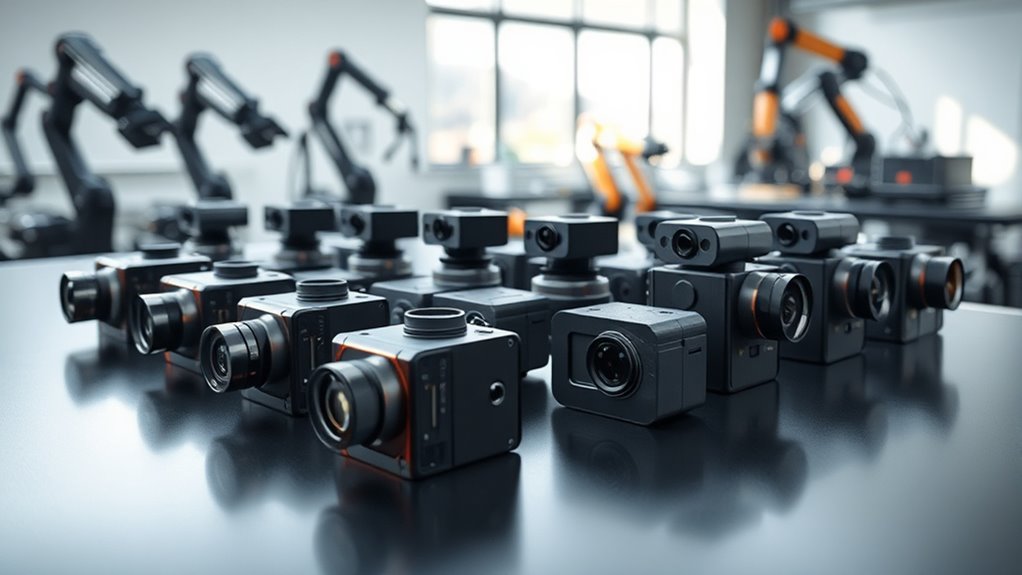
If you want precise 3D sensing for your robotics projects in 2027, there are some fantastic depth cameras to consider. Top picks like the Luxonis Oak-D Lite come with built-in AI and autofocus, making them perfect for smart applications. Then there’s the Intel RealSense D435i, which features synced IMU data to enhance motion tracking.
The Astra Pro offers a ±3 mm accurate range, giving you strong versatility in different environments. For easier deployment, the PoE-powered Oak-D-Pro Wide is a great choice. If your project demands rugged hardware, the industrial-grade Vzense DS87 stands out.
Each of these depth cameras excels at specific robotics needs by blending durability with advanced depth sensing technology. Curious which one fits your setup best? Keep reading for deeper insights into these top options.
| Image | Name | Editor's Rating | Price |
|---|---|---|---|

|
|
||

|
|
||

|
|
||

|
|
||

|
|
Yahboom Nuwa-HP60C Depth Camera for Robotics
- 【3D visual technology】Using structured light 3D imaging, the camera can provide high-precision depth maps for...
- 【High-performance depth computing】The built-in depth computing chip is designed for the robot's obstacle avoidance...
- 【Support AI functions】A variety of AI functions such as OpenCV, AR vision, gesture control, motion capture, etc. are...
The Yahboom Nuwa-HP60C Depth Camera is designed to bring accurate depth perception to indoor robotics without the need for extra processing hardware. Its built-in depth computing chip enables robots to navigate and avoid obstacles independently, reducing system complexity. This makes it an efficient solution for developers seeking reliable spatial awareness in compact setups.
With a depth sensing range of 0.2 to 4 meters, the camera uses structured light 3D imaging to deliver high-precision depth maps ideal for indoor environments. It supports advanced functions like OpenCV integration, AR vision, gesture control, and motion capture, enhancing robot interaction capabilities. The camera’s USB connectivity ensures easy integration with popular platforms such as Raspberry Pi, NVIDIA Jetson, and PCs.
Maintenance is straightforward due to the camera’s robust design, though it is not water resistant, so it should be kept away from moisture or humid conditions. Its fixed focus and aperture settings provide consistent image quality but limit adaptability in varying lighting or distance scenarios. This makes it best suited for controlled indoor applications where environmental conditions are stable.
Overall, the Nuwa-HP60C offers a compact and versatile depth sensing solution that simplifies robot vision systems while enabling complex AI functions. Its balance of precision and ease of use makes it a valuable tool for indoor robotic navigation and interaction projects.
Best for: Developers and hobbyists building indoor robots that require precise depth perception and obstacle avoidance without additional processing hardware.
What We Like:
- Built-in depth computing chip for standalone obstacle avoidance
- Supports OpenCV, AR vision, gesture control, and motion capture
- Compatible with Raspberry Pi, NVIDIA Jetson, and PCs via USB
- High-precision depth mapping within 0.2 to 4 meters
- Compact design simplifies integration into indoor robot platforms
Specification:
| Feature | Details |
|---|---|
| Manufacturer | Yahboom |
| Depth Range | 0.2 – 4 meters |
| Connectivity | USB |
| Supported Platforms | Raspberry Pi, NVIDIA Jetson, PC |
| Focus | Fixed |
| Aperture | Fixed |
| Water Resistance | No |
Astra Pro 3D Depth Camera for Robotics Research
- Lab-Grade Indoor Accuracy, ±3mm at 1m – Achieve sub-millimeter precision with structured light technology. Perfect...
- High-Efficiency Processing for Real-Time Robotics – Powered by Orbbec ASIC, Astra Pro robot camera delivers...
- Seamless Multi-Camera Sync for Scalable Systems – Synchronize up to 30 sensors at 30 fps with zero frame drops...
Robify’s Astra Pro 3D Depth Camera transforms how robotics researchers capture spatial data with remarkable precision. Offering ±3 mm accuracy at 1 meter, it ensures highly reliable depth sensing for detailed environment mapping and navigation.
The camera covers a broad depth range from 0.6 to 8 meters, allowing flexibility in various robotics scenarios. Its ability to synchronize up to 30 units at 30 fps supports extensive multi-camera setups, ideal for complex tracking and coordinated robot operations.
Designed for seamless integration, the Astra Pro works across Windows, Linux, and Android platforms, and supports popular frameworks like ROS1/ROS2 and OpenNI. Its compact, lightweight form factor consumes less than 3 W and connects via USB 2.0, simplifying setup and maintenance.
Thanks to structured light technology combined with Orbbec ASIC processing, the device delivers artifact-free point clouds and depth maps. This makes it a reliable choice for SLAM, AI vision, and automation projects that demand real-time data with zero blind spots.
Best for: Robotics researchers and developers requiring precise, real-time 3D depth sensing with multi-camera synchronization for advanced robotics applications.
What We Like:
- Accurate depth sensing with ±3 mm precision at 1 meter
- Supports synchronization of up to 30 cameras at 30 fps for large-scale tracking
- Broad depth range of 0.6–8 meters suitable for diverse environments
- Compatible with Windows, Linux, Android, ROS1/ROS2, and OpenNI SDK
- Lightweight design with low power consumption and simple USB 2.0 connectivity
Specification:
| Feature | Details |
|---|---|
| Manufacturer | Robify |
| Depth Accuracy | ±3 mm at 1 meter |
| Depth Range | 0.6–8 meters |
| Max Cameras Sync | 30 at 30 fps |
| Operating Systems | Windows, Linux, Android |
| Connectivity | USB 2.0 |
| Power Consumption | < 3 W |
| Cable Length | 1.5 meters |
| Weight | Lightweight (exact weight N/A) |
Intel RealSense Depth Camera D435F – 8263D435FDK
- Design: Compact camera peripheral with dimensions of 90 x 25.8 x 25 mm, perfect for indoor security use
- Resolution: 1080p video capture resolution and 2 megapixel effective still resolution for clear and detailed images
- Connectivity: USB-C 3.1 Gen 1 connectors for easy integration with compatible devices
The Intel RealSense Depth Camera D435F offers precise depth sensing designed to enhance spatial awareness in both indoor and outdoor environments. Its stereoscopic technology delivers depth accuracy under 2% at 2 meters, helping robotics developers and security professionals capture reliable 3D data for complex tasks.
This compact camera features a minimalist design with a tabletop mount, making installation straightforward and unobtrusive. The inclusion of night vision and an IR pass filter improves performance in low-light settings by reducing noise, ensuring clear depth information even when lighting conditions are less than ideal.
Connectivity is simple and efficient through USB-C, providing both power and data transfer in a single cable. While the camera excels in depth sensing, its 2 MP RGB camera may not meet the needs of applications requiring high-resolution imaging. Additionally, it is not water resistant, so care should be taken when using it outdoors in harsh weather.
Maintenance is minimal, thanks to its robust design and reliable components. The camera integrates seamlessly with Intel RealSense SDK 2.0, supporting a wide range of devices and development platforms, making it versatile for various applications.
Best for: Robotics developers and security professionals seeking accurate, compact, and versatile depth sensing for indoor and outdoor spatial awareness.
What We Like:
- High precision depth sensing with stereoscopic technology.
- Compact design with easy tabletop mounting.
- Night vision and IR pass filter for improved low-light performance.
- USB-C connectivity simplifies power and data transfer.
Specification:
| Specification | Details |
|---|---|
| Manufacturer | Intel |
| Model | RealSense Depth Camera D435F |
| Depth Accuracy | <2% at 2 meters |
| Field of View | 69° |
| RGB Camera Resolution | 2 MP |
| Connectivity | USB-C |
| Mounting | Tabletop mount |
| Features | Night vision, IR pass filter |
| Weight | Approx. 100 g |
| Dimensions | Compact form factor |
Luxonis Oak-D Lite Robotics Camera – Auto Focus
- OAK-D Lite is the ultimate camera for robotic vision that perceives the world like a human by combining stereo depth...
Experience precise 3D perception with the Luxonis OAK-D Lite Robotics Camera, designed to enhance robotics and augmented reality projects. This compact device delivers sharp, high-resolution stereo depth and color images, transforming how machines interpret their environment.
Equipped with a 13 MP auto-focus RGB sensor and true image stabilization, it ensures clear, detailed visuals even in dynamic settings. The camera processes data efficiently on-device with a powerful 4 TOPS RVC2 core, enabling real-time AI-driven depth analysis without relying on external hardware.
Its sleek design includes USB-C connectivity and built-in IMU sensors, supporting seamless integration into various robotics and AR systems. While it excels in controlled environments, note that it is not water resistant and records video at up to 1080p resolution, which may limit applications requiring ultra-high-definition footage.
Maintenance is straightforward thanks to its solid build and reliable components, making it suitable for continuous use in lab or workshop settings. The Luxonis OAK-D Lite stands out by combining compactness with advanced neural processing for developers focused on precise, on-device 3D vision.
Best for: Robotics developers and AR professionals needing a compact stereo depth camera with integrated AI for accurate spatial perception.
What We Like:
- High-resolution 13 MP auto-focus sensor with image stabilization
- Efficient on-device neural processing at 4 TOPS
- Compact design with USB-C and integrated IMU sensors
- Reliable performance in low-light conditions
Specification:
| Feature | Details |
|---|---|
| Manufacturer | Luxonis |
| Dimensions | Ultra-compact (exact size not specified) |
| Weight | Not specified |
| Sensor | 13 MP auto-focus RGB |
| Neural Processing Power | 4 TOPS (RVC2 core) |
| Connectivity | USB-C |
| Viewing Angle | 73 degrees |
| Additional Sensors | Built-in IMU |
| Video Resolution | Up to 1080p |
Intel RealSense Depth Camera D435i (82635D435IDK5P)
- the intel realsense d435i includes:
- a bmi055 inertial measurement unit.
- the intel realsense sdk 2. 0 which provides a depth and imu data stream.
The Intel RealSense Depth Camera D435i redefines depth sensing by merging high-precision imaging with inertial measurement. This compact device captures detailed 1080p video with a global shutter, ensuring clear visuals even in dynamic scenes. Integrated with a BMI055 IMU, it delivers synchronized motion data, enabling accurate spatial awareness and enhanced environmental interaction.
Designed for ease of use, the camera connects via USB-C and comes with a desktop tripod, simplifying setup and positioning. Its manual focus and digital stabilization features allow users to fine-tune image quality for specific applications. While the fixed aperture limits low-light performance, careful calibration can maximize depth accuracy across diverse environments.
Maintenance is straightforward, with durable construction minimizing the need for frequent adjustments. The D435i excels in robotics, advanced imaging, and projects requiring tightly aligned depth and motion data streams. Its versatile compatibility across operating systems and devices ensures seamless integration into various development workflows.
Best for: Engineers and developers needing precise, synchronized depth sensing combined with inertial measurement for robotics and advanced imaging projects.
What We Like:
- Combines depth sensing with an inertial measurement unit for synchronized data
- High-quality 1080p video capture with global shutter for accurate imaging
- Includes USB-C cable and tripod for easy setup and stable positioning
- Supports manual focus and digital stabilization for customized image control
Specification:
| Feature | Details |
|---|---|
| Manufacturer | Intel |
| Dimensions | Compact handheld design |
| Weight | Lightweight |
| Color | Silver |
| Connectivity | USB-C |
| Sensor Type | Global shutter, 1080p video |
| Integrated IMU | BMI055 inertial measurement |
| Depth Range | Approximately 10 meters |
Astra Pro ROS 3D Depth Camera for Robotics

- 【Accurate Depth Sensing】Experience reliable indoor 3D perception with Orbbec Structured Light Technology, delivering...
- 【Real-Time RGBD Vision】Powered by the Orbbec ASIC, the Astra Pro supports multiple imaging modes, including...
- 【Easy System Integration】Connect through a single USB 2.0 interface for both power and data transmission. Featuring...
Experience precise 3D sensing with the Astra Pro ROS 3D Depth Camera, designed to enhance robotics projects through accurate depth perception. This camera provides rich data streams including point cloud, depth map, IR, and RGB outputs, enabling advanced robotics tasks like SLAM and AI vision. Its ability to support both ROS1 and ROS2 frameworks ensures smooth integration into diverse robotic systems.
The camera offers multiple depth resolutions up to 1280×1024 at 7 FPS, delivering detailed environmental mapping within a 0.6 to 8-meter range. With ±3 mm accuracy, it supports critical applications requiring precise distance measurements. Its compact design and low power consumption make it easy to maintain and deploy on various robotic platforms.
Connectivity via USB 2.0 ensures straightforward setup across Windows, Linux, and Android devices. While the single USB 2.0 interface may limit data throughput compared to newer standards, it remains sufficient for many standard robotics applications. Regular maintenance is minimal, focusing mainly on keeping the lens clean and firmware updated.
Overall, this 3D depth camera balances functionality and ease of use, offering reliable performance for robotics developers aiming to improve navigation and vision capabilities.
Best for: Robotics developers and researchers who need a versatile, high-accuracy depth camera compatible with both ROS1 and ROS2 for autonomous navigation and AI vision projects.
What We Like:
- Supports multiple data outputs (point cloud, depth map, IR, RGB) for diverse robotics applications
- Compatible with Windows, Linux, and Android via USB 2.0 for flexible integration
- Offers high-resolution depth sensing up to 1280×1024 with ±3 mm accuracy
- Compact, low-power design suitable for various robotic platforms
Specification:
| Feature | Details |
|---|---|
| Manufacturer | Astra |
| Depth Resolution | Up to 1280×1024 pixels |
| RGB Video Resolution | 1280×720 pixels |
| Depth Range | 0.6 – 8 meters |
| Depth Accuracy | ±3 mm |
| Frame Rate | 7 FPS at highest depth |
| Connectivity | USB 2.0 |
| Operating Systems | Windows, Linux, Android |
| Dimensions | Compact (specific size not provided) |
| Power Consumption | Low |
Intel RealSense Depth Camera D415, 720 Pixels

- UPC: 735858352291
- Weight: 0.550 lbs
The Intel RealSense Depth Camera D415 offers precise 3D depth sensing with a 720-pixel resolution, perfect for robotics applications that require accurate environmental mapping. Its design helps capture detailed depth data, making it easier to navigate and interact with complex spaces.
This camera features a 70° viewing angle and an auto-focus CMOS sensor with infrared support, allowing it to perform well even in low-light conditions. The compact, USB-connected webcam form makes it simple to integrate with Windows-based systems, enhancing workflow efficiency.
Maintenance is straightforward due to its solid-state design, though it’s important to note it is not water-resistant, so use in harsh or wet environments is not recommended. The camera stores data on a 128 GB SD card and supports recording at 1080p, aiding in detailed visual documentation.
While the D415 excels in precise depth perception, the limited viewing angle may require multiple units for broader coverage. Its lightweight design and easy USB connectivity make it a reliable choice for diverse robotics projects.
Best for: Robotics developers and engineers seeking accurate 3D depth sensing with easy PC integration for controlled environments.
What We Like:
- High-precision 720-pixel depth resolution for detailed 3D mapping
- Auto-focus CMOS sensor with infrared compatibility for enhanced low-light use
- Compact, USB webcam-style design compatible with Windows devices
- Supports 1080p video recording and large onboard storage
- Easy integration into robotics systems requiring accurate depth data
Specification:
| Feature | Details |
|---|---|
| Manufacturer | Intel |
| Depth Resolution | 720 pixels |
| Viewing Angle | 70° |
| Sensor Type | Auto-focus CMOS |
| Connectivity | USB |
| Supported OS | Windows |
| Video Resolution | 1080p |
| Storage | 128 GB SD card |
| Form Factor | Compact webcam-style |
| Water Resistance | No |
Luxonis Oak-D Pro Robotics Camera – Auto Focus

- OAK-D Pro is the ultimate camera for robotic vision that perceives the world like a human by combining active stereo...
Experience advanced depth sensing with the Luxonis OAK-D Pro Robotics Camera featuring Auto Focus. This device is designed for robotics projects that require accurate environmental perception, even in difficult conditions like low light or texture-poor scenes. Its compact, rugged metal body ensures durability while delivering precise depth data.
The camera integrates a 12 MP auto-focus RGB sensor with active stereo depth sensing and an IR dot projector, allowing it to capture detailed 3D information. On-device neural network inferencing enables efficient processing of vision tasks without relying on additional hardware, streamlining your workflow.
Maintenance is straightforward due to its sturdy build and USB-C connectivity, which simplifies data transfer and power supply. Features like night vision and optical zoom extend its functionality across a range of robotics applications, from navigation to object recognition.
While video capture is capped at 720p with 30 fps, the system excels in depth accuracy and computational efficiency. Its specialized design serves well in environments where traditional cameras struggle to deliver consistent results.
Best for: Robotics developers and engineers requiring precise, reliable depth sensing and computer vision in challenging or low-light environments.
What We Like:
- Combines 12 MP auto-focus RGB camera with active stereo depth and IR dot projector for accurate 3D sensing.
- On-device neural network processing reduces dependency on external computing resources.
- Night vision and optical zoom enhance performance in diverse robotics tasks.
- USB-C connectivity offers easy maintenance and data handling.
Specification:
| Feature | Details |
|---|---|
| Manufacturer | Luxonis |
| Dimensions | Compact, metal-encased |
| Weight | Not specified |
| Camera Resolution | 12 MP auto-focus RGB |
| Video Capture | 720p at 30 fps |
| Connectivity | USB-C |
| Special Features | Active stereo depth, IR dot projector, night vision, optical zoom |
Oak-D-Pro Wide PoE Stereo Robotics Camera

- Please note that this is NOT A WEBCAM. This is a Spatial AI + CV camera for Robots. It is specifically designed for...
- OBJECT DETECTION: Artificial Intelligence allows for fast and accurate object detection and identification.
- OBJECT TRACKING: Stereo cameras allow for accurate depth perception and object tracking in real-time.
The Oak-D-Pro Wide PoE Stereo Robotics Camera transforms how engineers tackle depth sensing and object detection in robotics. Its wide field-of-view active stereo system with an IR laser dot projector enhances spatial accuracy, making complex navigation and environment mapping more reliable. This precision reduces errors in robot movement and interaction.
Designed for continuous operation, the camera’s PoE (Power over Ethernet) connectivity simplifies installation by providing power and data through a single cable. This reduces clutter and maintenance needs in robotic setups. The integrated IR illumination LED supports night vision, allowing robots to function effectively in low light or dark environments.
Onboard AI processes real-time object detection and tracking, improving responsiveness without relying on external computing resources. The camera’s compact and lightweight design fits easily into sophisticated robotics projects where space and weight are critical factors. Maintenance is straightforward since the device is built to endure demanding conditions.
The open-source software platform provides full flexibility for developers to customize and optimize functionality. This makes the Oak-D-Pro Wide PoE ideal for projects requiring precise depth sensing combined with intelligent vision. However, it is specialized equipment and may require technical expertise to integrate fully.
Best for: Engineers and developers building advanced robotic systems needing accurate stereo depth sensing and AI-driven object tracking.
What We Like:
- Accurate spatial perception with wide FOV active stereo and IR laser dot projection
- Real-time onboard AI for fast object detection and tracking
- Simplified deployment with PoE connectivity
- Night vision capability via IR illumination LED
- Open-source software allows easy customization and integration
Specification:
| Feature | Details |
|---|---|
| Manufacturer | Luxonis |
| Dimensions | 70 mm x 40 mm x 25 mm |
| Weight | Approximately 100 g |
| Power | Power over Ethernet (PoE) |
| Field of View | Wide-angle stereo |
| Vision Mode | Stereo depth + IR night vision |
Intel RealSense? Depth Camera D435

- Wide-field model of the genuine Intel RealSense compatible camera "RealSense Depth Camera D400" series, depth...
- Main Intel RealSense components: Intel RealSense Vision Processor D4, Intel RealSense module D430
- Depth sensor field of view (horizontal x vertical x diagonal): 91.2° x 65.5° x 100.6° (±3°)
The Intel RealSense Depth Camera D435 is designed to deliver precise depth sensing with a wide field of view, making it ideal for dynamic environments. Its active IR stereo technology and global shutter capture accurate depth information even when objects are moving, addressing challenges in real-time applications.
This camera offers a broad 91.2° horizontal angle, allowing users to scan large areas without repositioning. It supports up to 720p resolution at 90 frames per second, balancing detail and speed for responsive depth analysis. The minimum depth distance of 0.2 meters expands its usability to both close and mid-range tasks.
Maintenance is straightforward, as the device’s design minimizes calibration needs during operation. Its robust build suits robotics and automation projects where reliable, continuous depth data is crucial. However, the resolution may not meet needs requiring ultra-high detail, and users should consider this when selecting the device.
Best for: Robotics developers and engineers requiring fast, accurate depth sensing with a wide field of view in real-time applications.
What We Like:
- Wide 91.2° horizontal field of view for extensive scene coverage
- High frame rate of 90 fps ensures smooth depth data even in motion
- Close minimum depth of 0.2 meters supports versatile use cases
Specification:
| Feature | Details |
|---|---|
| Manufacturer | Intel |
| Dimensions | Not specified |
| Weight | Not specified |
| Depth Resolution | Up to 720p |
| Frame Rate | Up to 90 frames per second |
| Field of View | 91.2° horizontal |
| Minimum Depth | 0.2 meters |
Vzense DS 87/86 series ToF 3D Depth camera RGB-D Industrial Camera (DS87)

- DS86 can only be powered by DC power and IP42 rating. While DS87 can be powered either by DC power or Power over...
- Smart Logistics · Parcels Recognition and Sorting · Palletizing and Depalletizing · Dimension Measurement
- Visual Guidance · Visual Control for Delta Robot · Electric Fence · Smart Agriculture
The Vzense DS 87/86 series ToF 3D Depth camera offers precise depth sensing tailored for industrial environments. Its advanced Time-of-Flight technology provides accurate 3D and RGB-D imaging, helping professionals solve challenges in automation and robotics. This camera ensures reliable depth and color data for applications like AGV collision avoidance and gesture recognition.
Designed for durability, the DS87 model features an IP67 rating, protecting it from dust and water, which reduces maintenance needs in harsh conditions. The inclusion of Power over Ethernet (PoE) simplifies installation by allowing data and power over a single cable. The DS86, while less rugged with an IP42 rating, still delivers dependable performance for less demanding settings.
Users benefit from 1080p video quality with adjustable exposure settings and internal data storage, supporting flexible operation and easier system integration. Its fixed-focus lens keeps operation straightforward but may not suit tasks requiring variable focal lengths. Overall, this camera balances robust design with functional depth sensing for industrial use.
Best for: Industrial automation and robotics professionals needing dependable, high-quality 3D depth and RGB-D imaging in challenging environments.
What We Like:
- IP67-rated DS87 model ensures durability in tough conditions.
- Power over Ethernet (PoE) support streamlines connectivity.
- High-quality 1080p video with manual and automatic exposure control.
- Internal storage facilitates data handling without external devices.
Specification:
| Attribute | Details |
|---|---|
| Manufacturer | Vzense |
| Model Series | DS 87/86 |
| Depth Sensing Type | Time-of-Flight (ToF) |
| Protection Rating | IP67 (DS87), IP42 (DS86) |
| Video Resolution | 1080p |
| Connectivity | Ethernet with PoE (DS87) |
| Lens Type | Fixed-focus |
| Application Areas | Industrial automation, robotics |
Factors to Consider When Choosing a Depth Camera for Robotics
When choosing a depth camera for your robot, you’ll want to contemplate factors like depth range accuracy and the type of sensor technology it uses. Make sure the camera is compatible with your platform and offers the connectivity options you need.
Also, think about whether onboard processing capabilities are important for your application. This can make a big difference depending on how much data you need to handle in real time. It’s all about matching the camera’s features to what your robot really needs.
Depth Range Accuracy
Although selecting a depth camera might seem straightforward, you’ll need to carefully evaluate its depth range accuracy to make certain it meets your robot’s specific operational needs. Start by choosing a sensor whose usable range comfortably covers your tasks—short-range operations may require 0.2–4 m, while navigation in large spaces demands 6–10+ m.
Pay close attention to accuracy specs as a function of distance, since absolute error usually grows with range (e.g., ±3 mm at 1 m vs <2% at 2 m). Don’t overlook depth resolution and precision; millimeter-level precision is vital for fine manipulation, while centimeter-level might suffice for mapping.
Also, consider environmental factors like ambient light and surface texture, which impact accuracy. Finally, confirm frame rate and spatial resolution at your target distances to make certain reliable data for dynamic tasks.
Sensor Technology Type
How do you choose the right sensor technology for your robot’s depth camera? Consider your environment and range needs first.
Structured light sensors excel indoors at short to medium distances but struggle in sunlight due to IR interference.
Time-of-Flight (ToF) sensors offer consistent performance across varied lighting and longer ranges, from under a meter to tens of meters.
Stereo-vision systems rely on matching features between cameras, working well outdoors and at longer ranges but need textured scenes and more processing power.
Active stereo adds an IR projector to improve depth on low-texture surfaces and in low light but uses more energy and risks interference.
Balance these tradeoffs—range, precision, lighting robustness, motion artifacts, and computational costs—to pick the sensor technology that best fits your robot’s tasks.
Compatibility With Platforms
Since integrating a depth camera into your robotics platform requires smooth communication and processing, you’ll need to verify compatibility across software, hardware, and operating systems.
Start by confirming SDK and middleware support like ROS1/ROS2, OpenNI, or RealSense SDK to guarantee drivers, APIs, and example code are ready for your platform.
Next, check hardware interfaces and bandwidth needs—USB2, USB3, USB-C, or Ethernet—and make sure your compute device (Raspberry Pi, NVIDIA Jetson, PC) can handle power and data throughput.
Don’t forget to verify OS compatibility with Linux, Windows, or Android, including any required kernel drivers or firmware.
Also, match the camera’s compute model—on-device or raw output—to your processing architecture.
If you’re using multiple cameras, make sure synchronization and scalability features meet your system’s demands.
Connectivity Options Available
After guaranteeing your depth camera works smoothly with your platform’s software and hardware, the next step is to evaluate how it connects to your system.
USB (USB‑2/3/C) remains the most common wired choice, offering data and power through one cable. USB‑3/C provides higher bandwidth for detailed RGB and depth data.
Ethernet with Power over Ethernet (PoE) supports longer cable runs, centralized power, and stable high-bandwidth transfer. It’s ideal for remote mounting.
Wireless options like Wi‑Fi enable mobility and multi-camera setups but bring latency and potential packet loss.
If you’re syncing multiple cameras, look for hardware sync lines or precise network protocols to guarantee tight alignment.
Finally, double-check host compatibility and driver support since some interfaces require proprietary drivers for full functionality.
Onboard Processing Capabilities
When choosing a depth camera for robotics, you’ll want to take into account its onboard processing capabilities carefully. Cameras with dedicated depth ASICs or NPUs offload computation from your host system, lowering CPU/GPU load and reducing latency for real-time tasks like obstacle avoidance.
Look for integrated IMUs or timestamp-aligned sensors to simplify sensor fusion and pose estimation without extra synchronization. Evaluate onboard compute power in TOPS, matching it to your workload—lightweight neural inference might need around 4 TOPS, while complex detection demands more.
Built-in firmware features like depth filtering and artifact suppression can reduce bandwidth by sending preprocessed data. Don’t forget to check power draw and thermal limits; high compute performance often means higher wattage and potential throttling, especially in compact setups.
This guarantees sustained performance during extended operation. So, keeping an eye on these factors will help you pick the right camera that balances power, efficiency, and reliability.
Environmental Resistance Features
Beyond processing power, your depth camera must withstand the conditions it faces in the field. Check the IP rating carefully—higher numbers like IP67 mean better protection against dust and water. This is essential for outdoor or industrial use.
Also, confirm the camera’s operating temperature and humidity ranges to make certain it performs reliably in your environment. If your robot moves over rough terrain or mounts on drones, choose cameras with shock and vibration tolerance. This helps prevent sensor damage and maintain accuracy.
For outdoor or bright-light scenarios, pick sensors with IR robustness or optical filters that reduce sunlight interference. Finally, consider additional protection like sealed enclosures or rugged housings. These guard against contaminants, corrosion, and impacts.
These features keep your depth camera durable and dependable in challenging conditions.
Software and SDK Support
How easily your depth camera integrates with your robotic system can make or break your project. You should make certain the camera offers a well-documented SDK with support for the languages you use, like C++, Python, or ROS nodes, including clear examples for depth, RGB, and point-cloud streams.
Make sure to verify native support for ROS1/ROS2 and relevant message types such as sensor_msgs/PointCloud2 to simplify integration. It really helps to check the SDK’s real-time performance too, including low-latency APIs, hardware timestamps, and multi-threaded capture.
Long-term maintenance is important—look for active driver updates, backward-compatible APIs, and solid community or vendor support. And don’t forget to consider advanced SDK features like multi-camera sync, calibration tools, depth filtering, and point-cloud utilities. These can significantly reduce your custom development and speed up deployment.
Power Consumption Efficiency
Alongside software compatibility, power consumption plays a key role in selecting a depth camera for your robotic system. You should evaluate both average and peak power draw separately for the sensor and onboard processors, since consumption can spike during high-rate pointcloud output or on-device inference.
Check if the camera uses single-cable USB/PoE power or needs separate wiring, as this affects system efficiency. It’s also smart to consider adjusting frame rates or resolution to reduce power consumption and extend battery life, especially for mobile robots.
Onboard compute units like ASICs or IMUs offload processing from your main CPU but add baseline power use, so balance accordingly. Finally, look for power management features like sleep modes and dynamic scaling, plus metrics like mAh or Wh at typical frame rates to estimate runtime on your platform.
Frequently Asked Questions
How Do Depth Cameras Integrate With Robot Operating Systems (ROS)?
You connect depth cameras to ROS using dedicated drivers and nodes that publish sensor data as topics. This lets you process real-time 3D information for mapping, navigation, and object detection within your robot’s software framework.
It’s pretty straightforward once you have the right drivers installed. These drivers act like translators, making sure the camera’s data speaks the same language as ROS. Then, you can tap into that data anytime through ROS topics, which is super handy for your robot’s tasks.
What Are the Common Software Development Kits (SDKS) for These Cameras?
You’ll often use SDKs like Intel RealSense SDK, Microsoft Azure Kinect SDK, and OpenNI. These provide tools and APIs to access depth data, integrate with ROS, and help you develop robotics applications efficiently and effectively.
These SDKs make it easier to get started with your projects because they handle a lot of the complex stuff behind the scenes. Plus, they usually come with sample code and documentation, so you’re not starting from scratch.
Can These Cameras Be Used Effectively in Outdoor Environments?
You might think sunlight ruins depth sensing, but many modern cameras handle outdoor glare well.
You’ll find they work effectively outside, especially models with IR filters and adaptive exposure.
These features let your robot navigate bright, complex environments confidently.
What Are the Power Requirements for These Depth Cameras?
You’ll find most depth cameras need between 5V to 12V power, drawing around 1 to 3 amps depending on features.
Make sure your power supply matches these specs to keep your robotics system running smoothly and efficiently. It’s really important to get this right so you don’t run into any unexpected shutdowns or performance issues.
How Do Depth Cameras Handle Varying Lighting Conditions?
Depth cameras adapt to varying lighting by using infrared sensors or structured light, letting you capture depth even in low light. Some also adjust exposure automatically, so you won’t lose accuracy when lighting changes around your robot.
It’s pretty handy because these features help the camera see clearly no matter if it’s bright or dim. That way, your robot can keep working smoothly without missing a beat.
Conclusion
Imagine your robot traversing a maze of shadows and light, effortlessly sensing every obstacle with crystal-clear depth. Choosing the right depth camera is like giving your robot eyes that see beyond the surface, turning complex environments into simple maps.
Whether you pick a sleek Intel RealSense or a robust Yahboom, your robotics project will gain precision and confidence. These cameras don’t just capture images—they provide vital data that helps your robot navigate smarter and safer.
Trust these top depth cameras to bring your robot’s vision to life. With the best depth cameras for robotics, your machine will explore with newfound clarity, making complex tasks feel effortless. Ready to upgrade your robot’s perception? The right depth camera is the key to unlocking advanced, reliable robotic vision.