3 Best Starter Cameras for Filmmaking in 2027 Beginners Love
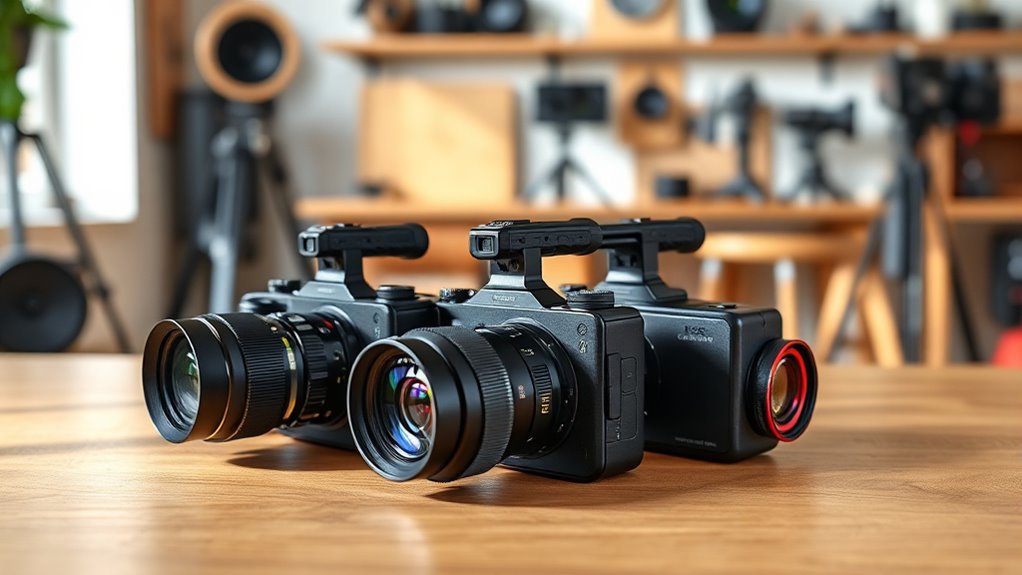
For 2027, beginners love the Blackmagic Pocket Cinema Camera 4K for its true 4K sensor and flexible MFT mount, ideal for creativity.
Pair it with the Power Bundle for extended battery life and pro audio.
The Canon VIXIA HF G70 offers 4K UHD, 20x zoom, and built-in stabilization—perfect for steady, sharp footage.
Both deliver great image quality and ease of use.
If you want to make the smartest gear choice, keep exploring the pros and features.
There’s a lot to consider, but these cameras are definitely a great place to start.
| Image | Name | Editor's Rating | Price |
|---|---|---|---|

|
|
||

|
|
||

|
|
Blackmagic Design Pocket Cinema Camera 4K (CINECAMPOCHDMFT4K)
- INCREDIBLE IMAGE QUALITY: Features 4/3” image sensor with native resolution of 4096 x 2160 and an active MFT lens...
- MULTIPLE RECORDING OPTIONS: Record your footage to SD/UHS-II and CFast 2.0 cards or alternatively to external SSD...
- MULTIPLE FILE FORMATS: Supports industry standard formats such as Apple ProRes in all formats up to 4K or 12-bit...
Step into professional filmmaking with the Blackmagic Design Pocket Cinema Camera 4K, a tool designed to elevate your video production. This camera’s 4/3″ CMOS sensor captures true 4K resolution, delivering sharp, cinematic footage that brings your vision to life. Its 13 stops of dynamic range ensure details are preserved in shadows and highlights.
Low-light shooting is simplified thanks to the camera’s dual native ISO up to 25,600, allowing clear, noise-free images even in challenging conditions. The compact, lightweight body with a bright 5″ LCD makes handheld shooting comfortable and straightforward, ideal for on-the-go projects.
Versatility is a key advantage, with an active Micro Four Thirds mount that supports a wide variety of lenses and adapters. This flexibility helps you adapt quickly to different shooting scenarios, from wide landscapes to tight close-ups. Regular maintenance involves careful lens handling and keeping the sensor clean to maintain image quality.
While the camera offers professional codecs like Blackmagic RAW and ProRes, it requires extra investment in lenses and batteries, as none are included. Its lack of built-in stabilization means additional gear may be necessary for smooth motion shots.
Best for: filmmakers and videographers seeking a professional 4K cinema camera with excellent low-light capability and adaptable lens options for diverse projects.
What We Like:
- High-quality 4K video with wide dynamic range and superior low-light performance
- Lightweight, ergonomic design with a bright 5″ touchscreen for easy framing
- Supports numerous lenses via the active MFT mount and professional recording codecs
- Compact size suited for handheld and mobile setups
Specification:
| Feature | Details |
|---|---|
| Manufacturer | Blackmagic Design |
| Sensor Type | 4/3″ CMOS |
| Resolution | 4096 x 2160 (4K) |
| Dynamic Range | 13 stops |
| Max ISO | 25,600 (dual native ISO) |
| Display | 5″ bright LCD touchscreen |
| Lens Mount | Active Micro Four Thirds (MFT) |
| Body Material | Carbon fiber polycarbonate |
| Weight | Approx. 0.9 kg (2 lb) |
Blackmagic Pocket Cinema Camera 4K Power Bundle
- INCREDIBLE IMAGE QUALITY: Features 4/3” image sensor with native resolution of 4096 x 2160 and an active MFT lens...
- MULTIPLE RECORDING OPTIONS: Record your footage to SD/UHS-II and CFast 2.0 cards or alternatively to external SSD...
- MULTIPLE FILE FORMATS: Supports industry standard formats such as Apple ProRes in all formats up to 4K or 12-bit...
Experience cinematic filmmaking made accessible with the Blackmagic Pocket Cinema Camera 4K Power Bundle. This kit is designed to simplify your workflow and keep you shooting longer without interruptions. Its compact design helps you capture stunning visuals effortlessly, whether in the studio or on location.
With 13 stops of dynamic range and dual native ISO up to 25,600, it tackles challenging lighting conditions, delivering clear, vibrant 4K footage up to 60fps. The Micro Four Thirds lens mount offers flexibility, letting you choose from a wide variety of lenses to fit your creative vision. Bluetooth connectivity adds convenience by allowing remote control during shoots.
The bundle ensures continuous power with three LP-E6 batteries and a dual charger, so you won’t miss a moment. Professional audio inputs and external SSD recording options support high-quality sound and extended recording times. Maintenance is straightforward, with durable components designed for regular use, though the camera isn’t water-resistant, so care is needed in wet environments.
Best for: filmmakers and videographers who want a compact, professional 4K cinema camera system with versatile lens compatibility and extended shooting capability.
What We Like:
- Includes essential accessories for all-day shooting and post-production.
- Excellent low-light performance with high dynamic range and dual native ISO.
- Supports versatile lenses via Micro Four Thirds mount.
- Professional audio inputs and external SSD recording for quality sound and storage.
- Compact and lightweight design for easy handling and transport.
Specification:
| Feature | Details |
|---|---|
| Manufacturer | Blackmagic Design |
| Dimensions | Approx. 5.7 x 4.3 x 3.3 in (14.5 x 11 x 8.4 cm) |
| Weight | Approx. 1.03 lb (470 g) |
| Sensor Size | 4/3″ CMOS |
| Max Resolution | 4K UHD (3840 x 2160) |
| Frame Rate | Up to 60 fps |
| Mount Type | Micro Four Thirds |
| Power Supply | LP-E6 batteries (3 included), AC adapter |
| Connectivity | Bluetooth, USB-C |
Canon VIXIA HF G70 4K UHD Camcorder
- 4K sensor and DIGIC DV6 image processor deliver crisp, sharp 4K UHD images, while an 8-blade aperture achieves...
- On-Screen Display (OSD) “Time Stamp” Recording embeds date, time, timecode and other data in your original camera...
- UVC Livestreaming - Stream HD video directly from the camera via UVC1 to a PC or Mac computer.
The Canon VIXIA HF G70 4K UHD Camcorder offers a perfect blend of quality and ease for those stepping into filmmaking. Its 4K resolution and 20x optical zoom help capture sharp, detailed footage, solving the problem of limited reach without bulky equipment. This makes it easier to get professional-looking videos in various settings.
Designed for smooth shooting, the camcorder’s Advanced Hybrid IS stabilization reduces shake, while the Hybrid AF with face detection keeps subjects crisp and in focus. The bright f/1.8 aperture enhances low-light performance and creates attractive background blur, adding cinematic depth effortlessly.
Maintenance is straightforward thanks to its dual SD card slots, which allow extended recording without interruption. The camcorder’s lightweight design and solid battery life make it easy to carry and use during long shoots. USB livestreaming adds a modern touch, letting you share content live without complicated setups.
However, it’s not built for harsh environments; it lacks water resistance and has a limited temperature range. Also, advanced users may find manual controls and audio inputs somewhat basic, which might restrict complex production needs.
Best for: Beginner to intermediate filmmakers seeking a compact, user-friendly 4K camcorder with strong zoom, image stabilization, and versatile shooting features.
What We Like:
- Crisp 4K UHD video with bright f/1.8 aperture and 20x zoom for detailed footage
- Smooth and stable recording via Advanced Hybrid IS and face detection autofocus
- Dual SD card slots for longer, uninterrupted recording sessions
- Lightweight and portable design suitable for on-the-go filming
- USB livestreaming capability for easy content sharing
Specification:
| Feature | Description |
|---|---|
| Manufacturer | Canon |
| Dimensions | Approx. 5.6 x 3.1 x 2.7 in (14.2 x 7.9 x 6.9 cm) |
| Weight | 16 oz (0.45 kg) |
| Zoom | 20x Optical Zoom |
| Aperture | f/1.8 |
| Screen Size | 3.5 inches |
| Storage | Dual SD card slots |
Factors to Consider When Choosing a Starter Camera for Filmmaking
When choosing your first filmmaking camera, you’ll want to think about sensor size and how it affects image quality. Consider video resolution options and whether the camera supports lenses you might need.
Don’t forget to check audio inputs and battery life to keep your shoots running smoothly. It’s all about making sure your gear works well for the kind of projects you want to create.
Sensor Size Importance
Although sensor size might seem like a technical detail, it plays a crucial role in your filmmaking results. Larger sensors like full-frame or APS-C gather more light per pixel, boosting low-light performance and dynamic range.
This means your shots look cleaner and more detailed in dim conditions. Sensor size also affects depth of field; bigger sensors give you a shallower depth of field, helping you achieve that cinematic background blur effortlessly.
Keep in mind, smaller sensors crop your image, so you’ll need wider lenses to get the same framing as full-frame cameras. Plus, sensor size influences lens choices and availability, so consider what lenses you want to use.
Balancing sensor size with your filming style will set you up for success right from the start.
Video Resolution Options
How much resolution do you really need in your starter filmmaking camera? Shooting in 4K (3840×2160) gives you four times the detail of 1080p, letting you capture sharper images and reframe shots easily during editing.
Plus, downscaling 4K footage to 1080p creates smoother, more stable videos. However, higher resolutions demand more storage and processing power—expect file sizes about 3–4 times larger than 1080p and heavier editing loads.
If you plan on slow-motion shots at 60–120 fps, remember many cameras drop to 1080p at those frame rates, so weigh resolution against frame rate needs.
Also, consider your target platform: 1080p works well for web and social media, while 4K suits theatrical releases or future-proofing your projects.
Choose wisely to balance quality and workflow efficiency.
Lens Compatibility Range
Since lenses directly shape your footage’s look and versatility, you’ll want a starter camera that offers broad lens compatibility. Check the mount type to guarantee it supports a wide range of native lenses—primes, zooms, and specialty options covering focal lengths from wide (~14–24mm) to telephoto (~70–200mm).
Confirm if the camera works well with common adapters (like MFT↔EF or EF↔PL) so you can use legacy cine glass or third-party lenses without losing autofocus, aperture control, or stabilization. Keep sensor size and crop factor in mind, as they affect the effective focal length and depth of field.
Finally, make sure the lens ecosystem includes fast apertures for low light, plus macro, anamorphic, and cine lenses if you plan to explore diverse shooting styles. It’s all about having the right tools ready when creativity strikes.
Audio Input Features
Lens choices shape the image, but capturing clear sound brings your footage to life.
When choosing a starter camera, prioritize audio input features like balanced inputs (XLR or TRS) or a mic jack with phantom power (48V). These let you connect professional condensers and wireless systems without extra adapters.
Make sure the camera has a dedicated headphone output so you can monitor sound in real time, catching unwanted noise before it’s too late. Manual audio level controls and visual meters help you set proper gain, preventing clipping or muffled dialogue.
If possible, opt for multiple inputs to record backup or dual mics simultaneously, adding flexibility. Also, built-in timecode or line-level inputs simplify syncing with external recorders, improving your workflow.
Battery Life Considerations
Although battery life might not seem like a top priority at first, it plays a crucial role in your filming experience. You’ll want to check the battery capacity and expected run-time—typical LP-E6 style batteries last 1.5–3 hours but high resolution and frame rates drain them faster.
Don’t forget accessories; external monitors, mics, and wireless transmitters can boost power use by 20–100%, so plan accordingly. Bring at least two spare batteries per day or use dual chargers and USB power solutions to avoid downtime.
Also, higher bit-rate codecs like RAW increase processor load and heat, cutting battery life compared to H.264/H.265. Finally, consider fast chargers and mounting options like V-mount plates to extend your shooting time seamlessly on location.
Budget and Value
Set a realistic budget that covers not just the camera body but also essential accessories like lenses, memory cards, spare batteries, and a basic microphone. Accessories often add 30–50% to the camera’s sticker price, so don’t overlook them.
Prioritize cameras recording in widely supported codecs like ProRes or H.264/HEVC for easier editing. But keep in mind, higher-quality codecs and RAW files demand more storage and powerful editing systems.
Balance sensor size and low-light performance against cost. Larger sensors improve image quality but also increase both camera and lens prices.
Think long-term: investing in a body with robust connectivity (external SSD, XLR audio, HDMI out) can save you money on future upgrades. Finally, factor in media speed requirements, backup solutions, and any necessary licenses or software for your workflow to understand total ownership costs.
Frequently Asked Questions
Can I Use External Microphones With These Starter Cameras?
Yes, you can use external microphones with these cameras. Most starter models have a mic input or support adapters, letting you improve audio quality easily.
Just check compatibility and remember to secure your gear properly while filming. It’s a simple way to make your videos sound way better!
What Is the Average Battery Life of These Cameras?
You’ll get around 1.5 to 2 hours of battery life, enough to film a short movie marathon without feeling like you’re draining the sun itself.
Just keep a spare battery handy for longer shoots!
Do These Cameras Support Live Streaming Capabilities?
Yes, most of these starter cameras support live streaming, letting you connect directly via USB or HDMI. You’ll find easy-to-use software compatibility, so you can stream high-quality video without extra complicated gear or setups.
It’s pretty straightforward, making it perfect for beginners who want to get started quickly. Just plug in, set up your software, and you’re ready to go live!
Are These Cameras Compatible With Smartphone Apps for Remote Control?
Yes, most of these cameras are compatible with smartphone apps, letting you remotely control settings, start or stop recording, and preview shots.
This feature gives you flexibility and makes shooting much easier, especially when you’re solo. It’s super handy to have that kind of control right at your fingertips.
What Types of Memory Cards Are Required for Recording?
You’ll need SD, microSD, or CFexpress cards depending on your camera model.
Make sure to choose cards with fast write speeds to handle high-resolution video recording smoothly. This helps avoid interruptions or dropped frames during your shoots.
Conclusion
Choosing your first filmmaking camera can feel overwhelming, but focusing on features like image quality and ease of use simplifies the process. Did you know that 72% of beginner filmmakers say having a reliable, user-friendly camera boosts their confidence on set?
Whether you pick the Blackmagic Pocket Cinema Camera 4K or the Canon VIXIA HF G70, you’ll have the tools to start creating stunning films right away. Trust your instincts and start shooting your vision today!
Finding the best starter cameras for filmmaking in 2027 doesn’t have to be complicated. Beginners love models that offer great performance without a steep learning curve. So, dive in with one of these cameras and watch your filmmaking skills grow!