
How You Use Kosher Salt for Baking Simply
When you bake with kosher salt, it’s best to measure it by weight, not volume, to get the seasoning just right. Different brands have varying crystal sizes, so weighing guarantees consistent saltiness every time.
This is especially important because flaky kosher salts, like Diamond Crystal, can pack differently than table salt.
If you’re substituting table salt for kosher salt, use about double the volume of kosher salt to keep the flavor balanced.
Make sure to dissolve or mix the salt thoroughly for even flavor throughout your baked goods.
Keep your salt accessible as you bake and don’t be afraid to adjust seasoning as you go.
Keep exploring and experimenting to master the perfect salt use in your baking!
Key Takeaways
- Measure Diamond Crystal kosher salt by volume, as its large flakes are consistent for baking. Use double the volume of kosher salt compared to table salt for similar saltiness.
- Make sure to dissolve kosher salt completely in liquids or mix it well into doughs for even seasoning. This helps spread the flavor nicely throughout your recipe.
- Store kosher salt in a wide-mouthed container near your workspace for easy access. That way, you won’t have to hunt for it mid-baking.
- Always taste and adjust seasoning during baking to get the flavor just right. Don’t be afraid to tweak it as you go!
How to Measure and Substitute Kosher Salt for Baking
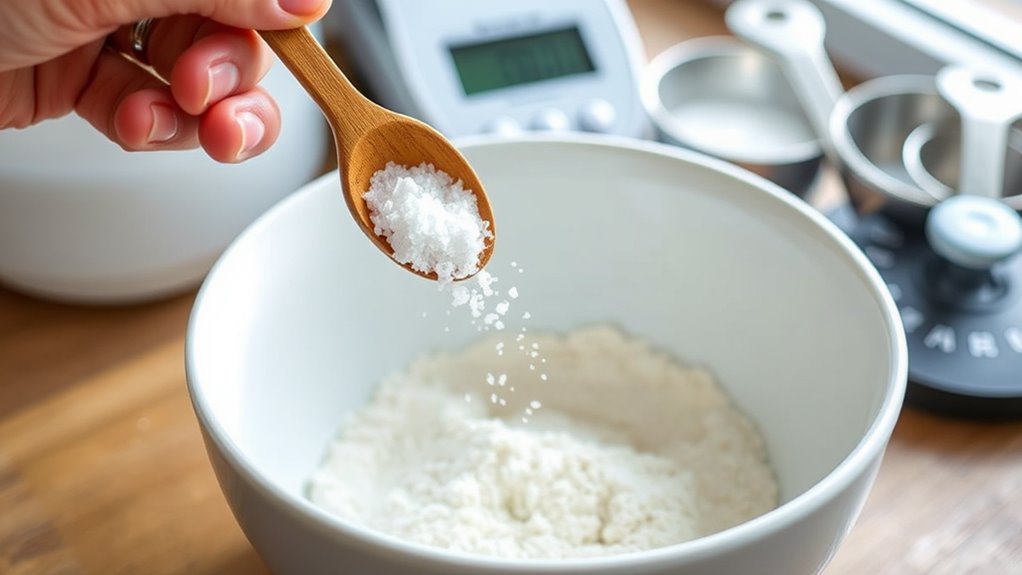
Because kosher salt crystals vary in size and density, you should measure them by weight rather than volume when baking. Measuring by volume can lead to inconsistent results since the larger, irregular crystals pack differently in a spoon.
For example, 1 teaspoon of Diamond Crystal kosher salt is about half as salty as 1 teaspoon of table salt, so you’ll need to make an adjustment when substituting. If your recipe calls for table salt, use roughly double the volume of kosher salt, but always confirm by weight for accuracy.
Different brands like Morton and Diamond Crystal have distinct crystal sizes, which means you can’t swap them without adjusting the amount. Weighing kosher salt guarantees you maintain the right saltiness and texture in your baked goods.
Keep a kitchen scale handy for precise measuring, especially when scaling recipes or substituting kosher salt for table salt. That way, your baking turns out perfect every time.
Easy Tips to Use Kosher Salt Effectively in Baking
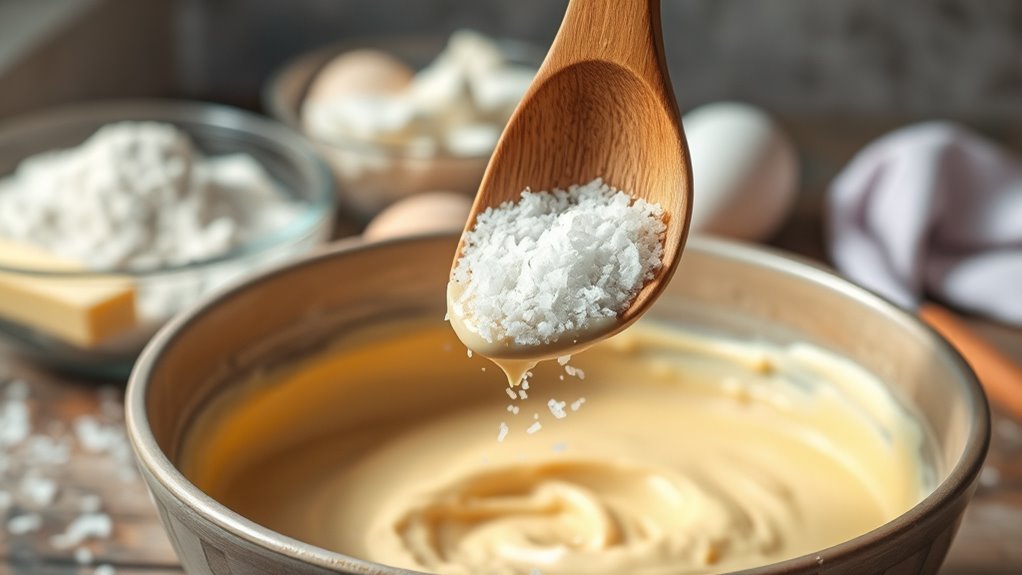
Knowing how to measure kosher salt accurately sets the stage for using it well in your baking. When you choose Diamond Crystal kosher salt, you get flaky, hollow crystals that dissolve quickly and provide even seasoning.
Since kosher salt has large grains, always use volume measurement—not weight—to guarantee you add the right amount. Remember, for recipe substitution, use about twice the volume of kosher salt compared to table salt to match salinity.
To get even seasoning, dissolve kosher salt thoroughly in liquids or mix it well into doughs. Keep your kosher salt stored near your workspace in a wide-mouthed container.
This makes it easy to sprinkle and taste as you bake, so you can adjust seasoning on the fly. Following these simple tips helps you make the most of kosher salt’s unique qualities for perfectly seasoned baked goods every time.
Frequently Asked Questions
What Is the Best Way to Use Kosher Salt?
The best way to use kosher salt is to measure it carefully. Dissolve it in liquids when needed to make sure it blends well.
Sprinkle it evenly over doughs or batters. This helps distribute the flavor throughout.
You can also add it as a finishing touch. It gives extra texture and a nice flavor contrast that really makes dishes pop.
Can I Substitute Kosher Salt for Regular Salt in Baking?
Yes, you can substitute kosher salt for regular salt, but use more kosher salt by volume since its crystals are larger. Adjust amounts carefully, crush it if needed, and consider the brand’s density for best results.
Just keep in mind that kosher salt isn’t as dense as table salt, so a tablespoon of kosher salt won’t equal a tablespoon of regular salt. It’s a good idea to start with a bit less and taste as you go if possible. This way, your baking turns out just right!
When a Recipe Says Kosher Salt, What Does That Mean?
When a recipe says kosher salt, it means using large, flaky crystals, usually Diamond Crystal. You should measure carefully since its texture differs from table salt, affecting saltiness and how it dissolves in your baking.
Why Should I Use Kosher Salt Instead of Regular Salt?
Think of kosher salt as your baking’s secret weapon—it gives you better control, avoids bitter chemical tastes, and seasons evenly thanks to its coarse crystals.
You’ll avoid oversalting and get tastier, well-balanced baked goods every time. It’s like having a little extra confidence in the kitchen!
Conclusion
Now that you know how to measure and substitute kosher salt in baking, you’ll see it’s more flexible than you thought. While some believe kosher salt can’t replace table salt, you’ve learned it’s all about adjusting amounts correctly.
Using kosher salt can even enhance your recipes with better control over seasoning. So, don’t shy away—embrace kosher salt in your baking and discover how it truly elevates your dishes with simple, smart tweaks.
In baking, kosher salt offers a great way to fine-tune flavor without overpowering your ingredients. Its coarse texture and purity make it a favorite for many home bakers. By understanding how to use kosher salt properly, you can improve your baking results and enjoy a more balanced taste every time.