
10 Facts About Kosher Salt Vs Regular Salt Saltiness
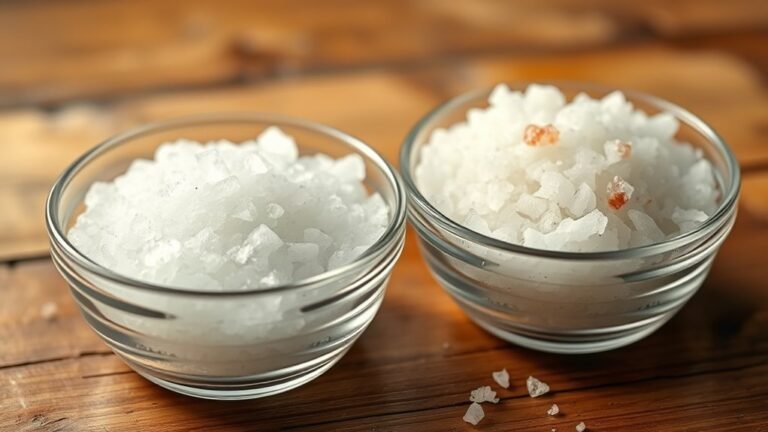
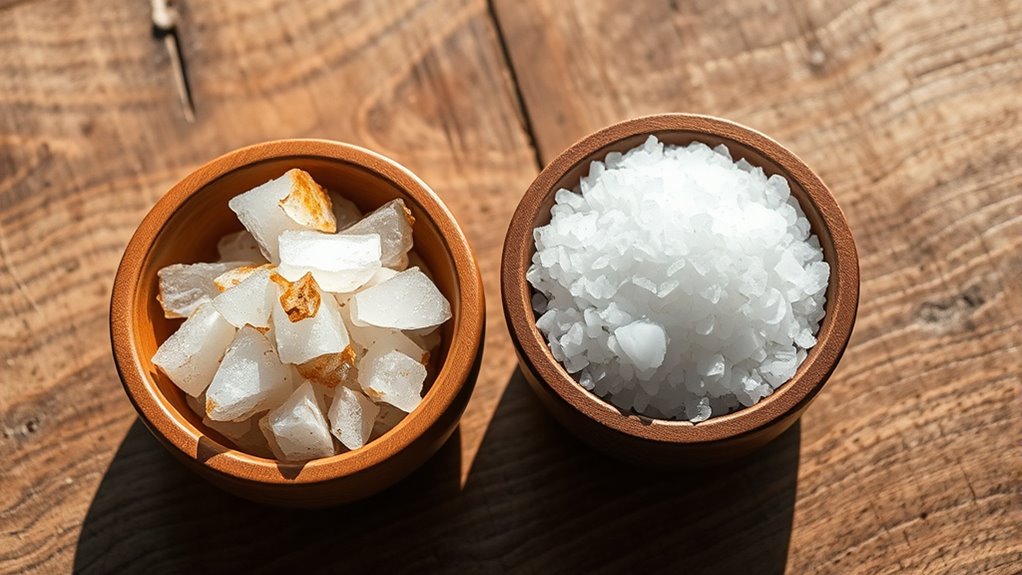
You’ll notice kosher salt has larger, coarser crystals than regular table salt, making it less salty by volume since it packs less densely.
Table salt often contains additives like iodine and anti-caking agents, which can change flavor, while kosher salt is usually purer.
Kosher salt’s flaky texture dissolves slower, giving you better control when seasoning.
For precise flavor, it’s best to weigh salt instead of measuring by volume.
Keep exploring to master salt usage in your cooking.
Key Takeaways
- Kosher salt has larger, coarser crystals, making it less salty by volume compared to finer, denser table salt. This means if you use the same amount by volume, kosher salt will taste milder.
- Table salt’s fine grains pack tightly, so you get more salt per teaspoon. That results in a stronger salty taste when compared directly to kosher salt.
- Additives like iodine and anti-caking agents in table salt can change its flavor a bit. Kosher salt, on the other hand, is usually additive-free, which some people prefer.
- Kosher salt also dissolves slower, which gives you better control when seasoning or finishing dishes. It offers a milder taste that can be easier to manage.
- Because of differences in crystal size and density, it’s important to adjust quantities or weigh your salt for accurate saltiness. That way, your dish won’t end up too salty or too bland.
What Makes Kosher Salt Different From Table Salt?
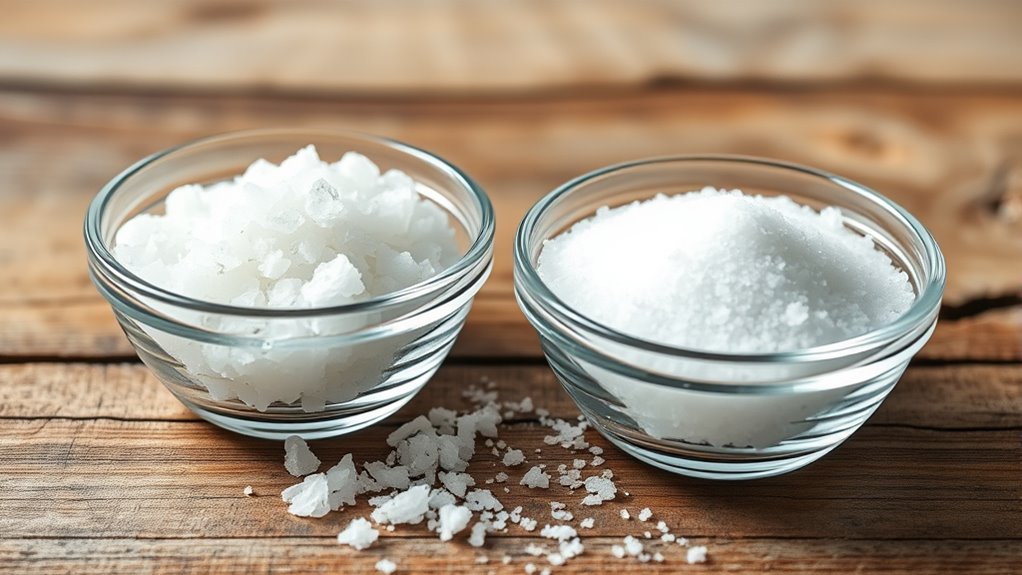
Although both kosher salt and table salt serve the same basic purpose, their differences in grain size, density, and additives considerably affect how you use them in cooking. Kosher salt features larger, coarser grains, while table salt has fine, densely packed grains.
Kosher and table salt differ in grain size, density, and additives, influencing their use in cooking.
This difference in grain size impacts their salinity—kosher salt is less salty by volume because its crystals are less dense. When you measure a teaspoon of kosher salt, it contains less salt than the same volume of table salt, so you’ll need to adjust amounts accordingly in recipes.
Additionally, kosher salt usually lacks additives like iodine and anti-caking agents, which are common in table salt. The larger grains of kosher salt also dissolve more slowly, giving you better control when seasoning by hand.
Understanding these distinctions helps you choose the right salt and use it effectively to achieve the flavor and texture you want in your dishes. It’s pretty handy to keep these differences in mind next time you’re cooking!
How Crystal Size And Density Affect Saltiness And Measurement
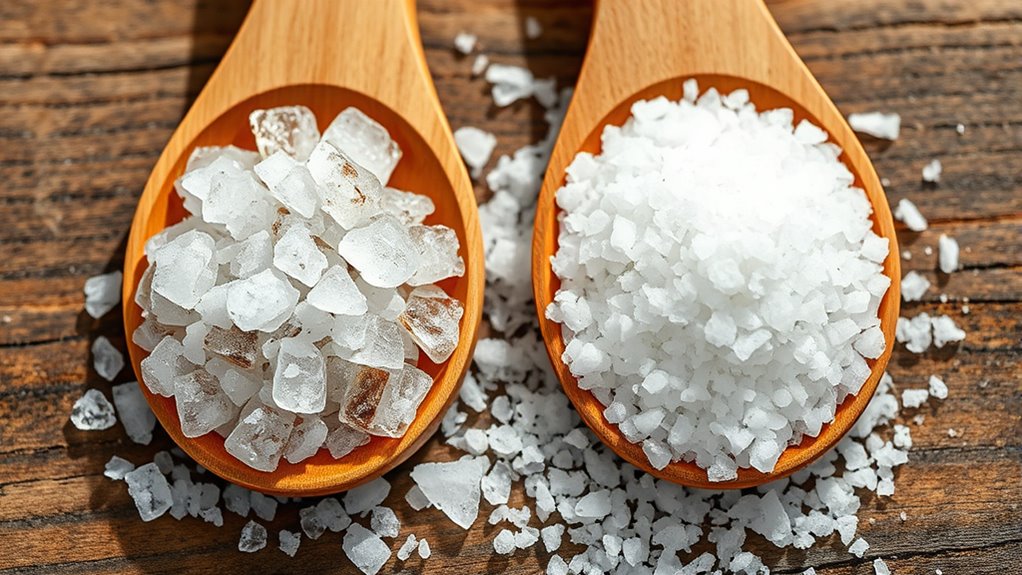
The size and density of salt crystals directly influence how salty your food tastes when you measure salt by volume. Coarser crystals, like those in kosher salt, have larger crystal size and more air space, making them less dense.
This means a teaspoon holds fewer salt crystals, reducing the overall saltiness compared to fine salts. On the other hand, table salt’s small, dense crystals pack tightly, so a teaspoon contains more salt, increasing saltiness in your dish.
Because of these differences in density, measurement by volume can be misleading. If you substitute kosher salt for table salt without adjusting the amount, your food may end up less salty than intended.
To get the right saltiness, you need to take into account crystal size and density when measuring. Adjusting quantities based on these factors ensures your recipe’s flavor stays balanced and consistent every time.
Why Table Salt’s Additives Matter
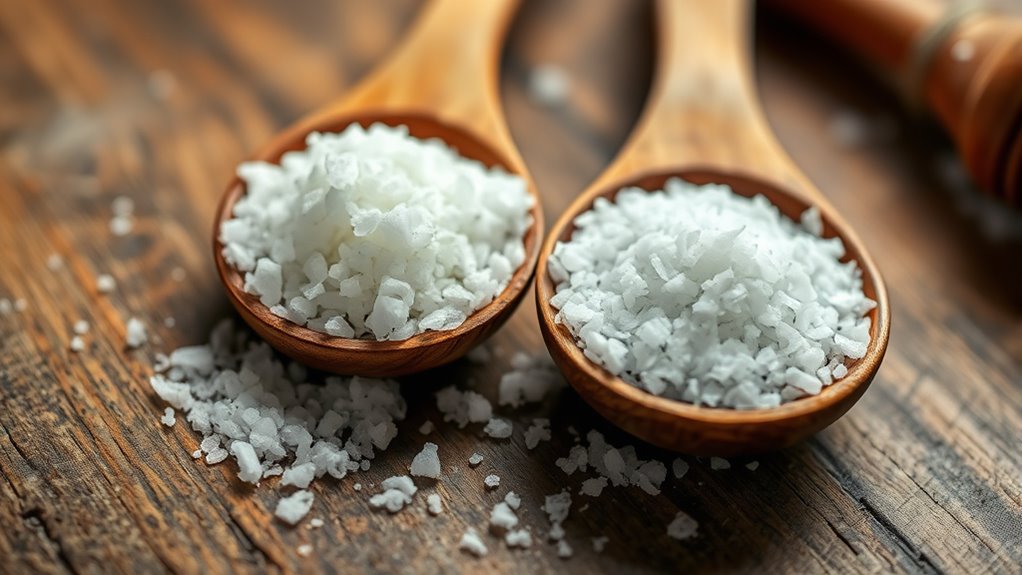
When you choose table salt, you’re also taking on the additives it contains, like iodine and anti-caking agents, which can subtly change the flavor of your food. Iodized salt includes iodine added for health benefits, but it can introduce a metallic or chemical taste, altering the salt’s natural profile.
Similarly, anti-caking agents prevent clumping, but they may affect the salt’s purity and add faint off-flavors. These additives influence how table salt dissolves and interacts with your ingredients, which can impact seasoning precision and overall taste.
If you’re aiming for a pure flavor, these additives matter because they might mask or modify the essential saltiness you want. That’s why many chefs prefer salts without additives, like kosher salt, to keep their dishes tasting clean and natural.
Understanding how these additives affect iodized salt helps you make better choices for your cooking and enjoy a true salt experience.
Why Kosher Salt Tastes Milder Per Volume
Because kosher salt crystals are larger and coarser than table salt, you’ll notice it tastes milder when measured by volume. This is due to its crystal size, which makes kosher salt less dense and more airy.
Kosher salt’s larger, coarser crystals make it less dense and milder in taste by volume.
When you scoop a tablespoon of kosher salt, the crystals don’t pack tightly, so there’s less sodium chloride compared to the same volume of fine table salt. This means the saltiness per volume is lower, even though, by weight, kosher salt’s saltiness matches that of table salt.
The irregular, flaky structure of kosher salt also contributes to this effect, as it reduces the amount of actual salt in a given volume. So, when measuring kosher salt by volume, you’re getting fewer salt crystals, which explains why it tastes milder.
To achieve the same saltiness in recipes, you’d need to use a larger volume of kosher salt compared to finer salts.
When To Use Kosher Salt Or Table Salt In Cooking
Although both kosher salt and table salt serve as essential seasoning agents, you’ll find that choosing between them depends largely on the cooking method and desired texture. The difference in crystal size plays a big role in how each salt works in your kitchen.
Here’s when to use each:
- Reach for kosher salt when dry seasoning meats or vegetables—you’ll appreciate its coarse crystals and better tactile control. It makes it easier to feel and spread the salt evenly.
- Use table salt in baking or recipes where salt needs to dissolve quickly and evenly, thanks to its fine crystal size. It blends right in without leaving any graininess.
- Sprinkle kosher salt during cooking for gradual flavor release without overwhelming saltiness. Its bigger crystals melt slower, giving you more control.
- Avoid using table salt as a finishing salt; its fine grains don’t provide the texture kosher salt’s larger crystals do. So, if you want that nice crunch or visual pop, kosher salt’s the way to go.
How Substituting Different Salts Impacts Your Recipes
When you swap kosher salt for table salt, the difference in crystal size means a teaspoon won’t deliver the same saltiness. You’ll need to adjust the amount to get the flavor just right, or your dish might end up under- or over-salted.
It’s all about paying attention to salt volume and flavor impact. That way, you keep your recipes balanced every time.
Salt Volume Differences
Since different salts vary in crystal size and density, substituting one type for another can change the saltiness of your dish. Salt volume matters because kosher salt’s larger grain size and lower bulk density mean a teaspoon holds less sodium than table salt.
These measurement differences can throw off your recipe’s flavor.
Here’s what you need to know:
- A cup of kosher salt weighs about 25% less than the same volume of table salt.
- You’ll need roughly 1.5 times more kosher salt by volume to match table salt’s saltiness.
- Fine sea salt grains pack more densely than coarse kosher salt, making it saltier per teaspoon.
- For precise seasoning, weighing salt is more dependable than measuring by volume.
Understanding salt volume ensures your dishes taste just right every time.
Adjusting Salt Quantities
Knowing how salt volume differs between kosher salt and table salt helps you adjust quantities accurately in your recipes. Since kosher salt has larger, less dense salt crystals, a teaspoon holds about 30% less salt than a teaspoon of table salt.
When substituting kosher salt with table salt, you generally need to use roughly half the volume to match the salinity. Because salt crystals vary by brand and type, adjusting quantities by weight rather than volume offers greater precision.
Understanding these differences prevents you from over- or under-salting your dishes. So, when switching between kosher salt and table salt, consider the salt crystals’ size and density to maintain the right flavor balance.
That way, you can guarantee your recipes turn out just right every time.
Flavor Impact Variations
How does swapping one type of salt for another change your dish’s flavor? The flavor impact varies since saltiness depends on crystal size and density.
When you substitute kosher salt for table salt without adjusting, you might under-season due to larger flakes. Also, additives in table salt subtly alter taste compared to pure salts.
Consider these points when making a substitution:
- Larger crystal size means less saltiness by volume—adjust accordingly.
- Using coarse salt in fine salt recipes can mute flavor if unadjusted.
- Iodine and anti-caking agents in table salt affect subtle taste notes.
- Weigh your salt for accurate flavor impact rather than relying on volume.
Understanding these differences ensures your recipes hit the perfect saltiness every time.
How To Convert Between Salt Types For Accurate Seasoning
When you switch between different types of salt, adjusting your measurements is essential to keep the seasoning consistent. Since salts vary in crystal size and density, a simple volume-to-volume swap can throw off your recipe’s saltiness.
For example, a teaspoon of Diamond Crystal kosher salt is about 40% less salty by volume than a teaspoon of Morton kosher salt, so you’ll need to reduce Morton by about 25% when converting. Conversely, table salt is finer and denser, so you’ll increase the volume when switching from table salt to kosher salt.
To avoid guesswork, it’s best to measure salt by weight rather than volume, ensuring accuracy no matter the salt type. Always consult specific conversion guidelines for the salts you’re using to achieve perfect seasoning every time.
This careful conversion keeps your dishes balanced and flavorful, no matter which salt your recipe calls for.
Why Kosher Salt Works Great For Dry Brining And Finishing
You’ll find kosher salt’s large, flaky crystals make it easy to sprinkle evenly, giving you precise control during dry brining. Its texture not only helps the salt stick well to your food but also adds a satisfying crunch when used as a finishing touch.
Plus, because it’s pure and clean, it enhances your dish’s natural flavors without overpowering them. It’s like the perfect balance of taste and texture in every pinch.
Crystal Size Benefits
Because kosher salt has large, flaky crystals, it offers you better control and even distribution when dry brining meats. Its crystal size and coarse salt texture let you enhance flavor without overpowering the dish.
The large crystals dissolve slowly, giving you precise seasoning control. Plus, the coarse salt’s texture makes it easy to pinch and sprinkle exactly where you want.
Here’s why the crystal size benefits you:
- Large crystals cling well to meat surfaces, improving flavor absorption.
- Coarse salt texture helps create a crispy crust or bark.
- Slow dissolution prevents over-salting during finishing.
- Irregular crystal shapes add a professional, appealing texture to dishes.
With kosher salt, you get perfect seasoning and texture every time.
Even Salt Distribution
The large, flaky crystals of kosher salt don’t just enhance flavor—they also make it easier to spread salt evenly over your meats during dry brining. Thanks to its large crystals and irregular shape, kosher salt offers excellent even distribution, allowing you to season with precision and avoid clumping.
Its coarse texture provides better tactile control, so you can feel exactly how much salt you’re applying. Unlike finer salts that compact tightly, kosher salt’s structure prevents overcrowding, ensuring consistent coverage.
This unique texture also helps the salt dissolve evenly, promoting better absorption of flavors. When finishing dishes, kosher salt’s flakes add a pleasing crunch and visual appeal, making it the go-to choice for both seasoning and presentation.
Enhanced Flavor Texture
When you sprinkle kosher salt over your meats or vegetables, its large, flaky crystals make it easy to pinch and spread evenly. This makes it perfect for dry brining and finishing.
The coarse texture adds a satisfying crunch and makes your dishes look more appealing. Plus, its irregular shape helps the salt stick better to surfaces, which means deeper flavor infusion during dry brining.
Unlike finer salts, kosher salt dissolves slowly. This gives you more control over seasoning and allows for a gradual boost in flavor.
Here’s why kosher salt excels in flavor and texture:
- Easy to handle and spread evenly
- Adds a pleasant crunch with its coarse texture
- Sticks well thanks to its irregular shape
- Enhances flavor gradually for a perfect finish
How Brand And Processing Affect Kosher And Table Salt Flavor
Although kosher and table salts might look similar, the brand and processing methods you choose can really affect their flavor. Different brands like Morton and Diamond Crystal vary in crystal size and density. This changes how salty they taste by volume.
Processing methods also play a big role. Table salt often contains iodine and anti-caking agents, which can add a metallic or chemical note. Meanwhile, less processed kosher salts keep trace minerals that subtly influence flavor.
The crystal shape and size impact how quickly the salt dissolves. This affects how intense the taste feels.
| Brand | Crystal Size | Processing Methods | Flavor Impact |
|---|---|---|---|
| Morton Kosher | Larger, coarse | Minimal additives | Pure, milder saltiness |
| Diamond Crystal | Flakier, lighter | Minimal additives | Dissolves faster, brighter taste |
| Table Salt | Fine, uniform | Iodine, anti-caking agents | Slight metallic/chemical notes |
| Natural Salt | Varied | Minimal processing | Trace minerals add complexity |
Tips For Choosing And Using The Right Salt In Your Kitchen
Since different salts serve different purposes, you’ll want to choose the right type based on how you plan to use it in the kitchen. Knowing the difference between kosher salt and table salt helps you get the flavor and texture you want without guesswork.
Here are tips to guide you:
- Use kosher salt for seasoning and tactile control—its coarse grains make it easy to pinch and sprinkle evenly.
- Choose table salt for baking and recipes needing quick dissolution, as its fine grains blend seamlessly.
- Adjust measurements when substituting—kosher salt’s volume doesn’t equal table salt’s due to crystal size differences.
- Experiment with specialty salts like sea salt for finishing touches that add texture and visual appeal.
Frequently Asked Questions
Is Kosher Salt More or Less Salty Than Regular Salt?
Kosher salt is less salty by volume than regular salt because of its larger crystals. You’ll need to use about 1.5 times more kosher salt to match the saltiness of table salt in your recipes.
Do Chefs Prefer Kosher Salt or Sea Salt?
You’d think chefs just pick one salt, but they don’t.
You’ll find them using kosher salt for seasoning control and sea salt for that final, fancy touch—because why settle when you can have both, right?
Is Kosher Salt Better for You Than Regular Salt?
You won’t find kosher salt inherently better for your health than regular salt since both contain similar sodium levels.
However, kosher salt’s lack of additives can make it a cleaner option when you want purity in your seasoning. It’s really about what you prefer in terms of taste and texture.
Which Salt Is the Least Salty?
If saltiness were a mountain, kosher salt would be the gentle hill compared to table salt’s Everest.
You’ll find kosher salt less salty by volume, so you’ll need more to hit the same flavor punch.
Conclusion
Think of kosher salt and table salt like two dancers with different rhythms—kosher salt’s larger crystals let you control the beat, while table salt’s fine grains hit every note sharply. When I switched to kosher salt for roasting, my chicken tasted juicier, proving how crystal size shapes flavor.
By understanding these differences, you’ll master seasoning like a pro. Using kosher salt vs regular salt isn’t just about taste; it’s about how each salt interacts with your food. Kosher salt’s texture helps you sprinkle more evenly, giving your dishes that perfect balance.
So, whether you’re cooking or finishing a meal, knowing when to use kosher salt or table salt can elevate your cooking game. Embrace the unique saltiness and texture of each, and you’ll turn every dish into a perfectly balanced performance your taste buds will applaud.