
10 Key Differences Between Kosher Salt and Regular Salt
You’ll notice kosher salt has larger, flaky crystals that give you better control and a cleaner taste, thanks to no additives or iodine, unlike regular table salt.
Table salt’s fine grains dissolve quickly, which is ideal for baking and sauces, but its additives can leave a metallic aftertaste.
Measuring kosher salt requires adjustments since its crystals take up more space but are less salty by volume.
If you want precise seasoning and flavor clarity, keep exploring these key differences.
Understanding the contrast between kosher salt and regular salt can really elevate your cooking game.
Key Takeaways
- Kosher salt has larger, flaky crystals without additives, while table salt has fine, uniform crystals often containing iodine and anti-caking agents.
- Kosher salt dissolves slowly for gradual seasoning; table salt dissolves quickly, ideal for baking and liquids.
- Kosher salt provides better tactile control and precision due to its coarse texture, unlike the fine grains of table salt.
- Volume measurements differ: kosher salt is less dense and less salty per teaspoon than table salt, requiring adjusted quantities.
- Kosher salt’s clean flavor suits finishing dishes and brining, while table salt’s additives can impart a slight metallic taste.
What Is Kosher Salt and How Does It Compare to Table Salt?
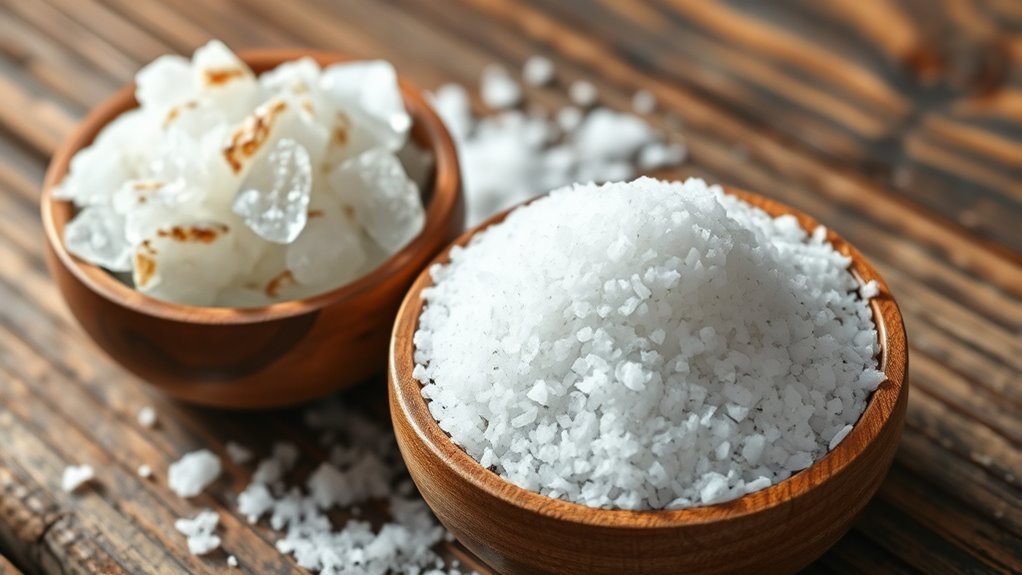
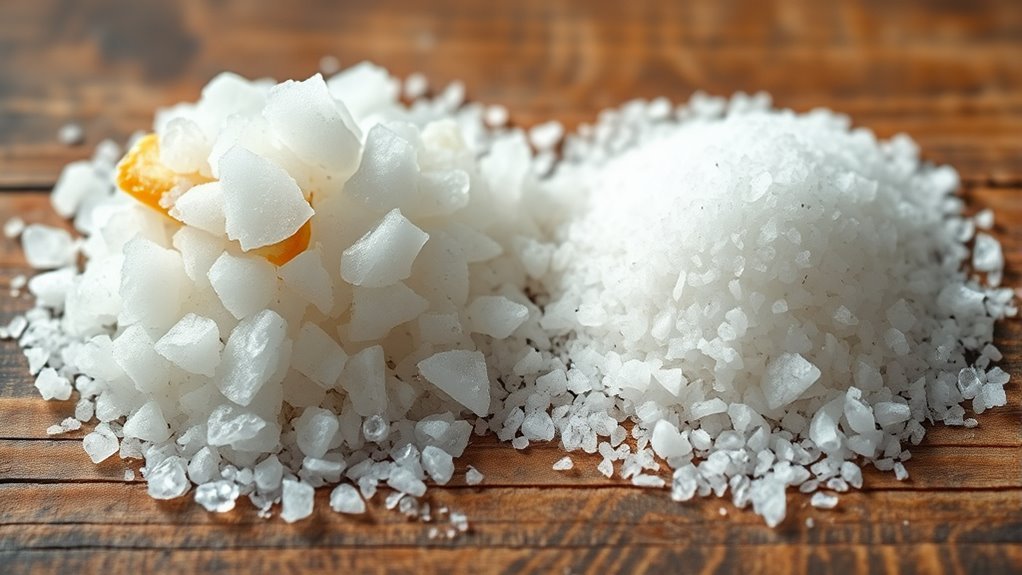
What makes kosher salt different from regular table salt? Both are primarily made of sodium chloride, but kosher salt stands out because it typically contains no additives or iodine, unlike table salt.
Kosher salt differs from table salt mainly by lacking additives and iodine, offering a purer taste.
You’ll notice that kosher salt has much larger, coarser grains, which makes it easier for you to handle and sprinkle evenly. This grain size difference means kosher salt weighs less per volume compared to the fine, compact grains of table salt.
Because of this, if you’re substituting one for the other in recipes, you’ll need to adjust the amounts accordingly to avoid over- or under-salting your dish. Additionally, kosher salt usually doesn’t have anti-caking agents or trace minerals that table salt often contains, so its flavor comes across as purer.
Its name comes from its traditional use in koshering meat, though not all kosher salt brands are officially certified kosher. Understanding these distinctions helps you choose the right salt for your cooking needs.
How Salt Texture and Crystal Size Affect Cooking and Flavor
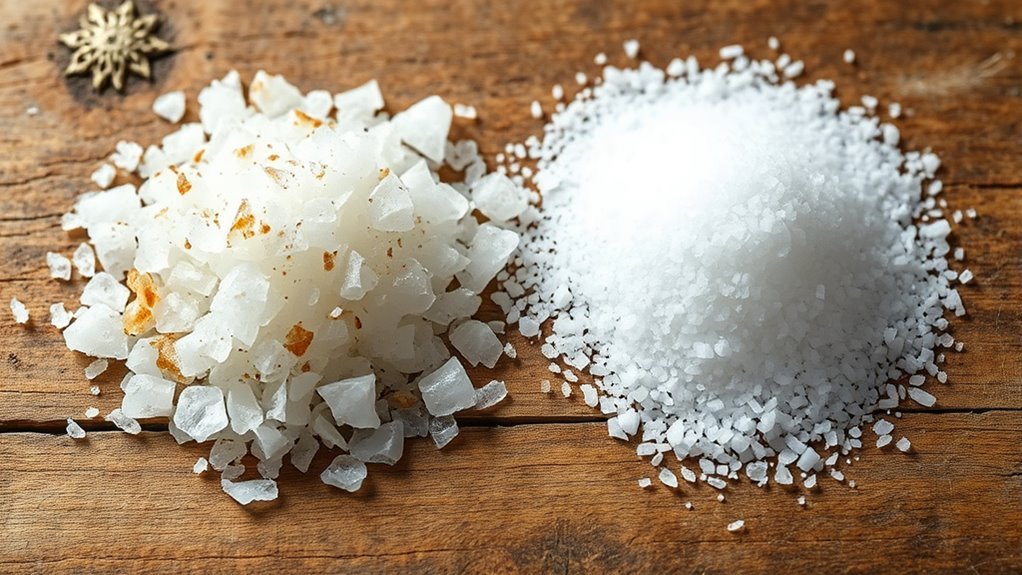
Because salt texture and crystal size directly influence how salt interacts with your food, understanding these factors can elevate your cooking. Larger crystal sizes in kosher salt dissolve more slowly, giving you better control over seasoning and dry brining.
This slower dissolution rate means flavor release happens gradually, enhancing your dish’s complexity. In contrast, fine table salt has small, uniform crystals that dissolve quickly, making it perfect for even distribution in baked goods and liquids.
Salt texture also affects how efficiently you can sprinkle or pinch salt, impacting precision in seasoning. Unrefined salts, with their irregular, flaky structure, trap more air pockets, which alters their density and volume measurements compared to more uniform salts.
Why Kosher Salt Feels Easier to Handle in the Kitchen
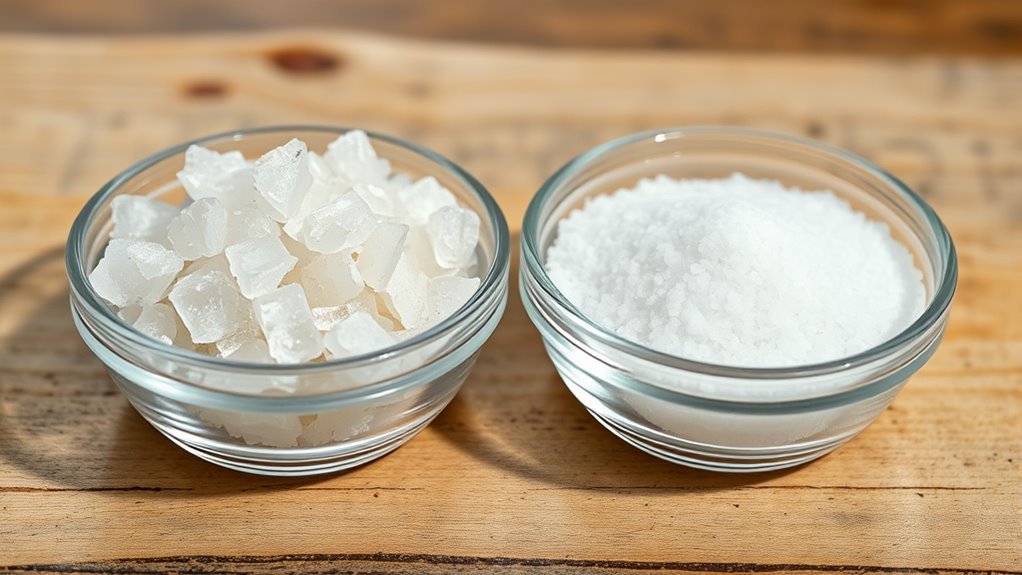
You’ll notice kosher salt’s large, coarse grains are much easier to pick up and pinch than regular salt’s fine crystals. This texture gives you better tactile control, letting you season with more accuracy and confidence.
Handling kosher salt feels natural, making it simpler to sprinkle just the right amount every time. It’s kind of like it was made for your fingers!
Grain Size And Texture
Three key features make kosher salt easier to handle in the kitchen than regular salt: its large, coarse grains, irregular crystal shapes, and light, flaky texture. The grain size of kosher salt is considerably bigger, which means the coarse crystals don’t slip through your fingers like finer table salt does.
This texture gives you better control when sprinkling or pinching, making seasoning more precise. Because kosher salt crystals are porous and chunky, they have a less dense texture, so they’re easier to manipulate by hand.
In contrast, regular salt’s tiny grains tend to scatter or clump, making it tricky to handle. So, when you want that effortless grip and smooth seasoning process, kosher salt’s grain size and texture really stand out.
Tactile Control Benefits
While seasoning your dishes, you’ll find kosher salt offers superior tactile feedback thanks to its large, coarse grains. This coarse texture gives you better tactile control, making it easier to sprinkle or adjust salt levels by hand.
Unlike fine table salt, which can slip through your fingers, the large grains of kosher salt stay put, so you can feel exactly how much you’re using. This helps you with more accurate measuring by touch, reducing the risk of over-salting.
Its irregular crystal shapes enhance your grip, especially when seasoning meats or dry brining. Overall, kosher salt’s substantial, coarse texture provides an intuitive, hands-on experience that lets you control seasoning precisely and confidently throughout your cooking process.
Ease Of Pinching
Building on the tactile control kosher salt offers, its large, coarse grains also make it much easier to pinch and handle in the kitchen. When you pinch kosher salt, its irregular, flaky texture gives you clear feedback, so you can season precisely without overdoing it.
The large grains don’t slip through your fingers like fine table salt, which feels dense and slippery, making handling more challenging. This open, airy crystal structure lets you easily pick up and sprinkle kosher salt evenly over your dishes.
Whether you’re a professional chef or a home cook, the ease of pinching kosher salt improves your seasoning control, letting you focus on flavor without fumbling with tiny, hard-to-grasp grains.
How Iodine and Additives Change Table Salt’s Flavor Compared to Kosher Salt
Because table salt contains iodine and anti-caking additives, you might notice a slightly metallic or chemical taste that doesn’t appear in kosher salt. The iodine added to processed salt can give it a subtle bitterness, altering its natural flavor.
These additives, meant to prevent clumping, also affect the mouthfeel and can mask the clean, straightforward taste you get from kosher salt. When you use kosher salt, which lacks these additives, you experience a purer, more natural saltiness that enhances your dishes without interference.
In contrast, the iodine and other additives in table salt sometimes dull the briny notes that make kosher salt desirable for seasoning and finishing. So, if flavor clarity matters to you, especially in delicate recipes, opting for kosher salt can make a noticeable difference by delivering a cleaner, less processed salt flavor.
Why Salt Grain Size Changes How You Measure It
If you’ve ever swapped kosher salt for table salt in a recipe, you’ve probably noticed the difference in how much you need to use. That’s because the grain size directly affects your measurement. Kosher salt has larger, irregular crystals that take up more space and don’t pack as tightly as the small, uniform grains of table salt.
When you measure by volume—a teaspoon, for example—you’re actually getting less salt with kosher salt because of the air gaps between crystals. This means the same volume of kosher salt weighs less and is less salty than fine table salt.
To get accurate seasoning, you either need to measure salt by weight or adjust the volume when switching between salts with different grain sizes. Understanding this helps you control saltiness better and avoid over- or under-salting your dishes. It makes your cooking more precise and consistent.
Why Different Salts Taste Saltier Even at the Same Volume
Although different salts may look similar when measured by volume, they don’t always taste equally salty. This happens because crystal size, grain size, and density affect the perceived saltiness.
Coarser salts like kosher salt have larger crystals, so less surface area touches your tongue at once, making them taste less salty. Finer salts, such as table salt, have smaller grains that dissolve quickly, delivering more sodium ions and a stronger salty flavor.
Density also plays a role—denser salts pack more particles into the same volume, increasing saltiness.
| Salt Type | Crystal Size | Density (g/cm³) | Perceived Saltiness | Grain Size |
|---|---|---|---|---|
| Kosher Salt | Large | Low | Mild | Coarse |
| Table Salt | Small | High | Strong | Fine |
| Sea Salt | Varies | Medium | Medium | Mixed |
| Himalayan | Medium | Medium | Medium-Strong | Medium |
| Flake Salt | Very Large | Low | Mild | Very Coarse |
Understanding these factors helps you adjust salt use for perfect flavor. So, next time you’re seasoning, you’ll know why some salts hit differently!
When to Use Kosher Salt vs. Table Salt in Cooking and Baking
When seasoning meats or vegetables by hand, reach for kosher salt because its larger grains give you better control and a nice crunch.
For baking, use table salt to guarantee even distribution and consistent flavor since it dissolves quickly and uniformly. Just remember to adjust the amounts if you swap one for the other, as their crystal sizes affect how salty your dish will taste.
Cooking Applications
Since kosher salt has large, coarse grains, you’ll find it perfect for manual seasoning and dry brining, giving you better control over how much salt you add. Its crystal size allows it to stick well on meats and vegetables, making it a favorite salt type for cooking applications that require tactile precision.
On the other hand, table salt dissolves quickly and evenly, so it’s better suited for recipes needing uniform salt distribution, especially in liquids and sauces. Remember, because kosher salt’s crystals are larger, a teaspoon contains less sodium than the same amount of table salt, so you’ll need to adjust quantities accordingly.
Understanding these differences helps you choose the right salt type and crystal size to enhance your cooking results every time. It’s all about picking what works best for your dish and your cooking style!
Baking Considerations
Because kosher salt has larger, coarser grains than table salt, you’ll need to adjust measurements carefully when baking to guarantee the right saltiness. Table salt’s fine crystal size dissolves quickly and evenly, making it ideal for baking recipes where precise salt distribution matters.
If you substitute kosher salt for table salt, reduce the volume by about 25% since its crystals are less dense and take up more space. Kosher salt’s irregular crystal size means it dissolves more slowly, so it’s better suited for seasoning meat or vegetables before cooking rather than in baked goods needing uniform salt incorporation.
For accurate baking results, consider measuring salt by weight or adjusting volume based on the salt type to maintain the recipe’s balance. That way, you keep your dish tasting just right every time.
Flavor Impact
How does the type of salt you use affect your dish’s flavor? Kosher salt’s larger crystal size gives you a more tactile seasoning experience, letting you control saltiness better. Because its crystals are coarser and less dense by volume, using the same amount as table salt results in a milder flavor—so you’ll need to adjust quantities accordingly.
Table salt dissolves quickly for even seasoning but often contains anti-caking agents and iodine, which can leave a metallic aftertaste that impacts your dish’s flavor. In contrast, kosher salt is pure and free from these additives, offering a cleaner, subtler taste.
When cooking or baking, choosing kosher salt can create a more nuanced flavor. Meanwhile, table salt’s fine grains provide consistent saltiness but sometimes at the cost of unwanted aftertastes.
How to Convert and Substitute Between Kosher Salt and Table Salt
When you swap kosher salt for table salt in a recipe, keep in mind that their grain sizes differ considerably, so a teaspoon of kosher salt won’t deliver the same saltiness as a teaspoon of table salt. Since kosher salt has larger, coarser grains, it contains less salt by volume compared to fine table salt.
When you substitute kosher salt for table salt, reduce the amount by about 25% to maintain the right saltiness.
If your recipe uses diamond crystal kosher salt, use roughly 1.5 times the amount of table salt for accurate conversion.
For the most precise conversion, measure both salts by weight with a kitchen scale rather than relying on volume measurements, which can be misleading due to crystal size differences.
Always adjust the salt amount based on taste and the specific salt’s texture to ensure your dish is perfectly seasoned.
How Salt Crystal Shape Affects Dissolving and Cooking
Although salt might seem simple, the shape and size of its crystals play an essential role in how quickly it dissolves and interacts with your food during cooking. Kosher salt features large, flaky, and irregular crystals that dissolve more slowly than the small, dense, cube-shaped crystals of regular table salt.
This difference in crystal shape affects how salt releases flavor and influences salt texture in your dishes. When you use kosher salt, its porous flakes absorb and release moisture gradually, allowing for a more controlled seasoning during cooking.
In contrast, fine table salt dissolves rapidly, making it ideal for baking or recipes requiring uniform salt distribution. Understanding these crystal shape differences helps you choose the right salt for your cooking needs, ensuring better control over seasoning and texture.
Why Kosher Salt Is Often Preferred for Seasoning and Brining
Because kosher salt has large, coarse grains and no additives, you’ll find it much easier to control when seasoning or brining. Its clean flavor enhances your dishes without any unwanted bitterness from additives.
The irregular crystals dissolve slowly, giving you better tactile feedback and even coverage on meats and vegetables.
Here’s why kosher salt is often preferred for seasoning and brining:
- Large, coarse crystals make it easy to pinch and sprinkle precisely
- No iodine or additives means a pure, clean taste
- Slower dissolving crystals allow for gradual seasoning
- Irregular crystal shape helps salt stick during dry brining
- Lower density means you use less volume to achieve the same saltiness
With kosher salt, you get consistent results and better control. It’s ideal for both seasoning and brining your favorite recipes.
Frequently Asked Questions
Which Is Better for You, Regular Salt or Kosher Salt?
Neither regular nor kosher salt is better for you; it’s more about how much you use.
You should watch your sodium intake overall, since both contribute equally to health risks when consumed in excess.
Why Do Chefs Use Kosher Salt Instead of Sea Salt?
Chefs use kosher salt because you get better control with its coarse grains, making it easier to season precisely. It dissolves slowly, offers a cleaner taste without additives, and lets you avoid over-salting your dishes.
Plus, its texture feels great between your fingers, so you can pinch and sprinkle just the right amount. That way, you’re not guessing how much salt is going in. It’s all about getting that perfect balance in flavor.
Can I Just Use Normal Salt Instead of Kosher Salt?
You can use normal salt instead of kosher salt, but it’s like trading a wide brush for a fine pen—you’ll need less and should measure carefully to avoid over-salting.
Normal salt is much finer and denser, so a little goes a long way. Just keep that in mind when you’re cooking!
When Not to Use Kosher Salt?
You shouldn’t use kosher salt when baking, candy-making, or in recipes needing precise salt measurements. Its coarse grains dissolve slowly and unevenly.
Conclusion
So, next time you’re reaching for salt, remember: kosher salt isn’t just fancy table salt with a fancy name—it’s the salt that actually knows how to party in your kitchen. Regular salt might try to keep things simple, but kosher salt’s texture and flavor game? Next level.
Just don’t get too serious measuring—because who knew salt could be this complicated? Embrace the crunch, the flavor, and maybe, just maybe, your food will thank you.
When it comes to cooking, the difference between kosher salt and regular salt can really change the game. Kosher salt’s larger flakes make it easier to pinch and sprinkle, giving you better control over seasoning. Plus, its unique texture helps it dissolve more evenly, enhancing the flavor without overpowering your dish.
So, whether you’re salting meat, seasoning veggies, or finishing a recipe, choosing kosher salt can elevate your cooking. It’s not just salt—it’s a kitchen essential that brings out the best in your food.