
Which of the Following Is a Salt?
You can identify a salt by checking if it’s an ionic compound formed from a neutralization reaction between an acid and a base.
Salts usually consist of metal cations and nonmetal anions combined through ionic bonds. These characteristics help distinguish salts from other types of compounds.
For example, NaCl is a classic salt because it forms when HCl reacts with NaOH. This reaction creates neutral, crystalline ions that dissociate in water without releasing H⁺ or OH⁻ ions.
So, if you want to understand how salts differ from acids and bases, keep exploring these traits. It’s a simple way to spot salts in chemistry!
Key Takeaways
- A salt is an ionic compound formed by the neutralization of an acid and a base. Salts consist of metal cations and nonmetal anions held by ionic bonds.
- When you dissolve salts in water, they break apart into their constituent ions. But here’s the cool part: salts don’t release H⁺ or OH⁻ ions, so they stay neutral in the solution.
- A common example you probably know is sodium chloride, or table salt (NaCl). It’s a classic example of what a salt really is.
How to Identify Salts: Ionic Compounds and Their Formation
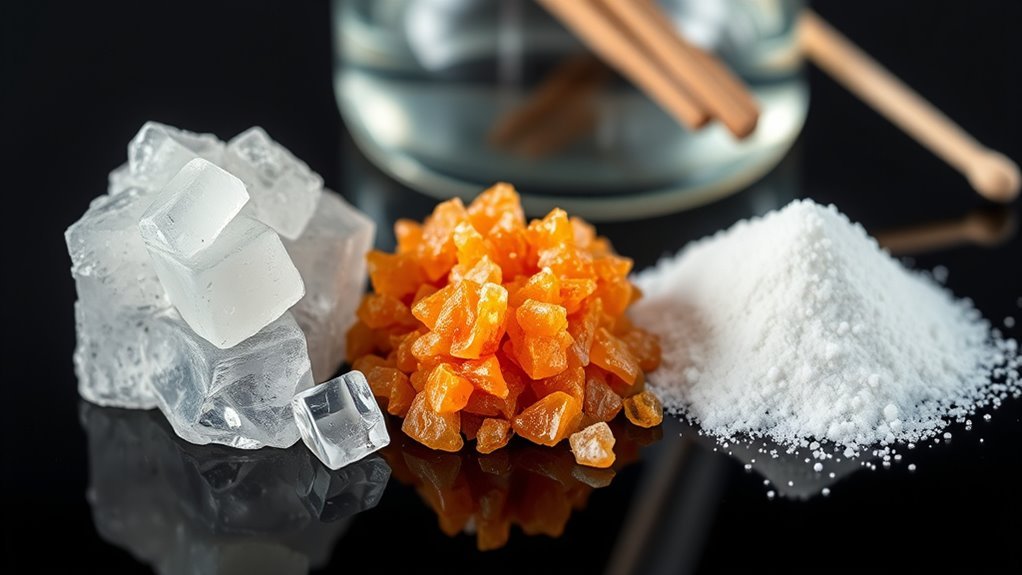
How can you identify a salt? You look for an ionic compound formed through the neutralization reaction between an acid and a base. During this reaction, the acid donates protons (H⁺), while the base supplies hydroxide ions (OH⁻).
These ions combine to produce a salt, consisting of metal cations and nonmetal anions. The ions in a salt are held together by strong ionic bonds, creating a stable ionic compound.
Salts form when metal cations and nonmetal anions bond ionically, creating stable compounds.
When dissolved in water, salts dissociate into their constituent ions. This is a key characteristic you can use to confirm their presence.
Recognizing salts involves understanding this formation process: the reaction of an acid and a base produces a new substance with distinct ions. Common salts like sodium chloride (NaCl) exemplify this ionic nature.
Why NaCl Is a Classic Salt, Not an Acid or Base
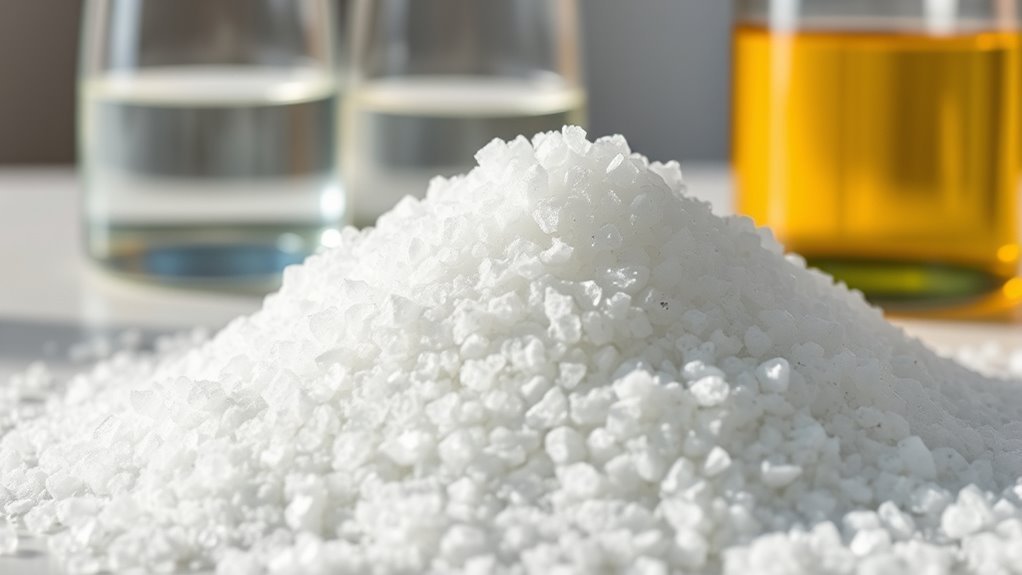
You can quickly spot why NaCl stands out as a classic salt by looking at how it forms and behaves. Sodium chloride, or NaCl, results from a neutralization reaction between a strong acid (HCl) and a strong base (NaOH).
This reaction produces an ionic compound composed of positively charged sodium ions (Na⁺) and negatively charged chloride ions (Cl⁻), held together by strong ionic bonds. Unlike acids or bases, NaCl doesn’t release H⁺ or OH⁻ ions in solution, which keeps it neutral.
Because NaCl is neutral, it doesn’t show typical acid or base properties like a sour taste or caustic behavior. Instead, it forms a crystalline structure that’s stable and characteristic of salts.
Frequently Asked Questions
What Are the 4 Types of Salts?
You’ll find four types of salts: neutral salts, acidic salts, basic salts, and double salts. Each forms differently—neutral from full neutralization, acidic or basic from partial, and double salts from two salts crystallizing together.
So, neutral salts come from a complete reaction between an acid and a base. Acidic or basic salts happen when the reaction is just partial.
And double salts? They’re kinda cool—they form when two different salts crystallize together in one compound.
Which of the Following Substances Is a Salt?
Imagine a handshake between two rivals—NaCl is that bond, a salt.
If you spot K₂SO₄, that’s another salt, formed when acids and bases make peace.
You’ll know salts by their ionic embrace.
What Is an Example of a Salt?
An example of a salt is sodium chloride (NaCl). You’ll find it forms when hydrochloric acid reacts with sodium hydroxide, creating an ionic compound.
This compound dissociates into positive and negative ions in water. So, basically, it splits up and spreads out, which is why salt dissolves so well.
Is Salt a Solid or a Gas?
Salt is a solid at room temperature because of its strong ionic bonds forming a crystalline structure. You won’t find salt as a gas under normal conditions since it requires extreme heat or pressure to change state.
Basically, salt sticks together tightly, which keeps it solid. Turning it into a gas isn’t something that happens easily or naturally.
Conclusion
Now that you know salts are ionic compounds formed from acids and bases, you can easily spot them. Take table salt, NaCl, for example—it’s not an acid or base, but a stable compound made from sodium and chlorine ions.
Next time you see a crystalline substance, think about its ions and origin. Understanding this helps you recognize everyday salts and their important roles in chemistry and life.
Salts play a crucial role in many chemical reactions and biological processes. By identifying their ionic nature and how they form from acids and bases, you’ll be able to tell which compounds are salts. So, whenever you come across a compound like NaCl, remember it’s a salt—a key player in both chemistry and daily life!