
How Does Kosher Salt Have Minerals?
You might think kosher salt contains minerals, but its refining process removes nearly all except pure sodium chloride. During manufacturing, impurities and trace minerals are stripped away to give you clean, uniform crystals without additives.
While some rare mineral-rich kosher salts exist, most don’t have enough minerals to make a difference.
If you want to understand how this compares to sea salt and why kosher salt stays so pure, keep exploring the details.
Key Takeaways
- Kosher salt is mostly just sodium chloride, and it has very little mineral content because it goes through a lot of refining and purification.
- During the processing, most of the minerals get stripped away to make sure the salt is pure and the crystals are uniform.
- You might find tiny amounts of minerals like magnesium, calcium, and potassium, but in standard kosher salt, these are usually negligible or not there at all.
- Sometimes, specialty kosher salts come from mineral-rich deposits and might have small amounts of minerals, but that’s pretty rare.
- Compared to sea salt, kosher salt doesn’t have the same natural mineral profile. Sea salt keeps those minerals because it’s made through evaporation, not heavy refining.
How Kosher Salt Retains Its Natural Minerals
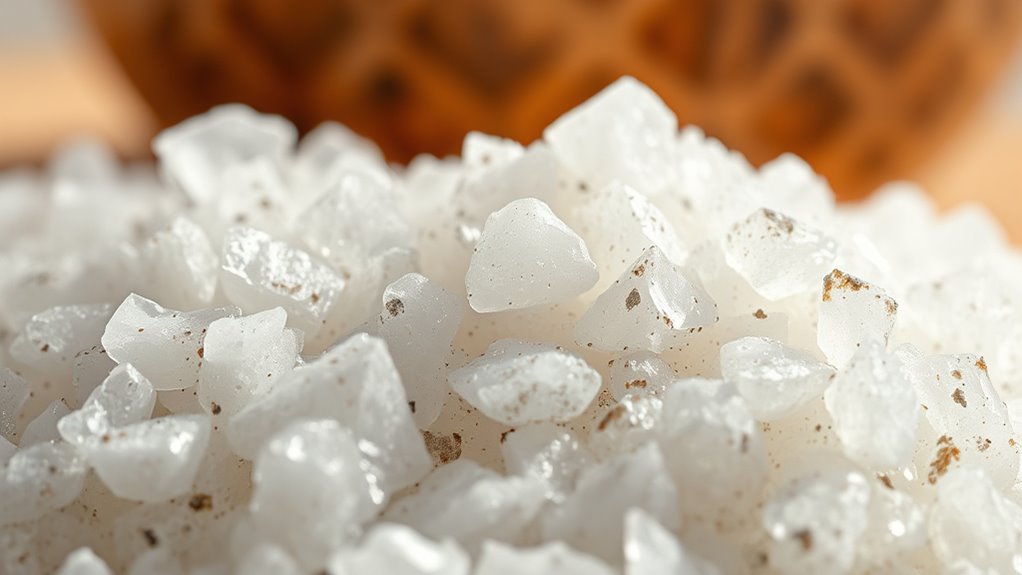
Although you might expect kosher salt to retain natural minerals, it actually doesn’t because manufacturers process it to remove impurities and trace elements. Unlike sea salt, kosher salt undergoes refining practices that focus on purifying the crystals, stripping away most of its mineral content.
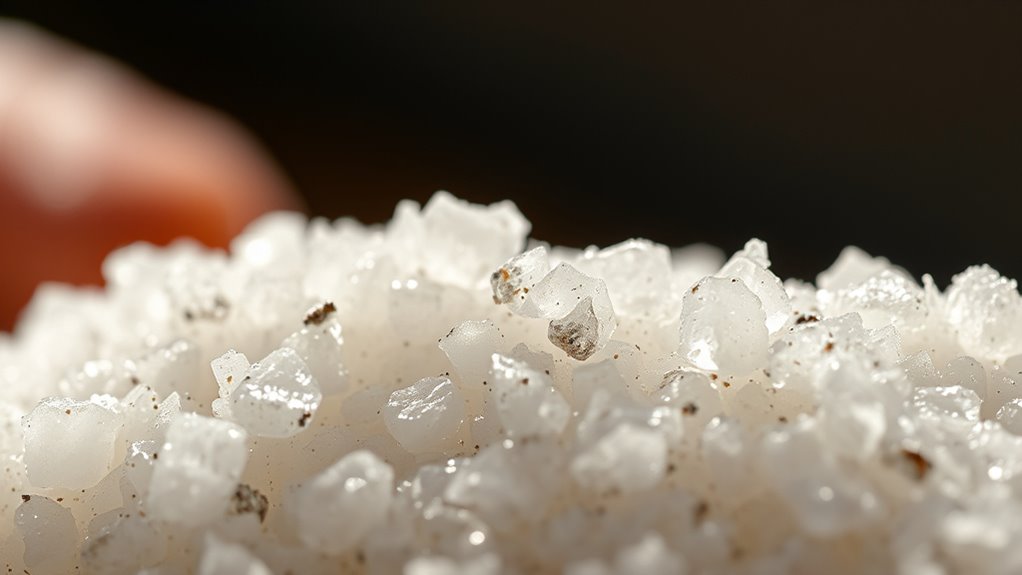
Kosher salt is refined to remove impurities, resulting in crystals largely free of natural minerals.
During processing, the salt is compressed and purified, reducing mineral traces like magnesium, calcium, and potassium. This results in a mineral profile with minimal natural minerals, making kosher salt mainly pure sodium chloride.
The mineral retention in kosher salt is intentionally low due to these refining practices, which aim to produce uniform, additive-free crystals. So, when you use kosher salt, you’re mostly getting sodium chloride without significant trace minerals or impurities.
Understanding this helps clarify why kosher salt differs from other salts that keep a richer mineral profile. In short, kosher salt is processed to prioritize purity over the retention of natural minerals or trace minerals.
Which Minerals Are Found in Kosher Salt and Where They Come From
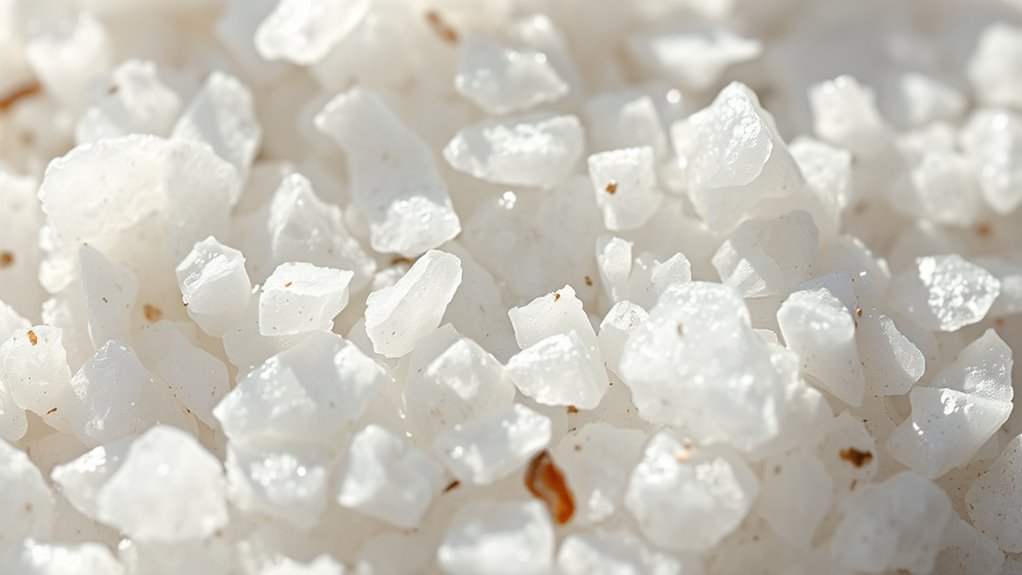
While kosher salt is mostly pure sodium chloride, you might wonder if it contains any minerals at all and where they come from. Generally, kosher salt has negligible minerals because it undergoes refining to remove impurities and trace elements.
Unlike sea salt, which retains minerals like magnesium, calcium, and potassium thanks to the natural evaporation process of seawater, kosher salt’s mineral content is minimal. This evaporation process traps seawater’s minerals in sea salt, but kosher salt production focuses on purity, stripping away these trace elements.
Occasionally, specialty kosher salts derived from mineral-rich salt deposits may contain small amounts of minerals, but this is rare. So, if you’re looking for minerals such as magnesium, calcium, or potassium, kosher salt won’t provide much.
Instead, it mainly offers clean sodium chloride, making it ideal when you want salt without added mineral complexity.
Frequently Asked Questions
Is Kosher Salt Healthier Than Regular Salt?
Kosher salt isn’t healthier than regular salt since both mainly contain sodium chloride. You’ll want to watch your intake regardless, as neither offers significant minerals or health benefits beyond seasoning your food effectively.
Basically, they do the same job when it comes to adding flavor. So, it’s more about your preference for texture or how you like to use it in cooking. Just remember, moderation is key with any kind of salt!
Which Salt Has 92 Minerals?
You’ve probably heard Himalayan pink salt has 92 minerals, and that’s mostly true—it contains many trace minerals from ancient seas.
But don’t expect kosher salt to match this; it’s mostly just pure sodium chloride.
Why Do Non-Jews Use Kosher Salt?
You use kosher salt because its large grains give you better control when seasoning. It’s free from additives, and offers a clean, natural flavor.
It’s perfect for cooking, curing, and finishing dishes with ease. Plus, many cooks just find it easier to pinch and sprinkle.
Which Salt Has 82 Minerals?
Ever wonder which salt boasts 82 minerals? That’s Himalayan pink salt.
You’ll find it packed with trace minerals like potassium, magnesium, and iron. It’s a flavorful, mineral-rich choice compared to regular table salt.
Conclusion
Now that you know kosher salt carries a natural mineral bouquet, you can appreciate how it’s more than just a seasoning. These minerals, like calcium and magnesium, sneak in during the salt’s journey from the earth or sea, giving it a subtle, savory depth.
So next time you sprinkle kosher salt, think of it as a tiny treasure chest. It’s not just about adding flavor — it’s also about boosting your food with those essential minerals. That’s what makes kosher salt special, turning every bite into something a little richer and more satisfying.