

10 Key Differences Between Himalayan Salt and Sea Salt
You’ll find Himalayan salt comes from ancient mountainous deposits, offering a rich mineral profile with less sodium and fewer contaminants than sea salt.
Sea salt, on the other hand, is harvested through seawater evaporation and can sometimes contain microplastics and heavy metals.
Himalayan salt’s pink color and finer crystals differ from sea salt’s white, flaky texture, which impacts both taste and use.
Plus, it’s often considered purer and safer for your health and the environment.
If you want a deeper look at their unique qualities, there’s definitely more to explore.
Each type of salt brings something different to the table, literally and figuratively!
Key Takeaways
- Himalayan salt is mined from ancient Himalayan deposits, while sea salt is produced by evaporating seawater in coastal pools.
- Himalayan salt contains 84 trace minerals with lower sodium, whereas sea salt’s mineral content varies and may include pollutants like microplastics.
- Himalayan salt has a pink hue with fine crystals; sea salt is white or gray with larger, flaky crystals ideal for finishing dishes.
- Himalayan salt is minimally processed and free from contaminants, while sea salt may contain microplastics and heavy metals from ocean pollution.
- Himalayan salt is safer long-term due to fewer pollutants, whereas sea salt contamination risks depend on source and processing quality.
Where Do Himalayan and Sea Salt Come From?

Where exactly do Himalayan salt and sea salt come from? You’ll find Himalayan salt mined from ancient salt deposits nestled in the Himalayan mountains, mainly in Pakistan. These salt deposits formed millions of years ago, preserving a unique mineral composition influenced by their geographic origin in mountainous terrain.
Himalayan salt is mined from ancient deposits deep within the mountains of Pakistan, shaped by its unique terrain.
On the other hand, sea salt originates from seawater evaporation. Coastal regions worldwide harvest it by evaporating seawater in shallow pools, leaving behind salt crystals rich in minerals from the ocean.
While Himalayan salt is often hand-mined from solid rock salt deposits deep within the mountains, sea salt is collected from evaporated seawater pools along various coastlines. This difference in origin—mountainous versus oceanic—plays a vital role in their distinct characteristics.
Understanding where these salts come from helps you appreciate how their geographic origin shapes their mineral content and appearance, though that’s a topic for another time.
How Do Their Mineral Contents Differ?

Both Himalayan salt and sea salt offer unique mineral profiles that set them apart. Himalayan salt contains all 84 essential trace minerals, including iron oxide, calcium, magnesium, and potassium, which contribute to its distinctive color.
Its mineral content is more diverse and abundant because it’s mined from ancient mountain deposits, giving it a richer mineral profile.
Sea salt’s mineral content varies depending on where it’s harvested but usually includes magnesium, calcium, and potassium in simpler forms. The mineral profile of sea salt reflects the ocean water and environmental factors, sometimes resulting in impurities like microplastics and heavy metals.
While Himalayan salt boasts a more extensive range of trace minerals, the amounts are minimal and unlikely to impact your health considerably.
When choosing between the two, consider that Himalayan salt offers a broader mineral profile, whereas sea salt’s content depends heavily on its geographic origin and exposure to pollution.
Why Himalayan and Sea Salt Look Different

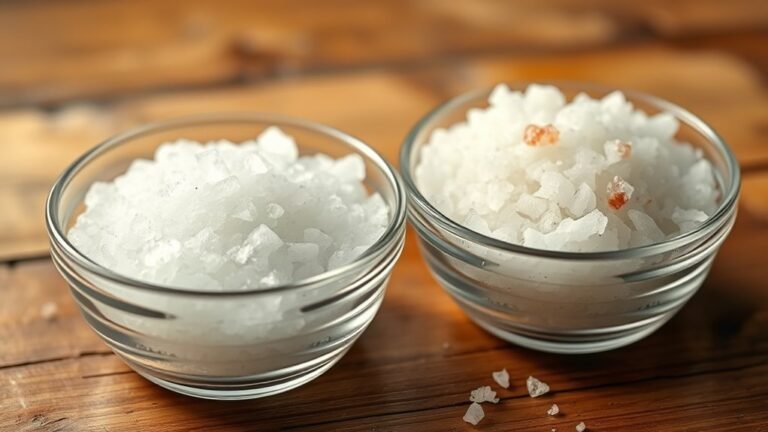
Though they come from very different sources, Himalayan salt and sea salt each display unique colors and textures that reflect their origins. Himalayan salt’s pink or reddish hue comes from iron oxide and a rich mineral content embedded in ancient mineral deposits found in mountainous regions. This color variation sets it apart, giving it a more opaque and varied appearance.
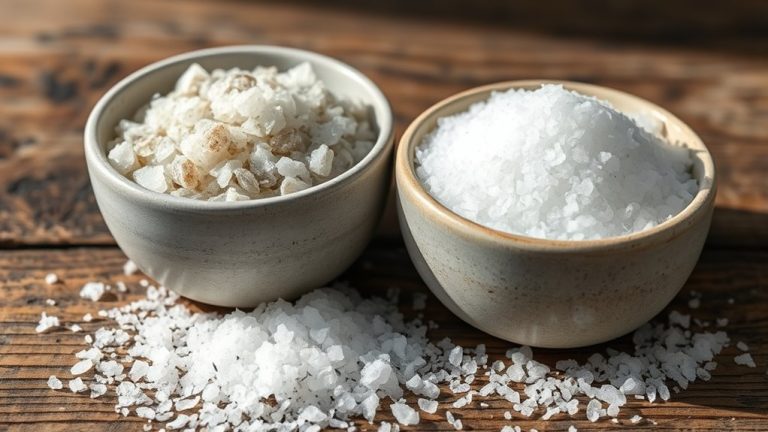
Sea salt, on the other hand, forms through the evaporation of seawater. Its color depends on the mineral content present in that water, typically resulting in a white or gray crystalline and flaky texture. Because sea salt lacks the diverse minerals found in Himalayan salt’s rock deposits, it appears more uniform and less colorful.
How Processing Impacts Himalayan and Sea Salt Purity and Safety
The origins of Himalayan and sea salt don’t just influence their appearance—they also affect their purity and safety. Himalayan salt is minimally processed, usually hand-mined and simply broken into grains. This careful extraction preserves its natural mineral content and purity, keeping it free from artificial additives and microplastics.
In contrast, sea salt is produced through the evaporation of seawater, which can introduce contamination from pollutants and microplastics found in the ocean. Although sea salt often undergoes filtration, current methods may not fully eliminate these contaminants or heavy metals, raising safety concerns.
Because of this, when you choose Himalayan salt, you’re opting for a product with a cleaner, more natural processing method that maintains high purity and reduces the risk of contamination. Sea salt’s purity and safety can vary depending on its source and processing, so it’s important to weigh these factors when selecting your salt.
Health Benefits of Himalayan vs Sea Salt
You’ll find Himalayan salt offers a richer mineral profile compared to most sea salts, which can sometimes carry microplastics and heavy metals. Both salts help maintain electrolyte balance and hydration, but Himalayan salt’s purity might give it an edge in safety.
Let’s explore how these differences impact their health benefits. It’s pretty interesting to see what sets them apart!
Mineral Content Comparison
Understanding the mineral content of Himalayan salt and sea salt can help you choose the best option for your health. Himalayan salt is more mineral-rich, containing all 84 essential trace minerals like iron, calcium, magnesium, and potassium.
This diverse mineral profile not only gives it its distinctive pink or grey hue but also sets it apart from sea salt, which generally has fewer trace minerals and appears white due to fewer impurities. While both salts provide similar sodium chloride levels, Himalayan salt’s richer trace mineral content may offer added health benefits.
On the other hand, sea salt’s mineral content varies by geographic origin and may contain microplastics and pollutants. So, Himalayan salt can be a cleaner, mineral-packed choice for those seeking natural mineral supplementation.
Electrolyte and Hydration Support
Although both Himalayan salt and sea salt supply essential electrolytes like sodium, potassium, magnesium, and calcium, they help keep your body hydrated and your nerves functioning properly. Himalayan salt’s richer mineral content may offer stronger support for electrolyte balance.
It includes all 84 trace elements, which enhances the variety of electrolytes you consume. Plus, with a higher sodium content per teaspoon and larger crystal structure, Himalayan salt might promote more sustained hydration compared to the finer sea salt crystals.
However, moderation is key to avoid dehydration or blood pressure issues. So, keep that in mind when choosing your salt.
Consider these points:
- Both salts support hydration by providing crucial electrolytes.
- Himalayan salt contains a broader spectrum of trace elements.
- Higher sodium in Himalayan salt influences fluid balance more profoundly.
- Larger crystals slow sodium absorption, aiding hydration.
- Excessive intake of either can harm hydration and health.
Safety and Contaminant Risks
Since ocean pollution has increased over the years, sea salt can contain microplastics and heavy metals like lead. These substances may pose health risks when consumed regularly.
These contaminants come from pollutants in the water and raise concerns about long-term ingestion. It’s something to keep in mind if you use sea salt often.
In contrast, Himalayan salt is mined from ancient deposits untouched by modern pollution. This means it’s free from microplastics and most environmental contaminants.
Heavy metal levels in Himalayan salt remain low and within safety standards, providing a cleaner option. So, if you’re looking for something safer, this might be it.
While sea salt’s safety depends heavily on its source and processing, Himalayan salt generally offers a safer profile regarding contamination. If you want to minimize your exposure to pollutants and heavy metals, choosing Himalayan salt is a smarter, safer choice.
Hydration and Electrolyte Balance With Himalayan and Sea Salt
When you add a pinch of Himalayan or sea salt to your water, you’re not just enhancing flavor—you’re supporting your body’s hydration and electrolyte balance. Both salts contain essential minerals like sodium, potassium, and magnesium that play a vital role in maintaining hydration by regulating fluid balance in your cells.
Himalayan salt, often called hyaluronic salt due to its mineral-rich content, offers slightly less sodium than sea salt per serving. This difference can influence how effectively your body retains water.
Adding these salts to water helps activate the sodium-potassium pump, which is essential for muscle contractions and nerve signals. Their larger crystal structure means less sodium per teaspoon compared to table salt, making them a smart choice for hydration without excessive sodium intake.
- Supports electrolyte balance with natural mineral content
- Enhances cellular hydration efficiently
- Provides sodium for fluid regulation
- Contains potassium and magnesium for muscle and nerve function
- Offers a gentler sodium load per serving than table salt
Blood Pressure and Sodium: Effects of Himalayan and Sea Salt
When managing your blood pressure, it’s important to know that Himalayan salt usually has slightly less sodium per teaspoon than sea salt. Both types can raise blood pressure if you use too much, so keeping your intake within recommended limits is key.
Sodium Content Comparison
How much sodium are you really getting from your salt? When comparing sodium content, Himalayan salt contains about 380 mg of sodium per teaspoon, while sea salt has roughly 540 mg.
This sodium comparison shows Himalayan salt is slightly lower in sodium, which might matter if you’re watching your intake. Both salts have less sodium than regular table salt, which packs 2,300 mg per teaspoon.
Keep in mind, larger crystals of Himalayan salt can reduce sodium intake per volume due to lower density.
- Himalayan salt: ~380 mg sodium per teaspoon
- Sea salt: ~540 mg sodium per teaspoon
- Table salt: ~2,300 mg sodium per teaspoon
- Larger Himalayan crystals may lower sodium consumed
- Excess sodium, regardless of type, can affect blood pressure
Monitor your sodium intake carefully to manage blood pressure effectively.
Blood Pressure Impact
Although both Himalayan and sea salt contain sodium that can raise your blood pressure by causing your body to retain water, Himalayan salt’s slightly lower sodium content per teaspoon might offer a small advantage for managing blood pressure.
The mineral composition of each salt varies, but both still contribute sodium chloride, which impacts blood pressure. You should focus more on your total salt intake rather than choosing between these salts, as excess sodium raises hypertension risk.
Individual sensitivity to sodium also plays a role in how your blood pressure responds. So, keeping an eye on how much salt you consume overall is what really matters here.
| Factor | Himalayan Salt | Sea Salt |
|---|---|---|
| Sodium Content | Slightly lower | Slightly higher |
| Mineral Composition | Contains trace minerals | Contains trace minerals |
| Sodium Chloride | Present | Present |
| Blood Pressure Impact | Mildly lower risk | Slightly higher risk |
| Salt Intake Advice | Monitor overall intake | Monitor overall intake |
Recommended Intake Limits
You should limit your daily sodium intake to no more than 2,300 mg, with an ideal goal of 1,500 mg for certain groups to keep blood pressure in check. Both Himalayan and sea salt contribute to your salt consumption, but sticking to recommended sodium intake is key to managing blood pressure effectively.
Although Himalayan salt has slightly less sodium per teaspoon, using too much of either salt can raise blood pressure because of sodium-induced water retention. It’s really about how much sodium you consume overall, not just the type of salt.
- Follow dietary guidelines to avoid exceeding sodium limits.
- Individual sensitivity to sodium varies; keep an eye on your blood pressure.
- Cutting back on processed foods has a bigger impact on blood pressure than just switching salts.
- Use Himalayan or sea salt in moderation as part of your total salt intake.
- The main thing is to prioritize meeting sodium limits to protect your cardiovascular health.
Taste and Culinary Uses Compared
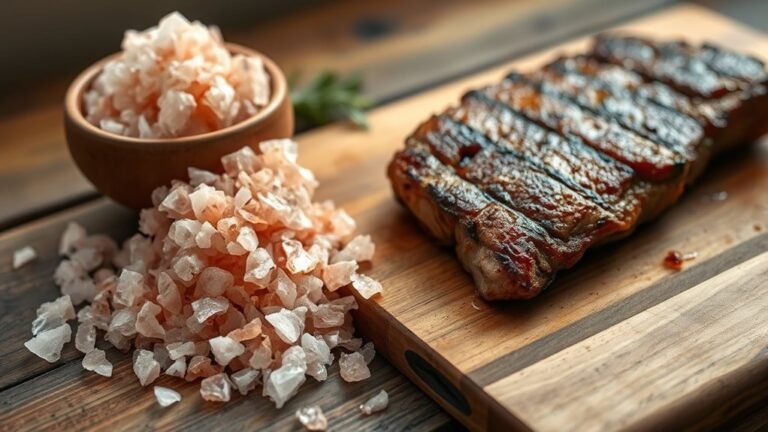
When choosing between Himalayan salt and sea salt for your recipes, consider their distinct flavor profiles and culinary uses. Himalayan salt offers a milder, slightly sweet taste due to its mineral content. This makes it ideal for baked goods and grilled dishes.
Sea salt, with its larger crystal structure, delivers a crunchier texture and a more pronounced mineral flavor. It often features earthy or smoky notes depending on its origin.
Both salts work well for cooking and finishing. But Himalayan salt’s consistent flavor and appealing pink hue make it popular for gourmet presentations.
Sea salt’s varied mineral profile can subtly change a dish’s flavor, especially when used as a finishing touch.
| Aspect | Himalayan Salt |
|---|---|
| Taste | Mild, slightly sweet |
| Flavor Notes | Consistent, mineral-rich |
| Crystal Structure | Fine to medium, less crunchy |
| Culinary Uses | Baking, grilling, presentation |
| Texture Impact | Subtle, smooth flavor enhancement |
| Aspect | Sea Salt |
| Taste | Earthy, herbal, smoky |
| Flavor Notes | Varies by origin |
| Crystal Structure | Large, coarse, crunchy |
| Culinary Uses | Finishing salt, seasoning |
| Texture Impact | Pronounced crunch and flavor burst |
Salt Safety: Which Is Better for Dinnerware?
When choosing salt for dinnerware, you need to take into account safety and durability. Himalayan salt’s porous surface can trap bacteria and chip easily, making it less ideal.
Sea salt, with its sturdier crystalline structure, offers a safer and more reliable option for serving and decorative use. So, if you want something that lasts and stays hygienic, sea salt is the way to go.
Dinnerware Safety Concerns
Although Himalayan salt blocks add a unique aesthetic to your table, they aren’t the safest choice for dinnerware due to their porous structure that can trap bacteria and contaminants. This porous structure increases contamination risk, making Himalayan salt less ideal for direct, prolonged contact with food or liquids.
In contrast, sea salt’s crystalline, non-porous nature offers better dinnerware safety, minimizing bacterial growth and contamination. When choosing between the two, consider these factors:
- Himalayan salt’s porous structure can harbor bacteria and microplastics
- Sea salt’s minimal processing and dense crystals reduce contamination risk
- Himalayan salt blocks aren’t recommended for moist foods or liquids
- Sea salt is generally safe for decorative and culinary dinnerware
- Proper hygiene guidelines advise against using Himalayan salt for continuous food contact
For dinnerware safety, sea salt remains the better option.
Usage Recommendations
Because Himalayan salt’s porous and softer crystalline structure absorbs moisture and bacteria easily, it isn’t a safe choice for dinnerware. Its porous nature compromises hygiene and stability, making it prone to damage from heat or liquids.
When considering usage, you should avoid Himalayan salt for plates or serving dishes due to these safety concerns.
On the other hand, sea salt offers better stability thanks to its denser, more stable crystalline form. This makes sea salt a practical and safer option for dinnerware, especially for decorative or culinary purposes.
Its minimal processing and solid structure reduce the risk of bacterial absorption, ensuring safer contact with food. So, for dinnerware usage, sea salt stands out as the safer, more reliable choice over Himalayan salt.
Environmental Impact and Contamination Risks of Himalayan and Sea Salt
Since sea salt comes from ocean waters heavily affected by pollution, it often contains microplastics and heavy metals like lead and mercury. These can pose health risks.
When you choose sea salt, you might ingest contaminants linked to inflammation and oxidative stress. Plus, sea salt harvesting can disrupt marine ecosystems and spread pollutants through evaporation ponds.
In contrast, Himalayan salt is mined from ancient, isolated deposits. So, it’s generally free from microplastics and modern pollutants, making it a cleaner option.
Consider these key points about environmental impact and contamination:
- Sea salt contains microplastics exceeding safety thresholds in some samples
- Heavy metals like mercury and lead are common pollutants in sea salt
- Ocean pollution increases contamination risks in sea salt
- Himalayan salt mining has less environmental impact compared to ocean harvesting
- Microplastic contamination is absent in Himalayan salt due to its geological origin
Choosing Himalayan salt helps you avoid many contamination risks associated with sea salt.
Frequently Asked Questions
Who Should Not Use Himalayan Pink Salt?
You shouldn’t use Himalayan pink salt if you have kidney or heart issues, or need low sodium.
Also, it’s best to avoid it if you’re pregnant, a child, or sensitive to trace minerals.
Always check with your healthcare provider before adding it to your diet.
Which Is the Healthiest Salt to Take?
You should choose Himalayan salt if you want fewer contaminants and more trace minerals, but both salts have similar sodium.
Focus on quality and moderation to stay healthy, since neither offers significant health benefits over the other.
Is Costco Pink Salt the Same as Himalayan Salt?
Don’t judge a book by its cover—you can’t always be sure if Costco pink salt is true Himalayan salt.
Check the label carefully because some products vary in mineral content, purity, and origin despite similar appearances.
Do You Drink Pink Salt in the Morning or at Night?
You can drink pink salt either morning or night. In the morning, it boosts hydration and energy.
At night, it helps relax muscles and supports adrenal function. Choose the time that fits your health goals best.
Conclusion
You might think all salts are basically the same, but Himalayan and sea salt offer distinct benefits you shouldn’t overlook. While Himalayan salt boasts unique minerals and a beautiful pink hue, sea salt often has a milder flavor and different mineral profiles.
Both are safe when used properly, so don’t worry about purity. Choosing either depends on your taste and health goals, making both great additions to your kitchen. Whether you prefer the vibrant color and mineral richness of Himalayan salt or the gentle flavor and texture of sea salt, each brings something special to your meals.
In the end, understanding the differences between Himalayan salt and sea salt can help you make a more informed choice. So, try them both and see which suits your cooking style and nutritional needs best!