
How Do I Select the Right Salt for a Buffer?
To select the right salt for your buffer, focus on balancing the salt type and concentration to boost protein stability and solubility. Choosing the appropriate salt is key because it directly affects how your protein behaves during purification.
Ammonium sulfate works well up to 2 M, enhancing ligand interactions and helping proteins stay stable.
On the other hand, sodium chloride may need to be used at higher levels, but it comes with the risk of precipitation. Remember, the salt influences both hydrophobic and ionic effects, so you want to adjust it carefully.
It’s also important to consider the buffer’s pH and other components while making these changes.
Fine-tuning these factors will improve purification and protein behavior in your experiments. Keep exploring and testing to uncover the best strategy that fits your specific needs.
It’s a bit of trial and error, but finding the right balance really pays off.
Key Takeaways
- Choose salts based on how they influence hydrophobic interactions and ionic strength for the specific protein or ligand you’re working with.
- Think about how different salt types affect protein stability, solubility, and binding. Ammonium sulfate and sodium chloride are common choices you might consider.
- It’s important to optimize the salt concentration. You want to improve protein binding and solubility without causing the protein to precipitate or become unstable.
- Also, keep in mind the buffer pH and other components. These interact with the salt and can influence the overall ionic strength and protein behavior.
- The best approach is to use empirical testing and try out different conditions. This way, you can find the salt type and concentration that work best to maximize purification efficiency and keep your protein stable.
How to Choose the Best Salt for Protein Stability and Solubility
When selecting the best salt for protein stability and solubility, you need to contemplate how different salts affect hydrophobic interactions and ionic strength. Salt selection plays a vital role in buffer systems by influencing protein stability and solubility.
Choosing the right salt is crucial for balancing protein stability and solubility through ionic strength and hydrophobic effects.
For instance, ammonium sulfate is widely favored because at salt concentrations up to 2 M, it enhances ligand-protein interactions and stabilizes protein structures effectively. Sodium chloride, however, may require higher salt concentrations—often up to 3 M—to reach similar effects, but such high salt levels can reduce protein solubility.
You also must consider buffer pH and other buffer components, as they interact with salt concentration to shape ionic strength and hydrophobic interactions. Since these factors vary with the type of salt, trial and error is often necessary to optimize your buffer system.
Balancing ionic strength and hydrophobic interactions guarantees that proteins remain soluble and stable, ultimately improving your experimental outcomes. It’s a bit of a balancing act, but getting it right makes all the difference.
How Salt Type and Concentration Influence Buffer Performance and Protein Purification
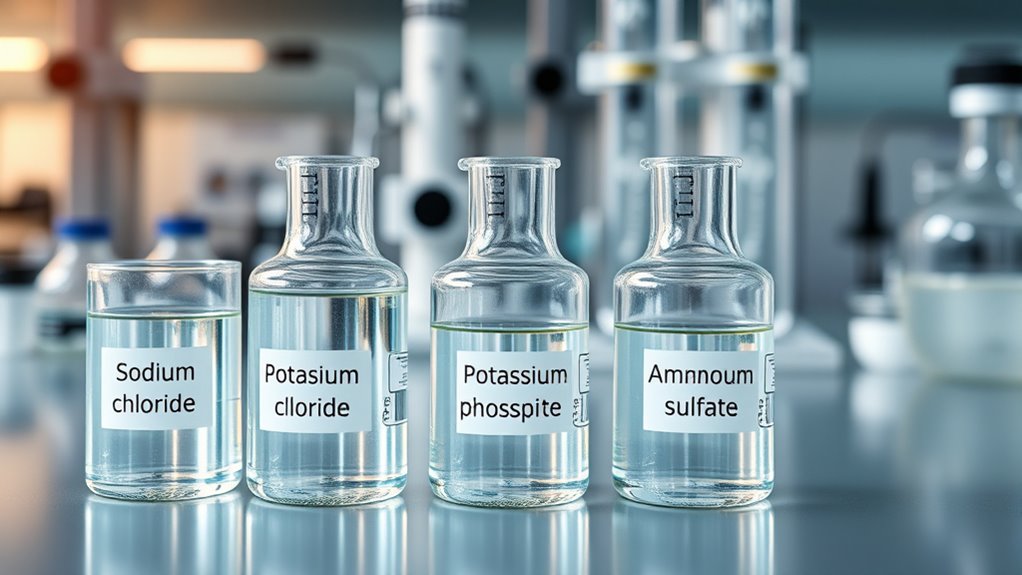
Although choosing the right salt type is vital, you also need to fine-tune its concentration to optimize buffer performance and protein purification. Different salt types—like sodium chloride, ammonium sulfate, and sodium sulfate—impact ionic strength and hydrophobic interactions differently, influencing protein binding and elution.
For example, ammonium sulfate often offers superior separation and elution resolution at concentrations up to 2 M. As you increase salt concentration, protein binding typically improves until you hit a threshold where salt effects cause solubility issues or protein precipitation. This balance makes salt optimization essential for maintaining solubility and achieving effective protein purification.
Furthermore, salt type affects selectivity in hydrophobic interaction chromatography (HIC) by promoting ligand-protein interactions uniquely, so empirical testing is key. By carefully adjusting both salt type and salt concentration, you enhance buffer performance, control elution profiles, and improve overall protein purification outcomes.
Frequently Asked Questions
How to Determine Which Buffer to Use?
You determine which buffer to use by matching its pKa to your target pH. It’s also important to consider how compatible the buffer is with your experiment.
Don’t forget to adjust the concentration to make sure your solution stays stable. Always test the buffer’s pH at your working temperature to guarantee accuracy. That way, you’ll know it’s just right for what you need.
How to Choose Buffer pH?
If you’re working with an enzyme active at pH 7.4, choose a buffer with a pKₐ near that. You’ll want the buffer’s pH close to your target for effective stability and ideal experimental results.
It really helps to keep the pH stable, so your enzyme stays happy and active. Picking the right buffer means your experiment runs smoothly without unexpected hiccups.
How to Make the Most Effective Buffer Solution?
You’ll make the most effective buffer by choosing salts with pKa near your target pH. Adjust the concentrations to ensure strong buffering capacity.
Also, make sure the salts you use are stable. Prepare the solution at the temperature of your experiment to keep the buffering consistent.
How to Adjust the pH of the Buffer?
Oh, sure, just sprinkle magic acid or base until your buffer obeys!
Seriously, add strong acid or base slowly, stirring and measuring pH at your experiment’s temperature.
Calibrate your pH meter first—no guessing games here!
Conclusion
Choosing the right salt for your buffer can feel overwhelming, but it’s also empowering. On one hand, the wrong choice might destabilize your protein, causing frustration and lost time.
On the other, the perfect salt enhances solubility and purification, turning your experiment into a success story. By understanding how salt type and concentration influence performance, you’re not just mixing solutions—you’re crafting the foundation for reliable, breakthrough results.
Don’t settle; select wisely. The right salt selection is key to maintaining protein stability and optimizing buffer performance. When you choose the appropriate salt and concentration, you improve solubility and purification efficiency, which leads to more consistent and successful experiments. So, take the time to make an informed choice—your buffer’s salt isn’t just an ingredient; it’s the cornerstone of your research success.